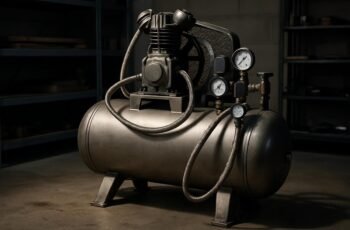
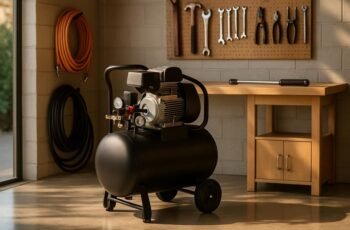
We’re discussing a coincidence you might notice: the choice between single-stage and two-stage often mirrors your exact workload, not just the label on the tank. We’ll weigh demand (CFM and PSI), duty cycles, and total ownership costs with precision, keeping a steady eye on efficiency and heat management. If our goal is dependable, long runtimes, the two-stage looks stronger; if simplicity and lower upfront cost drive us, the single-stage may fit. Let’s connect the dots carefully.
Key Takeaways
- Choose single-stage for intermittent, low-pressure needs and simple controls to minimize upfront cost and footprint.
- Opt for two-stage when steady high pressure or long runtimes are required to improve efficiency and reduce heat.
- Assess CFM and PSI demands across tools; match peak and sustained flow to stage capabilities to avoid undersizing.
- Consider space, installation constraints, and maintenance implications; two-stage often has longer warranties and distributed wear.
- Use a quick 5-step framework: profile load, estimate demands, compare stages, evaluate space, and weigh long-term ownership costs.
Single-Stage vs Two-Stage: Which Air Compressor Stage Fits Your Shop?
Choosing between single-stage and two-stage compressors hinges on your shop’s demands. We analyze efficiency, duty cycle, and outlet pressure to determine fit. In a single stage, the piston compresses air once before storage, yielding simplicity, lower upfront cost, and compact footprints, ideal for light-use tasks. The two-stage design splits compression into two steps, delivering higher pressure with reduced heat and longer life under continuous or demanding loads. We weigh efficiency gains against complexity, maintenance, and space constraints. For intermittent, low-pressure needs, a single stage often suffices, offering straightforward controls and quicker startup. When tools demand consistent higher pressure or extended runtimes, a two stage delivers steadier output and better energy use over time. Ultimately, matching stage to workload minimizes runtime and energy waste.
Assess Your Air Demand (CFM and PSI) for the Right Stage
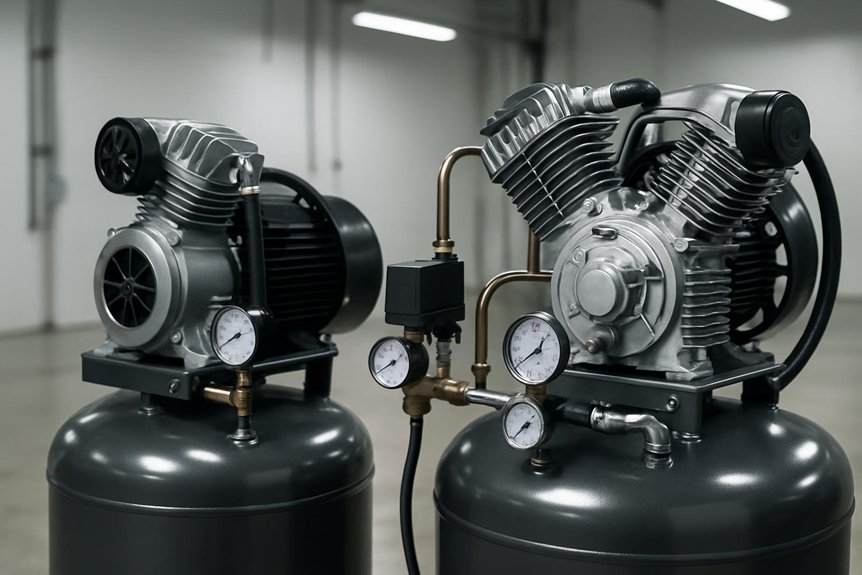
We assess demand precisely by cataloging both CFM and PSI requirements from our tools and workflows. We’ll compare those numbers to typical single-stage and two-stage performance envelopes to avoid over- or under-sizing. By matching the peak and sustained CFM with acceptable PSI, we set the right stage choice with clarity and rigor.
Assess Demand Precisely
Should I choose a single-stage or two-stage compressor? We begin by refining our demand precisely, translating observed flow into solid margins for stage selection. We use demand forecasting to project peak and average CFM at operating PSI, ensuring our estimates reflect real loading rather than ideal conditions. We map usage patterns across shifts, tools, and processes to identify variability and downtime, then quantify cushion needed for startup surges. This disciplined approach prevents over- or under-sizing, reducing energy waste and cycling wear. We document acceptable pressure bands and duty cycles, distinguishing continuous from intermittent tasks. With this precise demand picture, we can select a stage that meets sustained needs while preserving efficiency, reliability, and future scalability.
Match CFM and PSI
How do we align CFM and PSI to the right stage? We translate demand into the staged design by matching CFM with flow needs and PSI with pressure margins. We compare CFM peaks against compressor delivery curves, ensuring the first stage covers base load while the second stage handles overrun without excessive cycling. We evaluate PSI requirements for tools and accessories, ensuring the system maintains target pressure under load. Our assessment uses comparison criteria that distinguish between duty cycles, transient demands, and storage capacity. We benchmark efficiency with steady-state and peak efficiency benchmarks, confirming that the chosen stage minimizes energy per CFM. This method yields a precise, data-driven match, reducing undersupply and unnecessary compression losses.
Map Your Tools to the Appropriate Stage
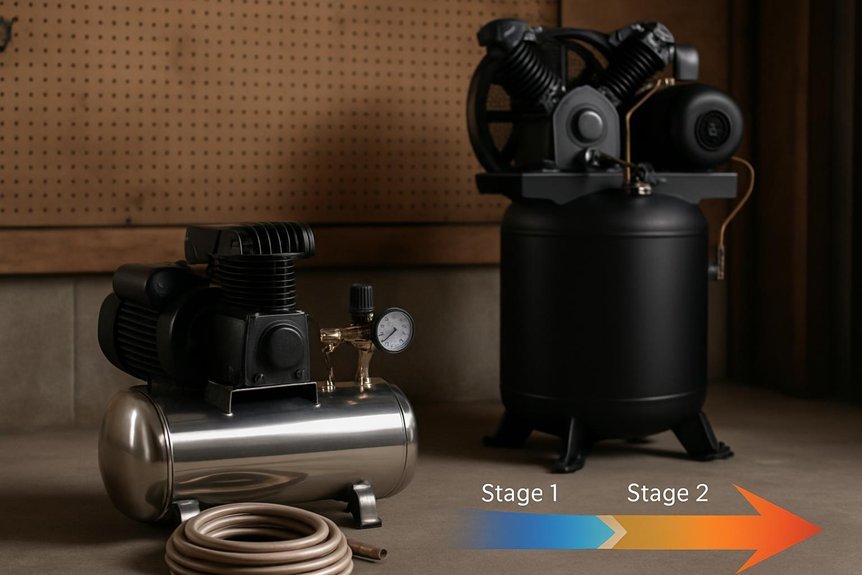
We map tools to the appropriate stage by aligning tool demand with stage capabilities and performance characteristics. This means we quantify each tool’s CFM and peak PSI, then assign it to the stage that sustains that load with efficiency and minimal pressure drop. Our approach emphasizes clear matching, stage-by-stage performance mapping, and practical guidelines for tool-to-air supply alignment.
Match Tools To Stage
When selecting between stages, we map each tool’s operating requirements to the appropriate compressor stage to optimize performance and efficiency. We assess duty cycle, pressure range, and duty consistency to determine whether a tool prefers a high-volume, moderate-pressure single-stage or a staged, higher-peak configuration. Our approach emphasizes stage comparison grounded in actual use, not theory, so tool pairing reflects peak deliverable CFM at target pressure. We consider startup surges, runtime stability, and irradiation of intake conditions to avoid excessive cycling or heat buildup. This method yields a clean decision path: match tool requirements to stage capability, validating that each tool operates with minimal compromise. Precision-driven mapping reduces energy waste while preserving reliability and service life.
Tool Demand Alignment
Tool demand alignment begins by translating each tool’s operating envelope into a concrete stage choice. We map peak flow, duty cycle, and variability to either a single-stage or two-stage configuration, ensuring the selected stage meets continuous needs without overprovisioning. We quantify startup surges, runtime averages, and intermittent bursts to establish a reliable envelope for each tool. This process yields a prioritized set of stage requirements, guiding us to balance capital cost, efficiency, and maintenance scope. We evaluate design tradeoffs like pressure stability versus compressor riser complexity, and we consider system-wide impacts on downstream components. Noise considerations also factor in, as stage selection affects overall sound signature and ventilation needs. Informed alignment reduces underutilization and accelerates payback while preserving performance margins.
Stage Performance Mapping
Could it be that aligning each tool to the correct stage hinges on translating its demand profile into a concrete mapping? We approach Stage Performance Mapping by quantifying tool cycles, duty cycle, and peak pressures to assign them to single-stage or two-stage operation. We create performance envelopes for each tool, then overlay compressor capability curves to identify where margins exist. This method highlights stage efficiency by aligning continuous flow requirements with compression ratio and intercooling benefits, while preserving headroom for startup surges. We also consider noise impact, ensuring that quieter stages handle low-demand intervals without compromising duty reliability. The result is a data-driven allocation strategy that minimizes energy use and maintenance while maximizing responsiveness to real-world tool usage patterns.
Costs, Lifespan, and Warranties by Stage
So, how do costs, lifespan, and warranties differ between single-stage and two-stage compressors, and what does that mean for total cost of ownership? We examine upfront price, operating expenses, and maintenance intervals. Single-stage units typically incur lower initial cost but higher energy use at full load, while two-stage models command a premium upfront with better efficiency and longer service intervals. Lifespan expectations align with component stress: fewer cylinders in single-stage can wear faster under heavy use; two-stage configurations distribute load, extending life when matched to duty cycles. Warranty terms generally reflect componentry and expected fatigue; two-stage units often offer longer coverage on pistons, valves, and crank assemblies. In our cost comparison, we weigh depreciation, reliability, and service needs to refine total cost of ownership.
Space, Footprint, and Installation Considerations
Choosing the right footprint and installation approach is essential to guarantee reliable, long-term performance. We assess layout constraints, weight distribution, and service access to minimize interference with workflows and safety clearances. Our analysis prioritizes space optimization, enabling efficient equipment clustering, service routing, and future upgrades without encroaching on client operations. We compare single-stage and two-stage configurations for their dimensional envelopes, cooling needs, and vibration isolation, translating these factors into practical footprints. We emphasize modularity for easier relocation or expansion, and highlight anchoring, vibration pads, and enclosure options that affect overall space utilization. By mapping utility connections and conduit runs early, we reduce install time and ongoing maintenance disruption. Ultimately, footprint reduction aligns installation simplicity with sustained performance and scalability considerations.
Maintenance Routines That Matter by Stage
What maintenance routines matter by stage, and how do they differ in impact between single-stage and two-stage compressors? We approach upkeep with a stage-specific lens, focusing on component stresses, efficiency, and longevity. For single-stage units, maintenance routines emphasize intake filtration, belt tension (where applicable), and moisture removal at the separator. The goal is to sustain consistent discharge pressure and prevent condensate-induced wear. Two-stage systems demand additional attention to inter-stage cooling and valve package integrity, since repeated compression cycles amplify gasket and seal fatigue. Across both, we prioritize lubrication integrity, filter cleanliness, and condensate management, but the two-stage model benefits from more frequent intercooler checks and stage alignment verification. In short, maintenance routines tailor to pressure ratios, flow demands, and thermal cycling to preserve performance.
Real-World Scenarios: When a Single-Stage Shines
In some real-world environments, a single-stage compressor excels when duty cycles are predictable and demand steady, moderate flow with consistent pressure targets. We approach this topic by comparing how control strategies match process stability, not just unit rating. For routine manufacturing tasks, painting, light assembly, or pneumatic tooling, single stage offers sufficient headroom with fewer moving parts, translating to simpler maintenance and shorter response paths. We assess pressure creep, outlet regulation, and reservoir sizing to ensure minimal fluctuation under steady load. While two stage systems deliver higher efficiency at larger volumes, a single stage remains advantageous where load variability is minimal and startup surges are common. When selection hinges on duty shape, single stage often aligns with practical, predictable workflows.
Total Running Costs and Efficiency: A Practical View
Total running costs and efficiency hinge on the system’s operating profile as much as on the unit’s nameplate. We analyze both options by quantifying energy use, maintenance needs, and downtime impacts under typical duty cycles. Our view is practical: efficiency isn’t just issuing more CFM per kW, it’s sustaining output with minimal transient losses and service interruptions.
1) Compare brake-even energy, compressor cycling, and heat recovery potential across scenarios.
2) Assess noise reduction considerations and startup transients that influence enclosure cooling loads and operator comfort.
3) Balance purchase price against long-term operating costs, spare parts, and downtime risk for reliable production.
A 5-Step Quick Decision Framework to Pick Your Stage
A five-step quick decision framework helps us rapidly distinguish single-stage from two-stage compressors without compromising rigor. We begin by clarifying load profiles, then estimate peak and average CFM demands to avoid undersizing. Next, we compare single stage benefits versus two stage tradeoffs under duty cycle, temperature rise, and energy use, focusing on real-world operating envelopes. Step three evaluates space, footprint, and installation constraints to assess practicality. Step four weighs ownership costs, including maintenance intervals, parts availability, and projected reliability, against long-term productivity. Finally, we synthesize findings into a decision matrix, highlighting when single stage benefits justify simplicity and when two-stage tradeoffs yield efficiency gains under higher pressure or continuous running. Our framework remains adaptable to varying use cases while preserving analytical rigor.
Frequently Asked Questions
Can Hybrids or Variable-Speed Compressors Bridge Single Vs Two-Stage Gaps?
Yes, hybrids and variable-speed units can bridge gaps, improving two stage efficiency and reflecting variable speed relevance, though true two-stage performance still matters for pressure stability, leakage, and duty cycle; we’d tailor to your load profile and runtime.
How Do Noise Levels Differ Between Stages in Quiet Shops?
Noise levels differ between stages: high at startup, moderate during steady run, low in the quiet shop. We provide a noise comparison and consider vibration impact, isolating components, mounting, and ambient resonance for a precise, analytical assessment.
Can Air Quality Requirements Affect Stage Choice?
Yes, air quality requirements can influence stage choice; higher purification needs push us toward staging to optimize filtration standards and reduce contaminants, while lower demands may allow a simpler single-stage setup with adequate air purification and filtration standards.
What Maintenance Quirks Are Unique to Each Stage Type?
We’ll answer: maintenance quirks differ—single-stage demands simpler lubrication and quicker wear checks, while two-stage requires staged lubrication management and more frequent valve inspections; lubrication demands are higher in two-stage, with tighter tolerances and cooler operation.
Do Warranty Terms Differ for Refurbished or Rebuilt Options?
Yes, warranty terms often differ for refurbished options; we recommend verifying coverage duration, parts, and labor specifics. We’ll analyze reliability, guarantee compatibility with your system, and compare refurbishment quality to standard new units before you decide.
Conclusion
We conclude that choosing between single-stage and two-stage comes down to demand, duty cycle, and total cost of ownership. For light, intermittent work, a single-stage keeps costs down and startups quick; for continuous, high-psi needs, a two-stage reduces heat and runs more efficiently over time. Case in point: a small shop switching from a single-stage for glue guns to a two-stage for die-cutter tools cut energy use by 15% while boosting uptime. Choose based on measured CFM/PSI and runtime.