We’re looking at stationary air compressors for home garages with a practical eye on power, duty, and space. They offer steady pressure and higher CFM for tools like grinders and spray guns, but demand thoughtful layout, dedicated wiring, and sound/heat management. The choice between piston and rotary affects maintenance and smoothness, while storage and installation costs matter. We’ll weigh these factors and potential setups to determine if a stationary unit fits your workspace—and what trade-offs to expect as you plan.
Key Takeaways
- Stationary air compressors can be suitable for home garages if sized for the tools you use and kept within a clean, well-ventilated space.
- Consider dedicated wiring, proper circuit protection, and cooling to manage startup surges and continuous use.
- Choose piston for simple, rugged tasks or rotary for smoother operation and lower vibration in a home setting.
- Plan layout to optimize access, hoses, and cooling paths while minimizing noise and vibration transmission.
- Budget for installation, maintenance, warranties, and service support to ensure reliable, long-term garage use.
How Stationary Compressors Fit Home Garages
Stationary compressors can fit home garages if you prioritize space, ventilation, and access to electrical service. We evaluate location by footprint, including vertical clearance for piping and hoses. A compact space mindset guides placement: near the work zone, away from heavy traffic, and with clear ingress for service. In garage layouts, consider floor hardening, vibration isolation, and drainage to avoid corrosion and shifting. Electrical service must meet motor amperage, circuit protection, and dedicated wiring to minimize nuisance trips. Ventilation reduces heat buildup and prolongs component life, so we favor airflow paths that don’t recirculate hot air into occupied areas. Access to cooling and maintenance points should remain unobstructed. By optimizing these factors, a stationary unit integrates reliably without compromising workspace or safety.
Stationary Air Compressors: Pros and Cons for DIYers
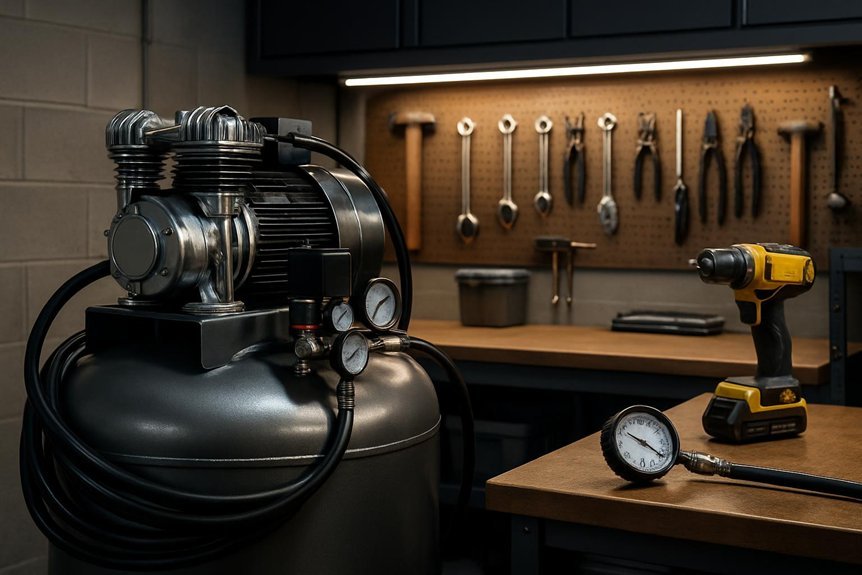
We weigh the setup and space needs against how a stationary unit fits your garage layout, including placement, ventilation, and accessibility for maintenance. We also consider noise and vibration—how mounting, pads, or isolation measures influence comfort and neighborly relations. In weighing pros and cons, we emphasize practical implications for DIYers, from installation footprint to ongoing sound and performance.
Setup And Space Needs
Ever wonder how much space a stationary air compressor actually needs in a home garage, and how that footprint affects workflow? We outline a precise footprint calculation, prioritizing accessibility, maintenance, and future expansion. Our goal is reliable performance without encroaching on critical work zones.
1) Footprint envelope and clearance: allocate room for service access and ventilation.
2) Mounting and placement: consider vibration isolation, containment, and accessibility for hoses.
3) Seasonal and service space: reserve a nearby area for filter changes and oil checks.
4) Operational workflow: ensure room for tool maneuverability, workflow pauses, and safety clearances.
This approach counters durability myths and airflow misconceptions while keeping layout practical and reproducible.
Noise And Vibration Considerations
Noise and vibration are the practical realities that follow a well-planned footprint and secure mounting. We approach this topic with precise metrics: noise is measured in decibels at standard operating load, while vibration is quantified by peak acceleration and transmitted force. A heavy, rigid base minimizes floor transmission, and vibration isolation pads or a purpose-built isolation platform reduce coupling to structure. Enclosures contribute to sound attenuation but must allow cooling and service access. Consider soundproofing housing as an integrated option to limit audible output without impairing performance. Balancing intake acoustics, exhaust paths, and muffling is essential. We weigh the trade-offs of added mass, airflow, and maintenance access to maintain safety, efficiency, and user comfort.
Key Performance Indicators for Home Use
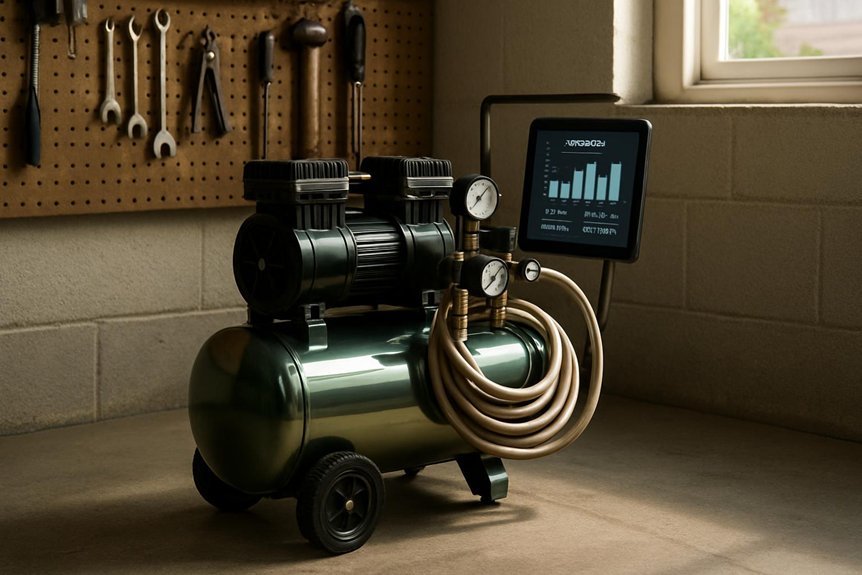
We weigh key performance indicators for home use by examining power needs, noise and vibration, and space and setup requirements. We’ll compare compressors by electrical load, decibel levels at typical duty cycles, and mounting or basing footprint to fit a standard garage. Our goal is to clarify practical trade-offs so you can align a unit with your space, tolerance for sound, and continuous-use demands.
Power Needs for Home
What power requirements should you expect for a home shop compressor? We approach this with precise metrics, comparing duty cycle, CFM at pressure, and electrical load. For home use, balance capacity with efficiency, ensuring startup current is manageable for standard circuits. We emphasize power efficiency and reliable oil lubrication to maintain performance over time, reducing heat and wear. We select models that deliver steady airflow at 90–115 psi for common automotive and hobby tasks, while avoiding oversized units that waste energy.
- Consistent CFM at target pressure without excessive run time
- Startup draw that won’t trip a standard 15-amp circuit
- Efficient cooling for prolonged duty cycles
- Long-term lubrication reliability minimizing maintenance
This approach keeps performance predictable, minimizes electricity cost, and preserves components.
Noise and Vibration Levels
From our focus on steady power delivery and cooling efficiency, we next examine how a compressor’s sound and vibration affect a home garage. We assess noise and vibration as performance indicators that influence comfort, safety, and placement. Sound levels determine hearing exposure and neighbor impact, while vibration affects mounting, structure, and tool stability. We compare decibel ranges, tonal content, and enclosure design, noting how mufflers and mounts reduce transmission. Practically, quieter units enable longer sessions and fewer complaints, while robust isolation minimizes wall resonance and equipment shift. Table provides a concise rhythm of metrics and outcomes.
| Metric | Impact/Outcome |
|---|---|
| Noise level | Comfort, nuisance mitigation |
| Vibration | Mounting integrity, tool steadiness |
| Enclosure | Acoustic dampening, heat management |
| Isolation | Structural comfort, longevity |
Space and Setup Requirements
Where should a homeowner place, size, and configure a stationary air compressor to ensure reliable operation and safe workflow? We address space planning, layout, and mounting to optimize space efficiency and workflow. Proper clearances, vibration isolation, and accessible service points prevent operational delays. Choose compact footprints or wall-mount configurations when space is tight, and confirm that mounting options support level operation and cable routing. Air-lines should be directed away from heat sources and moisture, with filtration and drainage near the point of use. Electrical supply must meet motor requirements with dedicated circuits and overload protection.
1) Reserve a stable, level base to minimize vibration and movement.
2) Prioritize wall or ceiling mounting where possible to free floor space.
3) Plan easy access for maintenance and drainage.
4) Align compressor with a dedicated circuit for steady, safe operation.
Space, Noise, and Setup: What to Plan For
To plan a garage setup for a stationary air compressor, start by mapping available floor space, overhead clearance, and access for hoses and drainage. We then evaluate noise sources, enclosure options, and vibration paths to minimize transfer to work surfaces. Our approach prioritizes space optimization by choosing compact footprints, hinged panels, and labeled hose routes that avoid tripping hazards. We specify mounting surfaces with level, solid support to maintain stable operation and predictable pressure performance. Acoustic considerations include enclosure materials, decoupled mounting, and ducted exhaust routing to reduce sound propagation. Vibration isolation is addressed through anti-vibration mounts and isolation pads, which protect equipment and surrounding cabinetry. Finally, we plan service access, drainage routing, and electrical separation to simplify maintenance and ensure safety.
Choose Your Compressor Type: Piston, Rotary, or Storage-Plus
We’ll now pick the compressor type that best fits a home garage: piston, rotary, or Storage-Plus. We assess reliability, footprint, and maintenance to match garage aesthetics and workflow. Piston units offer simple service and robust torque for intermittent tool use. Rotary designs excel in continuous run scenarios with smoother operation and quieter profiles. Storage-Plus systems optimize space with integrated tanks and cabinets, reducing clutter without sacrificing capacity. Consider cord length for convenient placement near outlets and minimizing extension cords.
- Piston: straightforward, rugged, cost-effective choice for hobby tasks.
- Rotary: smooth performance, lower vibration, higher duty suitability.
- Storage-Plus: space efficiency, integrated organization, tidy garage aesthetics.
- Selection criteria: outlet proximity, compressor cord length, expected tools, noise tolerance.
Air Delivery, Pressure, and Duty Cycle for Home Garages
Air delivery, pressure, and duty cycle define how well a home garage compressor can handle typical tools without overworking the unit. We assess air delivery as the volume per minute at a set pressure, ensuring compatible CFM ratings for grinders, impact wliers, and spray guns. Pressure stability matters; steady, within-rated PSI prevents tool stalling and reduces cycling losses. Duty cycle indicates the fraction of time the compressor runs before resting, measured as a percentage of a 10-minute window. A higher duty cycle supports continuous or intermittent tasks, while lower values curb heat buildup and wear. For home garages, select a unit with adequate air delivery at the required pressure and a duty cycle that matches intended use, avoiding undersized or oversized systems that compromise efficiency and lifespan.
Practical Use Cases in a Home Garage
In a typical home garage, practical use cases for a stationary air compressor hinge on reliable air delivery, stable pressure, and an appropriate duty cycle. We present concise examples that align with precise expectations and real-world needs, integrating both performance and appearance considerations.
1) Inflate tires and sporting gear quickly, ensuring consistent PSI without pressure drops.
2) Power impact tools for modest remodels while maintaining control over tool speed and cut quality.
3) Finish automotive projects with steady airflow, reducing heat buildup and tool chatter.
4) Support DIY storage and shop tasks, where compressor aesthetics blend with garage aesthetics while delivering dependable operation.
Maintenance and Longevity: Keeping It Running
Maintenance and longevity hinge on disciplined upkeep and preventive checks. We approach steady operation by routine inspection, filter cleaning, and air-oil separation validation, then documenting hours and service actions. We debunk maintenance myths by centralizing a schedule: daily quick checks, weekly consumable replacement, monthly performance tests, and annual system audits. Longevity myths are addressed with measured load management, proper duty cycles, and calibrated pressure settings to avoid overuse. To illustrate, we present a concise table:
| Factor | Action | Outcome |
|---|---|---|
| Filters | Inspect/replace | Clean compressed air |
| Oil separation | Verify | Reduced wear |
| Belts/seals | Inspect tension | Prevent leaks |
| Gauges | Calibrate | Accurate readings |
| Drain valves | Test | Moisture control |
Budgeting, Warranties, and After-Sale Support
Budgeting for an air compressor setup starts with a clear total-cost picture: purchase price, installation, electricity usage, and ongoing maintenance. We balance upfront investments against long-term value, using budgeting practices that reflect usage patterns, duty cycles, and potential upgrades. Warranties and after sale coverage influence risk, downtime, and cost-of-ownership, so we compare coverage terms, claim handling, and service networks before committing. Our approach prioritizes measurable returns: reliability, efficiency, and predictable expenses.
Assess total-cost of ownership, warranty terms, service access, and maintenance plans to optimize reliability and predictable expenses.
1) Compare total-cost of ownership across models, including hidden fees and uptime impact.
2) Validate warranty length and exclusions, noting transferability and required maintenance.
3) Confirm availability of local service, parts, and response times to minimize downtime.
4) Document renewal options, service contracts, and eligibility for preventive maintenance plans.
Frequently Asked Questions
How Loud Are Stationary Compressors in a Typical Garage?
A typical garage sees stationary compressors around 70–90 decibels at 3–10 feet. We note loudness comparison varies by model; higher CFM units run louder. Decibel benchmarks guide placement and hearing protection for safe operation.
Can I Run Tools Directly From a Stationary Compressor?
We can run tools directly from a stationary compressor, like weaving a power loom—but with limits. We’ll monitor garage noise, plan a maintenance schedule, and guarantee regulator pressure suits each tool for safe, precise operation.
What Maintenance Is Essential for Garage-Use Compressors?
We maintain essential maintenance basics: check oil and filters, drain condensate, inspect belts, and monitor pressure gauges; we also address noise considerations by isolating the unit and using proper mounting to minimize vibration for garage use.
Do Stationary Units Require Special Electrical Circuits?
Yes, stationary units typically require dedicated electrical circuits. We insist on proper ratings, wiring gauge, and a dedicated grounding path. We assess electrical circuits and dedicated grading to ensure safe startup currents and uninterrupted operation for garage use.
Are There Safety Concerns With Garage Air Systems?
We do see safety concerns with garage air systems, including adherence to safety codes and ventilation requirements. We caution readers that improper setup can cause fire hazards, leaks, or fumes; follow codes, maintain ventilation, and inspect connections regularly.
Conclusion
We’ve shown that stationary compressors can be a solid fit for home garages, delivering steady CFM, duty cycles, and reliable pressure for tools like grinders and spray guns. An interesting stat: a properly installed 60-gallon unit can sustain about 7–10 cfm at 90 psi, enough for frequent mid‑duty use. Plan space, vibration mounting, ventilation, and electrical needs, then choose piston for simplicity or rotary for smoother operation. With maintenance and budgeting in mind, they pay off over time.