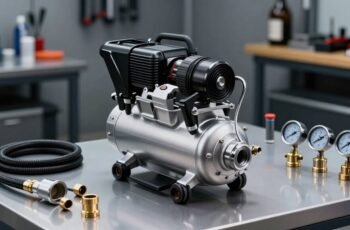
When selecting a reciprocating air compressor, understanding the technical specifications and how they align with your application is essential. We recognize that factors like airflow capacity, pressure ratings, and motor power directly influence performance and longevity. To make an informed choice, it’s vital to evaluate your operational requirements and environment. As we explore the key features and considerations, you’ll gain clarity on what makes a compressor suitable for your needs—and what pitfalls to avoid.
Key Takeaways
- Determine your required airflow (CFM) and pressure (PSI) to select the appropriate compressor size.
- Consider motor power, tank capacity, and build quality for durability and continuous operation.
- Check maintenance requirements and accessibility to ensure long-term reliability.
- Evaluate performance ratings like CFM, PSI, and horsepower to match application demands.
- Ensure proper ventilation, filtration, and operating conditions to optimize compressor efficiency and lifespan.
What Is a Reciprocating Air Compressor and How Does It Work?
Have you ever wondered how a reciprocating air compressor produces high-pressure air? It operates through a piston-cylinder mechanism, where a piston moves reciprocally within a cylinder. When the piston moves downward, it creates a vacuum that draws in atmospheric air through an intake valve. As the piston moves upward, it compresses the air, increasing its pressure and temperature. The compressed air then passes through a discharge valve into a storage tank or directly to the application. This cycle repeats rapidly, with the compressor’s crankshaft driving the piston via a connecting rod. The result is a continuous flow of high-pressure air, which can be regulated and stored for various industrial and commercial uses. This process combines mechanical motion with controlled valve operation to achieve efficient compression.
Key Features to Look for in a Reciprocating Air Compressor
When choosing a reciprocating air compressor, it’s essential to take into account specific features that guarantee ideal performance, durability, and efficiency. Key features include motor power, tank capacity, pressure regulation, cooling system, and build quality. Motor power determines the compressor’s ability to handle demanding tasks, while tank capacity affects continuous operation. Precise pressure regulation ensures consistent output, and an efficient cooling system prolongs component life. High-quality materials enhance durability under rigorous use.
| Feature | Importance |
|---|---|
| Motor Power | Impacts overall performance and load capacity |
| Tank Capacity | Dictates runtime and operational continuity |
| Pressure Regulation | Maintains stable pressure for precision tasks |
| Cooling System | Prevents overheating, extends lifespan |
| Build Quality | Guarantees reliability and longevity |
How to Choose the Right Size and Capacity for Your Needs
To select the appropriate compressor size, we must accurately assess your air demand based on your operational requirements. Matching compressor specifications, such as flow rate and pressure, guarantees ideal performance without oversizing. Precise evaluation of these factors leads to a reliable, cost-effective choice tailored to your needs.
Assessing Your Air Demand
Evaluating your air demand is a critical step in selecting the appropriate reciprocating air compressor, as it guarantees that the unit can meet your operational requirements without underperforming or wasting energy. To accurately assess demand, determine the total airflow required for all tools and processes during peak usage, measured in CFM (cubic feet per minute). Consider the following:
- Simultaneous operation of multiple tools or processes
- Peak usage periods to avoid undersizing
- The pressure requirements for each application
- The accumulated airflow needs, factoring in future expansion plans
Understanding these factors ensures you select a compressor with the correct capacity, balancing efficiency and performance. Proper assessment minimizes downtime, reduces energy costs, and ensures consistent operation aligned with your specific needs.
Matching Compressor Specs
Selecting the correct compressor size and capacity requires aligning the unit’s specifications with your assessed air demand. First, determine the required flow rate in CFM (cubic feet per minute) based on your peak operational needs. Next, consider the compressor’s rated capacity, ensuring it exceeds your maximum demand by at least 20% to accommodate fluctuations. Pay close attention to the compressor’s horsepower, as it directly correlates with airflow capability, and verify that the motor’s specifications align with your power supply. Additionally, review the pressure ratings—ensure the maximum working pressure surpasses your system’s requirements. Proper matching prevents overloading, reduces energy consumption, and minimizes wear. Accurate specification alignment guarantees ideal performance, efficiency, and longevity of your reciprocating air compressor.
Understanding Power, Pressure, and CFM Ratings
Understanding the relationship between power, pressure, and CFM ratings is essential for choosing the right reciprocating air compressor. Power indicates the motor’s capacity to perform work, directly affecting compressor efficiency and runtime. Pressure, measured in PSI, determines the maximum air force delivered, aligning with tool requirements. CFM (cubic feet per minute) reflects the volume of air the compressor can supply at a specified pressure, influencing continuous operation and tool performance.
Understanding power, pressure, and CFM ensures optimal compressor performance and tool compatibility.
Key points to consider:
- Higher power enables sustained operation under demanding conditions.
- Adequate pressure is necessary to match tool specifications.
- CFM ratings must meet or exceed tool airflow demands.
- Balancing these ratings guarantees ideal compressor performance and longevity.
Top Factors That Affect Compressor Performance and Durability
The performance and longevity of a reciprocating air compressor depend heavily on the quality of its components, as well as how it’s maintained and operated. Proper maintenance practices and operating conditions directly influence wear, efficiency, and failure rates. Understanding these factors helps guarantee the compressor delivers reliable, sustained performance over time.
Quality of Components
The quality of components in a reciprocating air compressor directly impacts its performance and long-term durability. High-grade parts *assure* efficient operation, reduce downtime, and extend service life. Critical components include the piston, cylinder, valves, and crankshaft, which must withstand high pressures and repetitive motion without failure. Inferior materials can lead to increased wear, energy loss, and costly repairs.
Key indicators of quality include:
- Use of premium alloys and corrosion-resistant coatings
- Precision manufacturing tolerances
- Robust sealing systems to prevent leaks
- Durable bearing and piston ring materials
Choosing compressors with superior components minimizes maintenance needs, enhances efficiency, and guarantees reliable operation over time.
Maintenance Practices
Have you considered how proper maintenance practices directly influence the performance and longevity of a reciprocating air compressor? Regular inspection and timely replacement of critical components, such as valves, piston rings, and cylinders, are essential to prevent wear and failure. Lubrication quality and schedules directly impact internal friction, heat generation, and component lifespan. Monitoring oil levels and conducting routine oil analysis help detect contamination or degradation, ensuring peak operation. Cleaning air filters and intercoolers reduces pressure losses and prevents particulate ingress that could cause damage. Tightening connections and checking for leaks maintain efficiency while reducing energy consumption. Implementing a preventive maintenance schedule based on manufacturer specifications minimizes unexpected downtime and extends overall compressor durability.
Operating Conditions
Operating conditions play a critical role in determining the performance and durability of a reciprocating air compressor. External factors such as temperature, humidity, and dust can considerably impact compressor efficiency and lifespan. High ambient temperatures increase thermal stress on components, while excessive humidity promotes corrosion and moisture buildup. Dust and particulates can clog filters and reduce airflow, causing overheating and wear. Proper operation within specified pressure and temperature ranges guarantees ideal performance and reduces the risk of failure. To maximize lifespan, it’s essential to monitor and control these conditions consistently.
- Maintain ambient temperature within manufacturer specifications
- Use filtration systems to minimize dust ingress
- Ensure proper ventilation to dissipate heat
- Regularly check for signs of corrosion or moisture buildup
Questions to Ask Before Purchasing a Reciprocating Air Compressor
Before investing in a reciprocating air compressor, it’s vital to ask targeted questions to guarantee it meets your specific operational needs. First, what is the required airflow rate (CFM) at your operating pressure (PSI)? Ensuring the compressor provides sufficient volume without excessive overcapacity is essential. Second, what is the duty cycle, and can the compressor sustain continuous operation if necessary? Third, what are the power requirements and energy efficiency ratings? Fourth, are the compressor’s dimensions and weight suitable for your workspace and installation constraints? Fifth, what are the maintenance intervals and accessibility of key components? Addressing these questions helps select a model that aligns with your application’s demands, minimizes downtime, and optimizes operational efficiency.
Tips for Maintaining and Troubleshooting Your Compressor
Regular maintenance is essential to keep your reciprocating air compressor running efficiently and to prevent costly breakdowns. Consistent inspection and timely replacement of key components ensure peak performance and extend the unit’s lifespan. To troubleshoot common issues effectively, monitor for abnormal noise, fluctuations in pressure, and excessive vibrations. Addressing these early prevents component failure and downtime.
Regular maintenance prevents breakdowns and extends your compressor’s lifespan through early issue detection and timely part replacement.
- Regularly check and change the oil to maintain proper lubrication and cooling
- Inspect valves and pistons for wear or damage and replace as needed
- Clean or replace air filters to ensure unobstructed airflow
- Drain moisture from the tank to prevent corrosion and moisture buildup
Frequently Asked Questions
What Safety Precautions Should I Follow When Operating a Reciprocating Air Compressor?
We guarantee safety by wearing protective gear, inspecting the compressor regularly, and following manufacturer instructions. We also check for leaks, avoid over-pressurization, and keep clear of moving parts, maintaining a safe environment for operation.
How Loud Are Reciprocating Air Compressors During Operation?
Reciprocating air compressors typically produce noise levels between 75 and 90 decibels, depending on size and design. We measure noise to guarantee safety, minimize disruption, and select suitable hearing protection, maintaining precise operational standards.
Can Reciprocating Air Compressors Be Used for Continuous Industrial Applications?
Yes, reciprocating air compressors can be used for continuous industrial applications if they are properly maintained, equipped with sufficient cooling, and designed for high duty cycles; however, they may require additional components to guarantee reliability.
What Are Common Signs Indicating My Compressor Needs Repairs?
We notice our compressor needs repairs when it unexpectedly loses pressure, makes unusual noises, or shows excessive vibration. These signs indicate potential component wear, leaks, or lubrication issues, prompting immediate inspection to prevent costly breakdowns and guarantee ideal performance.
Are There Eco-Friendly or Energy-Efficient Reciprocating Air Compressor Options Available?
Yes, we can choose eco-friendly reciprocating compressors with energy-efficient motors, variable speed drives, and advanced control systems that reduce power consumption, lower emissions, and enhance operational efficiency, making them suitable for sustainable industrial applications and cost savings.
Conclusion
Choosing the right reciprocating air compressor is like tuning a finely crafted instrument—every component must work harmoniously for ideal performance. By carefully evaluating your airflow, pressure needs, and workspace constraints, you guarantee long-term reliability and efficiency. With proper maintenance and informed decisions, your compressor will serve as a precise tool, much like a well-calibrated instrument, delivering consistent results and minimizing downtime for years to come.