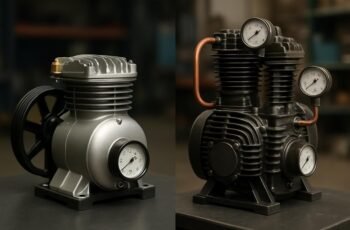
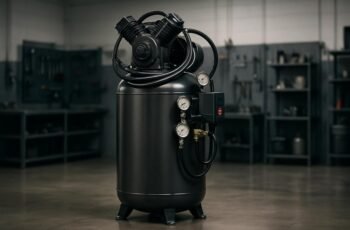
We’ll compare industrial and commercial air compressors by how they meet demand, from duty cycles to runtime and system efficiency. We’ll weigh pressure stability, reservoir sizing, and sequencing strategies that cut energy waste. We’ll also map where each type excels—reliability and uptime versus cost-per-CFM and serviceability. As we lay out the tradeoffs, a practical approach emerges, but a clear-eyed choice hinges on your specific load profile and total lifecycle costs.
Key Takeaways
- Industrial compressors are built for continuous, high-demand production with modular redundancy and precise control; commercial units prioritize accessibility and lower cost-per-CFM.
- Duty cycle and runtime, not just capacity, drive selection to minimize cycling and match peak vs. average demand.
- Industrial systems emphasize synchronized controls, sensor feedback, and predictive maintenance for steady pressure and energy efficiency.
- Applications vary: industrial for material handling and automation; commercial for facilities support and service sectors with scalable, modular setups.
- Total cost of ownership matters: industrial units cost more upfront but offer durability and efficiency, while commercial units may incur more frequent maintenance but lower initial cost.
How Industrial vs Commercial Compressors Meet Demand
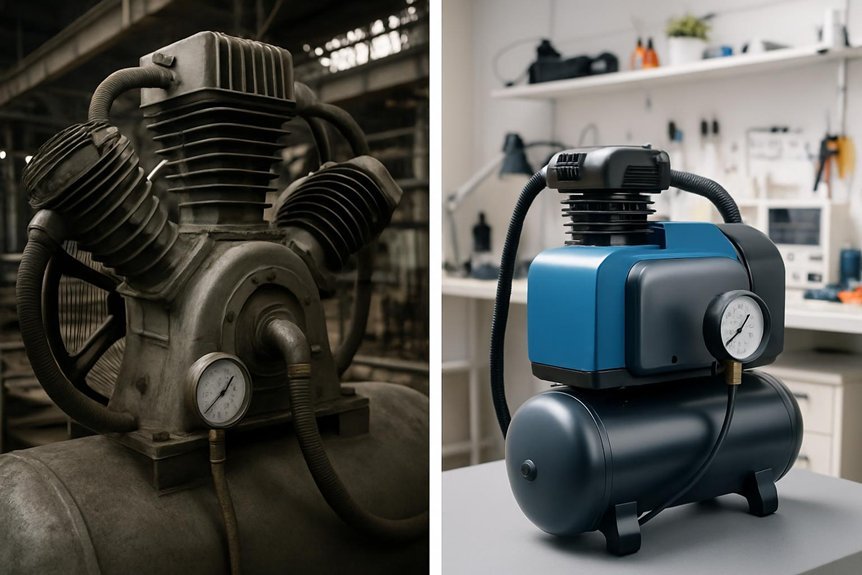
Industrial and commercial compressors differ in scale, duty, and reliability, but both must consistently meet demand with minimal downtime. We evaluate how each type aligns with process goals, energy use, and maintenance cadence. Industrial models prioritize sustained output, modular redundancy, and control precision to sustain continuous production and tight tolerances. Commercial units focus on accessibility, serviceability, and cost-per-CFM for lighter manufacturing or facility support. We weigh peak demand timing, reservoir sizing, and compressor sequencing to avoid pressure drops, unnecessary unloads, and wasted energy. Our view is that industrial efficiency hinges on synchronized controls, sensor feedback, and predictive maintenance. For peak demand events, staged capacity and intelligent headroom reduce cycling, boosting uptime and overall equipment effectiveness without overprovisioning.
Choosing by Duty Cycle and Runtime
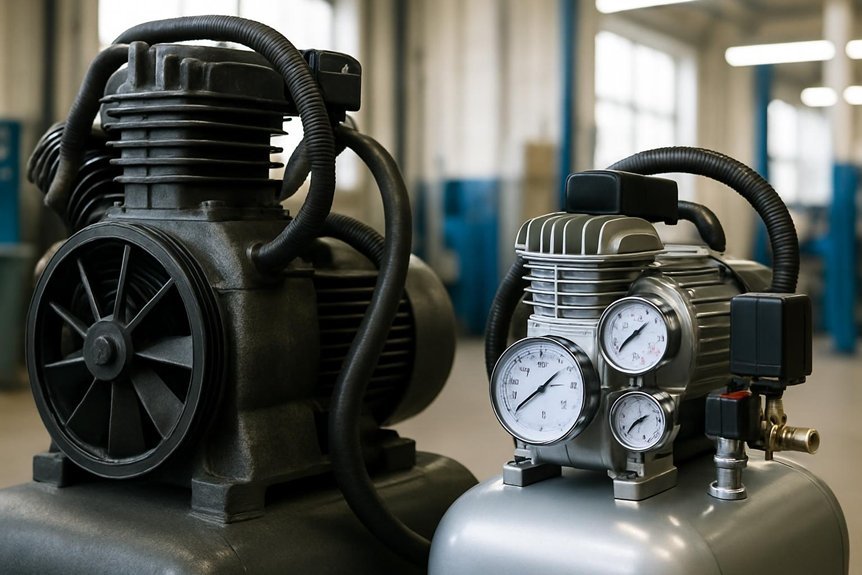
From our look at how industrial versus commercial units are built to meet demand, we can see how duty cycle and runtime drive selection more than raw capacity alone.
We examine how duty cycle and runtime challenges shape usage:
1) Assess peak vs. average demand to match cycling.
2) Consider continuous run needs and allowed rest periods.
3) Align compressor cooling and lubrication to duty expectations.
4) Plan for startup surges and load fluctuations.
This approach keeps our analysis objective and tech-forward, focusing on maintenance implications and lifecycle cost. By prioritizing duty cycle and runtime, we avoid over or under-sizing, delivering stable performance and predictable downtime. We emphasize data-driven comparisons and practical constraints, guiding you toward choices that balance reliability with total cost of ownership.
Pressure, Capacity, and System Efficiency Explained
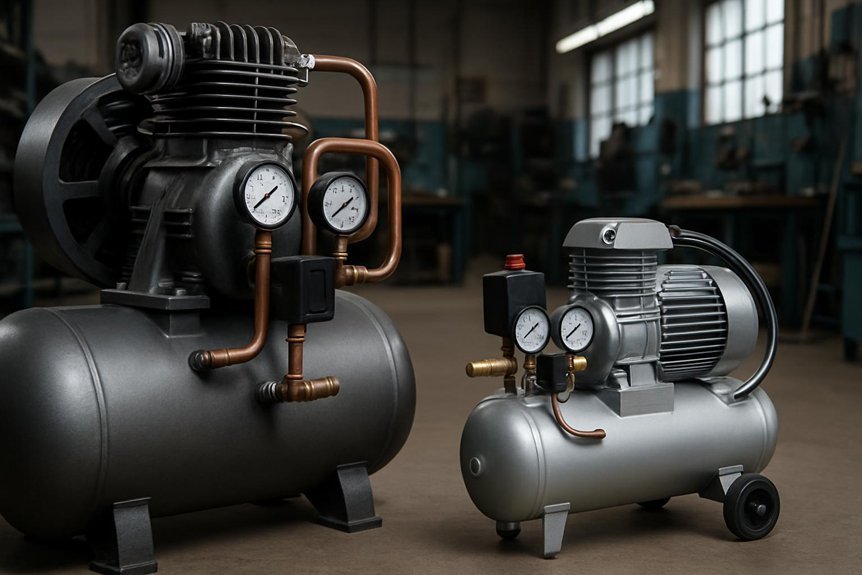
How do pressure, capacity, and system efficiency intertwine to shape compressor performance? We analyze how pressure dynamics drive usable air at target pressures while minimizing losses from leaks, heat, and cycling. In our view, capacity isn’t just a top-end number; it’s how the system responds to demand ramps, reflected in duty-cycle behavior and compressor sequencing. We measure efficiency as the balance between energy input and actual air output, factoring compressor type, aftercooling, and pressure drops along the manifold. Understanding capacity scaling helps predict how a unit behaves under load bands, influencing startup shabbiness and transient stability. Across configurations, tighter control of pressure dynamics and prudent capacity scaling yield steadier delivery, reduced wasted energy, and clearer performance metrics.
Applications and Industry Fit: Where Each Shines
Are different sectors better suited to specific compressor types, and why do those matches matter in day-to-day operations? We’ll unpack how industrial efficiency and durability scope shape fit. We compare applications, noting that industrial environments demand continuous runtime, while commercial setups favor cost-per-cubic-foot. Our assessment is data-driven, avoiding fluff.
- Material handling and automation lines—industrial sectors benefit from high reliability and consistent airflow.
- Automotive and manufacturing—precise pressure control blends with durability to minimize downtime.
- Food, pharma, and electronics—cleanliness and stable pressure align with efficiency benchmarks.
- General contracting and service industries—cost-conscious scales favor modular, scalable systems.
Ultimately, selection hinges on duty cycle, peak demand, and maintenance windows, not aesthetics.
Cost, Maintenance, and Long-Term Value Compared
What truly drives long-term value in industrial air compressors is a careful balance of upfront costs, ongoing maintenance, and total cost of ownership over the system’s life. We assess both models through a rigorous cost comparison, not just sticker price. Industrial units typically demand higher initial investment but offer better durability, higher efficiency, and longer service intervals when matched to load profiles. Maintenance frequency matters: routine checks, lubrication, and filter replacements impact uptime and energy use. Commercial options can be cheaper up front but may incur more frequent part replacements and shorter service cycles. Our approach weighs downtime risk, efficiency curve, and resale value. In sum, total lifecycle cost and reliability drive the ultimate decision, beyond initial price.
Frequently Asked Questions
How Do Inverter-Driven Units Affect Industrial Vs Commercial Use?
Inverter-driven units smooth output and reduce wear, benefiting both industrial grade versus commercial grade setups, with inverter driven implications like energy efficiency and quieter operation, though industrial uses prioritize reliability and redundancy while commercial favors cost and footprint flexibility.
Which Brands Back Industrial-Grade Warranties Versus Commercial Models?
We rely on industrial warranty brands like Ingersoll Rand, Atlas Copco, and Quincy, plus commercial warranty brands from these and similar makers; we assess coverage differences, reliability metrics, and service networks to guide informed decisions for tough workloads.
What Safety Standards Differentiate Industrial and Commercial Compressors?
We’ll cut to the chase: industrial safety standards require stricter guarding, higher ATEX/UL/CSA compliance, and more rigorous lockout/tagout procedures; warranty differentiation exists via equipment class, duty cycle, and service expectations. We’re evaluating industrial safety and warranty differentiation.
How Do Noise Levels Impact Facility Compliance for Each Type?
We must consider how noise levels affect compliance for each type; industrial noise demands stricter limits, impacting compliance and scheduling. We analyze energy efficiency, maintenance scheduling, and overall compliance impact to optimize performance for both sectors.
Which Startup Power Requirements Are Typical for Each Category?
Startup power requirements vary, generally higher for industrial units and moderate for commercial ones, with duty cycle shaping startup bursts. We analyze startup power requirements alongside duty cycle to assess electrical planning and reliability for each category.
Conclusion
We’ve mapped how industrial and commercial compressors meet distinct load profiles, and why duty cycle, runtime, and system efficiency drive the best fit. One striking stat: industrial setups often run >80% of time at substantial duty—fueling reliability through redundancy and predictive maintenance. For facilities evaluating uptime against upfront and lifecycle costs, the choice hinges on expected demand curves, outlet pressure needs, and serviceability. In short, pick the path that aligns with your load, not just the sticker price.