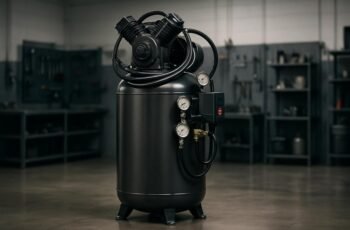
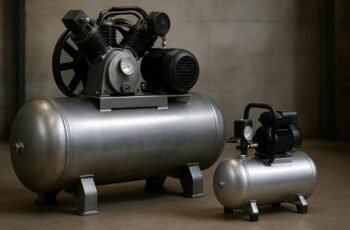
We’ll weigh 60-gallon vertical versus horizontal designs by footprint, access, and serviceability, then assess how each orientation affects stability, mobility, and run-time consistency in real shops. Vertical units save floor space but raise the center of gravity and complicate top-side maintenance; horizontals spread their footprint yet often offer easier side access and panel service. The choice hinges on ceiling height, rack system, and workflow cadence—a decision that should consider cooling efficiency and durability before finalizing. Which path aligns with your constraints?
Key Takeaways
- Vertical 60-gallon compressors save floor space but require adequate ceiling/rack clearance for top components and stability.
- Horizontal units offer broader side access for service panels and are easier to mount in low-clearance rooms.
- Vertical designs raise the center of gravity, potentially affecting startup stability and vibration.
- Horizontal layouts provide wider footprint and improved lateral stability, with easier filter and regulator access.
- Run-time and efficiency depend on duty cycle, cooling, and filtration; size and orientation influence ripple and surge attenuation.
Which 60-Gallon Design Suits Your Space?
Choosing between a 60-gallon vertical and a 60-gallon horizontal air compressor hinges on available space, layout, and workflow. We assess the design by concrete comparison factors: footprint, height, and integration with existing benches or cabinets. Vertical units excel when floor space is tight but require ceiling or rack clearance, while horizontals suit low-clearance rooms without overhead constraints. We evaluate accessibility for service, ports, and drain valves, ensuring safe clearance for hoses and fittings. Portability tradeoffs emerge from handle locations, casters, and overall mass distribution; vertical models tend to be taller and harder to maneuver, whereas horizontal ones stay stable on wheels but occupy wider footprints. Our conclusion balances space constraints with movement needs, delivering a layout-aware recommendation for optimal efficiency.
How Vertical vs Horizontal Layouts Affect Access and Maintenance
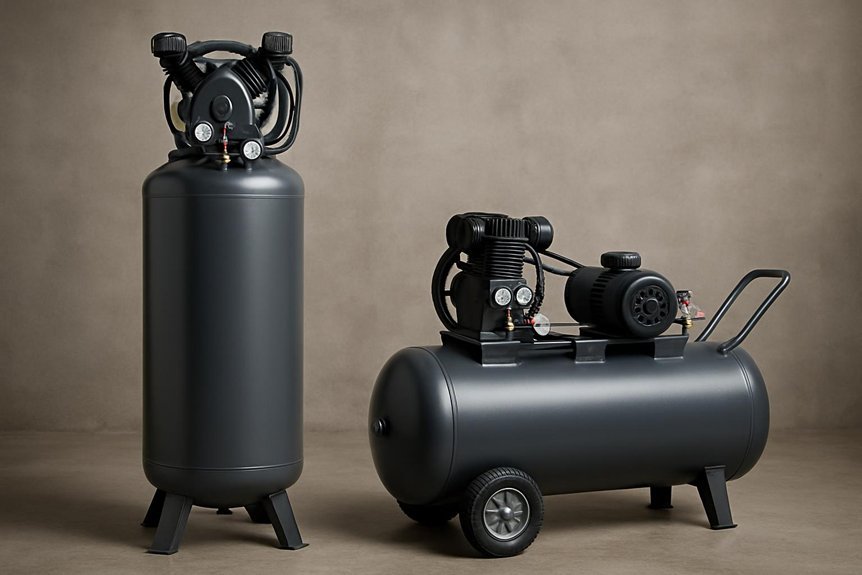
How do vertical and horizontal layouts influence access and maintenance in practice? We compare layouts by how they affect routine servicing and component visibility. With vertical designs, we gain straightforward line-of-sight to top components, but clearance around the sides can shrink, complicating filter or regulator access. Horizontal arrangements often offer broader side clearance, easing removal of belts, pulleys, and service panels, yet overhead reach can become awkward if top access panels sit high. We weigh vertical clearance against maintenance tasks, noting that top access panels may be easier to open in a vertical setup when space above is spared. In both orientations, service intervals hinge on clear access paths and unobstructed fasteners, not just component proximity or cabinet aesthetics.
Impact on Stability, Mobility, and Footprint in Real Shops
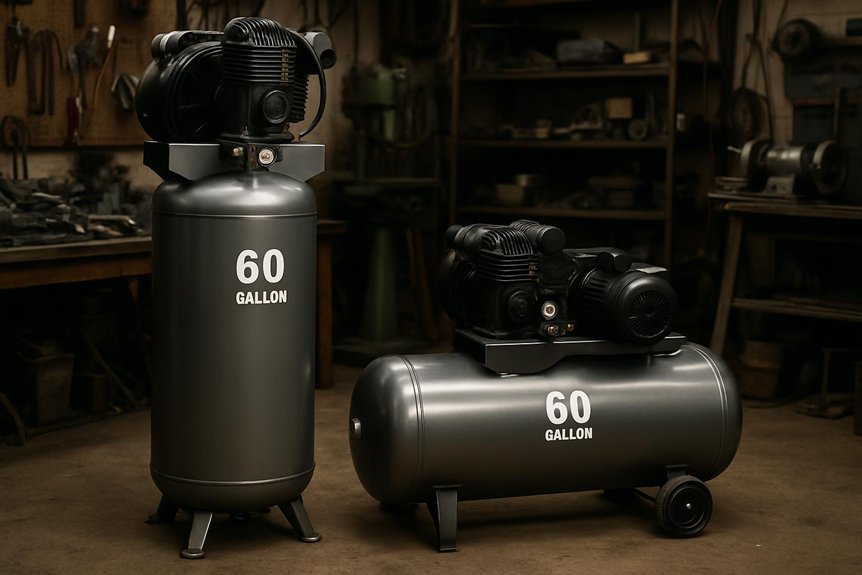
What is the practical impact of vertical versus horizontal layouts on stability, mobility, and footprint in real shops? We analyze how orientation shapes base support, vibration propagation, and floor plan fit. Vertical designs concentrate mass upward, which can raise the center of gravity and alter stability margins during startup transients, yet reduce horizontal footprint in tight spaces. Horizontal units spread weight laterally, potentially widening the footprint but improving linear stability against side loads. Space efficiency hinges on cabinet width, mounting options, and available clearance for service. Vibration damping performance depends on frame rigidity, mounting isolation, and belt/gear alignment common to each orientation. Mobility constraints emerge from handle geometry, wheeled bases, and door access to service panels, while maintenance access varies with component layout and belt paths.
Airflow, Tank Style, and Run-Time: Which Orientation Delivers Consistency
We’ll examine how airflow consistency interacts with tank style and how run-time is affected by orientation, focusing on measurable factors that drive steady delivery. We’ll compare how vertical versus horizontal layouts influence air distribution, peak flow stability, and recovery time under typical load profiles. By isolating these variables, we aim to clarify how each configuration supports predictable performance across real-world duty cycles.
Airflow Consistency Factors
Airflow consistency in our compressor setup hinges on three interrelated factors: air delivery rate (CFM stability), tank orientation, and run-time behavior under load. We examine how airflow consistency correlates with system design choices, focusing on how CFM stability, tank style, and load response interact. Air delivery rate fluctuations reveal sensitivity to compressor cycling, valve timing, and receiver volume, guiding our expectations for steady pressure delivery across duty cycles. Tank style influences surge attenuation and pressure ripple, with larger receivers dampening instantaneous demand spikes. Run-time implications depend on duty cycle, refrigerant-free cooling, and inlet filtration, yet we avoid preempting the next topic by noting only that orientation can shape ripple magnitude. In sum, consistent airflow requires coordinated sizing and control strategies, not just raw capacity.
Tank Style Impacts Run-Time
Tank style directly shapes how long your compressor can maintain pressure between cycles. We analyze run-time by linking tank geometry to air-fuel dynamics, noting how vertical and horizontal orientations influence heat dissipation, valve cycling, and rebound after depletion. In practice, vertical setups tend to favor compact heat management, potentially improving vertical efficiency during prolonged runs, while horizontal designs can offer steadier load responses at mid-cycle due to broader surface area exposure. We consider airflow continuity, regulator response, and compressor duty cycle to assess overall endurance. Our conclusion: orientation affects how consistently pressure is sustained, but performance hinges on tank volume and internal components. Readers benefit from evaluating vertical efficiency and horizontal portability in tandem to predict real-world run-time under expected workloads.
Budget, Parts Availability, and Long-Term Value by Design
How do budget considerations, parts availability, and long-term value shape the choice between a 60-gallon vertical and horizontal air compressor?
Balancing budget, parts access, and long-term value guides choosing vertical vs horizontal compressors.
We assess total cost of ownership, factoring initial price, maintenance, and component longevity. Availability of common components drives downtime and repair costs, so standardization wins. Long-term value hinges on design durability and ease of upgrades, not just sticker price. We prioritize space efficiency and noise considerations, noting how footprint and enclosure influence ongoing operation.
- Weigh initial purchase against expected service life to quantify ROI.
- Compare replacement part lead times and cross-compatibility across brands.
- Estimate maintenance intervals and consumable costs for each orientation.
- Factor in resale value based on popularity and modifiability.
Practical Use Cases: Garage, Workshop, and Pro Shop Scenarios
When choosing between a 60-gallon vertical or horizontal air compressor for garage, workshop, or pro shop use, we evaluate practical duty cycles, space constraints, and noise tolerance to determine which orientation minimizes disruption and maximizes uptime. In our assessment, vertical units excel where floor real estate is scarce, while horizontals benefit service benches with extended reach for multiple tools. Duty-cycle consistency informs runtime planning, ensuring tools like impact wrenches and sanders stay powered without frequent recharges. We prioritize compact maintenance access, enabling quick filter and oil checks without disassembling nearby equipment. Space efficiency emerges as a decisive factor in layout, airflow, and storage. Across scenarios, we balance footprint, vibration mitigation, and accessibility to sustain productivity with minimal footprint and clear reliability margins.
Frequently Asked Questions
How Quiet Is Each 60-Gallon Model in Typical Shop Environments?
We’d rate both as quiet operation overall, with horizontal models offering slightly steadier vibration management; air storage efficiency remains similar, tank orientation affects mounting and maintenance accessibility, and resale value and parts availability stay strong across brands.
Which Orientation Lasts Longer Under Heavy Daily Use?
We answer: horizontal lasts longer under heavy daily use, given steadier cooling and simpler coolant flow. We compare durability; vertical models show marginal wear in taps. Our durability comparison notes footprint impact modestly higher for horizontal setups.
Do Vertical or Horizontal Tanks Affect Air Storage Efficiency?
Vertical or horizontal tanks don’t inherently change air storage efficiency; geometry and seals do. We observe vertical efficiency benefits from compact heat dissipation, while horizontal durability offers steadier real-world operation, reducing vibration-induced losses.
Is Maintenance Access Significantly Easier in One Design?
Maintenance access is not significantly easier in one design; both offer comparable panel access. We assess maintenance access and parts availability, noting that standardization and distributor coverage often make parts widely available regardless of vertical or horizontal layouts.
Which Design Offers Better Resale Value and Parts Availability?
We believe vertical designs generally offer better resale value and broader parts availability, due to widespread OEM support and standardized components; horizontal units can lag. Resale value, parts availability hinge on model lineage, aftermarket support, and regional service networks.
Conclusion
In choosing between a 60-gallon vertical or horizontal compressor, we’ve weighed space, access, stability, and run-time to match real shop needs. Vertical saves floor area but raises the center of gravity; horizontal offers broader service clearance with easier maintenance. Consider ceiling clearance, room layout, and vibration isolation to minimize downtime. The right orientation is a tool, not a solution—like a compass guiding you through a crowded workshop toward consistent air supply and reliability. It’s a steady engine, like a heartbeat under pressure.