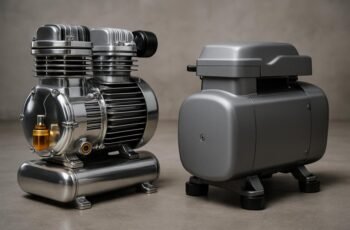
We weigh belt-driven versus direct-drive air compressors with careful, data-driven reasoning, balancing torque decoupling and duty cycles against efficiency and footprint. We’ll consider startup surge, maintenance cadence, and long-term costs to see which approach aligns with your shop’s load profile. Each option has trade-offs in space, noise, and reliability, so our goal is to map performance to use cases while keeping an eye on total cost. Let’s examine the critical differences that will shape your choice.
Key Takeaways
- Belt-driven compressors decouple motor and pump, smoothing torque and startup shocks; direct-drive offers higher efficiency and a smaller footprint.
- Belt-driven systems handle load changes with greater torque and can tolerate higher duty cycles; direct-drive favors simplicity and reduced wear.
- Belt-driven units are larger and heavier, with more alignment/tension maintenance; direct-drive models are more compact and easier to install.
- Noise and vibration: belt drives can exhibit belt-resonance and higher low-frequency content; direct-drive tends to smoother operation with less mechanical coupling.
- Total cost of ownership: consider upfront price, maintenance (belt life vs bearings), efficiency, and reliability to choose the best fit for use-case.
What Belt-Driven and Direct-Drive Air Compressors Do for You
Belt-driven and direct-drive air compressors perform the same essential job—creating compressed air—but they do so in fundamentally different ways that affect performance, maintenance, and cost. We evaluate what each type does for you by focusing on efficiency, reliability, and serviceability. Belt driven units decouple the motor from the pump, smoothing torque fluctuations and reducing startup shocks, which can extend pump life in demanding cycles. Direct drive attaches the motor directly to the pump, delivering higher efficiency and compact footprints, with fewer moving parts and lower maintenance in steady operations. In practice, belt driven systems favor higher torque at load changes, while direct drive prioritizes simplicity and reduced belt wear. Understanding these tradeoffs helps us predict long-term ownership costs and uptime. direct drive, belt driven.
How to Pick Between Torque, CFM, and Startup Speed
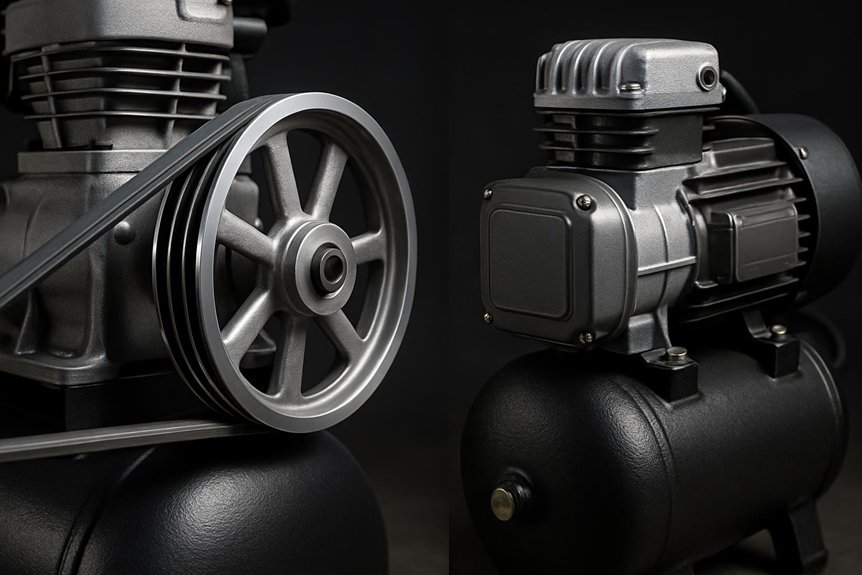
Choosing between torque, CFM, and startup speed comes down to matching the compressor’s behavior to your actual use case: stable, continuous runs versus frequent cycling, and load variation. We evaluate torque tradeoffs by linking it to pressure stability and response time: higher torque reduces lag but increases prime power and heat. CFM aligns with sustained air delivery, but undervariable demand it creates cycling that taxes the system differently than a steady draw. Startup speed matters for first-fire surge, brief demand spikes, and motor protection; slow startup minimizes electrical stress but can delay ready pressure. Our approach: quantify duty cycles, peak loading, and permissible fluctuation bands, then map preferences to a belt-driven or direct-drive topology. This yields calibrated choices that balance performance, efficiency, and practical operating envelopes.
Durability and Maintenance: Belt Wear vs Fewer Moving Parts
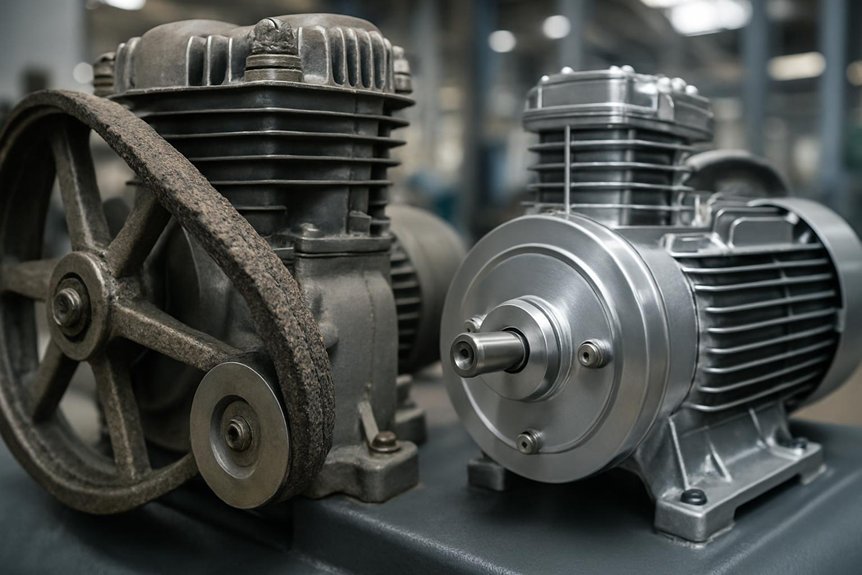
What trade-offs matter most when we weigh belt wear against having fewer moving parts? We approach durability and maintenance with precise criteria, comparing failure modes, maintenance intervals, and total lifecycle costs. Belt-driven units expose components to dynamic loads, tension fluctuations, and belt life degradation, which can increase downtime for adjustments or replacements. Direct-drive units reduce moving parts, lowering friction wear and aligning maintenance around motor bearings and couplings, but suppress alternatives for torque regulation and vibration isolation. We emphasize preventative checks: monitor belt life indicators, inspect pulley alignment, and verify tension consistency. Misaligned pulleys accelerate wear, cause belt cracking, and degrade efficiency. In contrast, fewer moving parts simplify servicing, but we still need routine lubrication, bearing inspection, and motor drive health to sustain performance.
Size, Footprint, and Portability: Which Fits Your Shop
We’ll compare size and footprint to determine what actually fits in your shop, balancing cubic inches, height clearance, and available wall or floor space. We’ll weigh portability and mobility against workflow, noting wheeled models, handle access, and maneuverability in tight layouts. Finally, we’ll assess how spatial fit—along with future expansion or reconfiguration—shapes the practical choice between belt-driven and direct-drive setups.
Size And Footprint
When selecting a compressor for your shop, size and footprint matter as much as performance, because a unit that fits the space constraints today must still accommodate layout changes tomorrow. We assess base dimensions, height, and required clearance for service access, mounting, and vibration isolation. Belt drive units typically present larger footprints and taller profiles due to pulleys, belts, and belt guards, yet can offer centralized air storage and grouped controls. Direct drive models often shave inches and weight, promoting compact layouts and easier installation. We evaluate footprint impact against capacity curves, maintenance access, and room for future upgrades. Our conclusion: choose a configuration whose footprint aligns with your ceiling height, workbench spacing, and vehicle or material flow, balancing belt drive rigidity with direct drive compactness.
Portability And Mobility
Portability and mobility directly shape how you deploy air pressure across a shop, and size and footprint are the gatekeepers of that practicality. We analyze fit by weight, dimensions, and transport ease, comparing belt driven and direct drive configurations for real-world layout.
| Criterion | Belt driven | Direct drive |
|---|---|---|
| Weight | Heavier, more static footprint | Lighter, compact form |
| Transport | Moderate effort, wheel setup common | Easy maneuver, built-in mobility |
| Space needs | Larger footprint | Smaller footprint |
| Vibration | Transmitted through belt | Reduced mechanical coupling |
| Setup time | Longer, belt tension matters | Faster, minimal tuning |
Our conclusion: portability hinges on intended workspace, balancing initial size against ongoing mobility, with belt driven favoring static shops and direct drive excelling in versatile layouts.
Spatial Fit For Shop
Sizing your shop around an air compressor means balancing the footprint, mobility, and layout interactions with other equipment. We assess spatial fit by measuring footprint, clearance, and access for service. Belt-Driven units demand slightly larger footprint but offer better torque at low RPM if space allows. Direct-Drive units save space yet tighten wiring and ventilation constraints. Key considerations include throughput needs, noise tolerance, and workflow integration. To optimize, we compare three practical criteria:
1) footprint and ventilation clearance, 2) accessibility for belt wear inspection and maintenance schedule, 3) portability options and layout harmony with ancillary tools. For belt wear risk, plan a maintenance schedule that minimizes downtime. Properly sizing the footprint reduces interference, improves safety, and preserves performance over time.
Noise, Vibration, and Comfort: Real-World Operating Differences
We compare noise profiles and vibration comfort across belt-driven versus direct-drive models to highlight how each design shapes real-world operability. We’ll quantify audible levels, frequency content, and transient behavior, then relate these to perceived comfort during extended use. Our aim is to identify practical implications for shop acoustics, operator fatigue, and tool responsiveness in typical workflow scenarios.
Noise Profiles Compared
Are belt-driven and direct-drive air compressors substantially different in operational noise and vibration, or do real-world measurements tell a more nuanced story? We approach noise profiles with precision, comparing how drive topology, motor load, and mechanical interfaces shape sound levels, peak impulses, and tonal content. We weigh belt efficiency and energy loss against direct-drive rigidity, linking performance to audible results. We also consider oil lubrication’s role in bearing quieting and heat management, which can influence perceived softness under load.
- Measured SPL differences across load ranges reveal overlap between technologies.
- Transient spikes from start/stop cycles matter more than steady-state levels.
- Tonal signatures reflect belt resonance and bearing quality more than horsepower alone.
Vibration Comfort Differences
How does vibration comfort differ in real-world use, and what do measurements reveal about belt-driven versus direct-drive configurations? We present results with a focus on perceptual impact, benchmarked against quantified vibration spectra and predicted comfort thresholds. Belt-driven systems show higher residualline-frequency harmonics due to belt tension modulation, while direct-drive units exhibit cleaner low-frequency content from motor foundations. In practice, envelope metrics reveal that occupants notice smoother operation from direct-drive, provided mount orientation minimizes receiver coupling. Mounts with rigid isolation reduce transmission for both designs, but belt-driven setups benefit more from optimized isolation to counter selective bandwidth peaks. The contrast ratio between audible noise and tactile vibration improves when vibration is damped at the source. Rigorous testing confirms equilibrium between performance goals and operator comfort, guiding practical selection.
Total Cost of Ownership: Upfront Price to Long-Run Savings
Although the upfront price often grabs attention, total cost of ownership (TCO) matters more for air compressors, because the long-run savings from efficiency, maintenance, and downtime reductions can outweigh initial cost differences. We evaluate TCO by balancing purchase price, operating efficiency, and reliability, with belt-driven designs offering different profiles than direct-drive units. To guide decision making, consider:
1) Belt maintenance: regular inspection and belt replacement costs, plus downtime impact.
2) Belt tension: proper tension sustains efficiency, reduces wear, and lowers energy use over time.
3) Long-run savings: energy efficiency, reduced maintenance intervals, and minimized failure risk compound annually.
Use-Case Scenarios: Hobbyist, Pro Shop, and Heavy-Duty Demands
When selecting a compressor, we must match the design to how you’ll actually use it, from a hobbyist garage to a pro shop and into heavy-duty applications. In hobbyist scenarios, belt driven units offer cost efficiency, adequate runtime, and slower ramping, keeping noise manageable and maintenance simple. Direct drive systems provide compact footprints and quicker response for intermittent tasks. In a pro shop, reliability and duty cycle matter; belt driven configurations excel where air demand is steady but spaced work breaks, while direct drive setups emphasize precise pressure control and faster startup for rapid tool cycling. For heavy-duty demands, rugged belt driven designs tolerate high duty cycles and heat better, whereas direct drive bargains are found in compact, high-output models with robust motors. Choice hinges on workflow, noise tolerance, and maintenance capability. belt driven, direct drive.
Quick-Start Decision Framework: Match Your Tools, Space, and Budget
We start by mapping your tools, space, and budget to the compressor’s capabilities, then prune options that don’t align with real work flows. Our framework emphasizes measurable fit, not hype, so you can pick confidently and deploy quickly. We assess belt efficiency and belt maintenance implications early, ensuring long-term value.
1) Tools and duty cycles: match air demand to compressor type and BPM stability, avoiding overkill or under-support.
2) Space and installation: size, sound, and serviceability drive location decisions; we prioritize accessible belts and routine checks.
3) Budget envelope: total cost of ownership, including maintenance cadence, part availability, and energy use, guides the final choice.
This approach yields a rational, actionable shortlist, finished with clear next steps.
Frequently Asked Questions
Do Belt-Driven and Direct-Drive Air Compressors Startup Speed Differ at Load?
We start faster with belt-driven units under load due to slip margins, but both top out similarly; belt efficiency and motor alignment critically influence startup speed, reducing inrush on start and maintaining consistent pressure under load.
Which Type Handles Intermittent Heavy Bursts Better—Belt or Direct-Drive?
We suspect no single answer; practical tests show belt systems tolerate bursts better, while direct-drive responds quicker but with higher wear risk. We think energy efficiency and portability factor in, but mechanisms differ with duty cycles.
How Do Maintenance Intervals Compare Between Belt Wear and Motor Bearings?
We find wear contributions for belt wear and motor bearings diverge: belts need periodic tension checks and lubrication for pulleys, while bearings demand regular lubrication and interval monitoring, with lubrication requirements and wear contributions guiding maintenance intervals.
Can a Belt-Driven Unit Outperform a Direct-Drive in Cold-Start Conditions?
Yes, a belt-powered unit can outperform in cold-start conditions, but only if belt slip and drive ratios are optimized; otherwise, gear-reliant direct-drive offers faster torque. We assess efficiency, startup surge, and component aging carefully for readers.
Are Noise and Vibration Noticeably Different Under Load Between the Two Types?
Yes, we observe modest noise and vibration differences under load: belt-driven units often show slightly higher baseline noise and more pronounced vibration patterns during surge, while direct-drive compressors exhibit more consistent, lower amplitude noise profiles.
Conclusion
We’ve broken down belt-driven and direct-drive options to illuminate tradeoffs, so you can match torque, CFM, startup behavior, footprint, and maintenance to real shop needs. In short, choose belt-driven for cost efficiency and forgiving duty cycles, or direct-drive for compactness and efficiency when space and quick response matter. Think of it as a precision gear: belts tune the rhythm, while direct drive keeps the tempo tight—pick the setup that keeps your workflow driving forward.