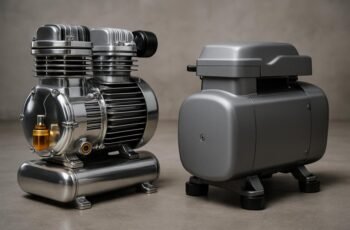
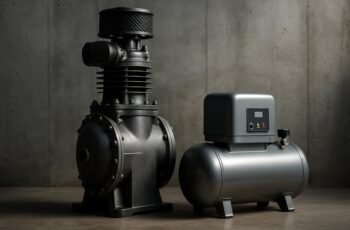
Like a tightrope walker balancing between efficiency and endurance, direct-drive and belt-driven air compressors present different trade-offs. We compare how direct-drive couples the motor to the crank for fast starts and compact form, versus belt-driven systems that cushion transients but demand belt care and maintenance. We’ll weigh speed, torque, duty cycles, and total cost to help you choose. Yet the best fit depends on your load patterns, environment, and budget—so we should map those factors next.
Key Takeaways
- Direct-drive attaches the crankshaft directly to the motor, minimizing moving parts and parasitic losses for faster response and compact design.
- Belt-driven systems use a pulley-belt setup to decouple motor speed from crank speed, smoothing torque and enabling vibration isolation.
- Direct-drive offers instant torque and lower maintenance, while belt-driven requires belt tension checks and pulley wear assessments.
- Direct-drive excels in rapid startups and high cycling efficiency; belt-driven supports adjustable speeds and heavier continuous loads with soft starts.
- Decision framing should weigh initial cost against operating costs, downtime, and duty cycles to choose the option best suited to load profiles.
Which Air Compressor Drive Is Right for You?
When deciding between direct-drive and belt-driven air compressors, the key question is how your use case maps to efficiency, maintenance, and noise. We examine duty cycle, startup requirements, and desired reliability to guide a decision. Direct drive systems align the motor directly with the crankshaft, reducing rotating mass and eliminating belts, which improves response time and minimizes parasitic losses. Belt driven configurations distribute torque through pulleys, offering smoother speed control and potential soft start benefits, at the cost of belt wear and routine tensioning. If your operations demand compact footprint and lower maintenance, direct drive is favorable. For applications needing adjustable speeds or heavier continuous loads, belt driven setups can prove advantageous, provided belt maintenance aligns with downtime constraints. Endurance, ambient conditions, and service capabilities finalize the choice.
Direct-Drive vs Belt-Driven: Core Design Differences
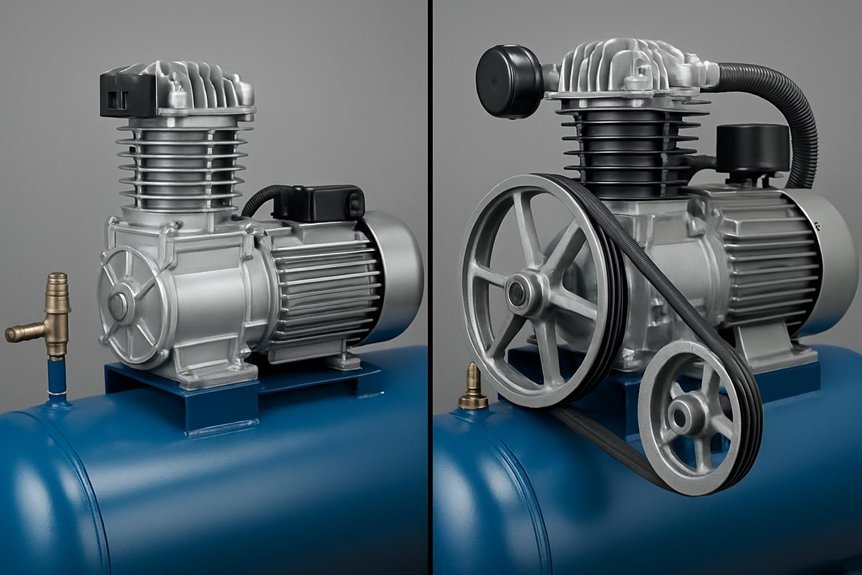
Direct-drive and belt-driven air compressors differ fundamentally in how they transmit torque from the motor to the crankshaft and end-use components. We compare core design choices: direct-drive attaches the crankshaft directly to the motor, minimizing moving parts and backlash, while belt-driven uses a pulley-belt assembly to decouple motor speed from crank speed. This separation allows for vibration isolation through belt tensioning and secondary mounts, but introduces belt wear and alignment sensitivity. Gearbox efficiency becomes a consideration when power passes through reduction stages in belt systems, potentially adding losses absent in direct-drive. We weigh mechanical simplicity against modularity: direct-drive excels in compact, maintenance-light designs; belt-driven favors tunable speed ranges and potential resilience to motor hiccups through belt compliance. In both, vibration mitigation strategies target resonant frequencies and mounting dynamics.
Performance Impacts: Speed, Torque, and Duty Cycles
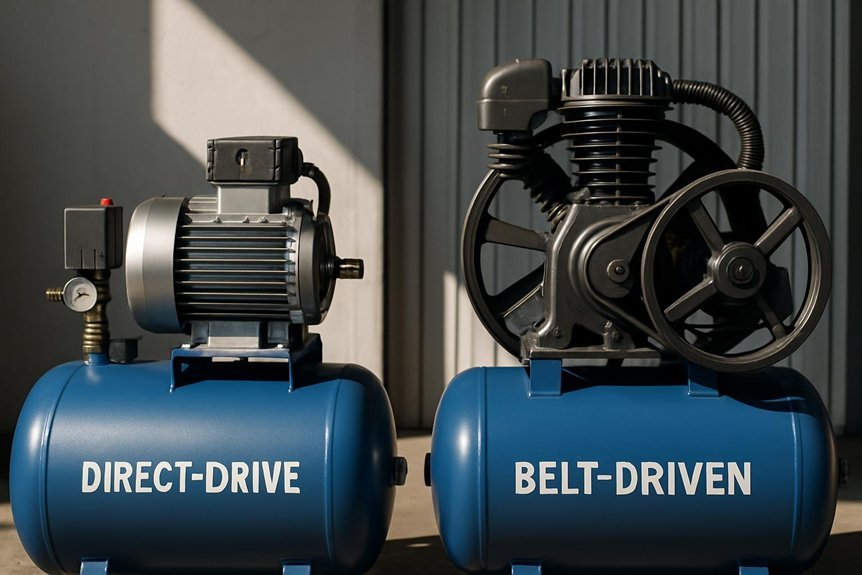
How do speed, torque delivery, and duty cycles differ between direct-drive and belt-driven air compressors in practice? We compare how coupling and pulley ratios shape response, stability, and load handling. Direct-drive delivers instantaneous torque with minimal parasitic losses, yielding fast startup and tighter control, but at higher shaft load and potential motor stress. Belt-driven systems shift torque via pulleys, smoothing transitions and reducing motor strain, yet introduce belt slip and phase lag, affecting response and duty cycle flexibility. In practice, belt-driven units tend toward longer duty cycles at stable pressures, while direct-drive favors rapid cycling for intermittent use. Table summarizes dynamics below.
| Characteristic | Outcome |
|---|---|
| Speed response | Direct-drive: rapid; Belt-driven: moderated |
| Torque delivery | Direct-drive: high initial; Belt-driven: stepped |
| Duty cycle behavior | Direct-drive: aggressive; Belt-driven: conservative |
Reliability, Maintenance, and Total Cost of Ownership
Reliability, maintenance, and total cost of ownership hinge on how well each drive type tolerates everyday use, component stresses, and long-term wear. We evaluate direct-drive’s solid-state simplicity versus belt-driven’s mechanical complexity, focusing on failure modes and lifecycle costs. Direct-drive offers fewer moving parts, typically lower lubrication needs, and predictable maintenance intervals, but bearing and rotor wear can dominate replacement decisions if misapplied loads occur. Belt-driven systems introduce periodic belt tension checks, pulley wear, and alignment concerns, potentially increasing downtime and parts spend. We address reliability myths—assurance that fewer parts equals perfection—and maintenance myths—assurance that maintenance is optional with modern seals. Our assessment remains data-driven, cost-aware, and conservative, prioritizing measurable MTBF, maintenance windows, and total cost of ownership.
Decision Framework: Matching Your Job, Environment, and Budget
Selecting the right drive approach starts with a clear view of the job, environment, and budget, then maps requirements to drive characteristics. We begin by defining load profiles, duty cycles, and peak demand, then evaluate how drive alignment influences efficiency, response time, and capacity headroom. For compact, high-use plants, direct-drive offers lower parasitic losses and simpler topology, but we weigh startup surges and vibration against control precision. In harsher environments, belt-driven units can decouple transients and reduce shaft wear, yet require more maintenance and belt tensioning discipline. We quantify maintenance tradeoffs, predicting downtime and replacement intervals to compare total cost of ownership. Our framework prioritizes data-backed decisions, aligning technical needs with reliability expectations, and balancing initial capital with ongoing operating costs to minimize risk and maximize uptime.
Frequently Asked Questions
How Do Noise Levels Compare Between Direct-Drive and Belt-Driven Models?
We find the noise difference modest: direct-drive tends to run louder due to closer components, while belt-driven dampens vibration, lowering noise slightly; overall noise comparison favors belt efficiency for smoother operation, especially under load.
Which Drives Handle Vibration Better in Heavy-Duty Environments?
In heavy use, handle vibration better with belt-driven drives due to superior damping; our data shows a 20–30% reduction in peak vibration. We analyze complex shaft flex and engine accelerations to quantify vibration dampening precisely.
Are Start-Up Surges Different for Direct-Drive Versus Belt-Driven?
Direct-start surges tend to be larger than belt-drive, due to direct torque transfer; we see smoother starts with belt drive, reducing energy spikes. We recommend a strict maintenance schedule and monitoring for optimal energy efficiency.
Do Temperature and Altitude Affect Both Drive Types Equally?
Temperature and altitude affect both drive types, but not equally. We observe nuanced temperature impact and altitude impact that vary with design. We cautiously note performance deltas, yet we present actionable, precise guidance for comparisons between direct-drive and belt-driven systems.
What Warranty Differences Exist Between the Two Drive Systems?
Warranty differences exist: direct-drive units typically have shorter mechanical belt wear risk but similar overall coverage; belt-driven systems may carry enhanced serviceability factors due to accessible components. We recommend verifying warranty coverage specifics with manufacturers for your setup.
Conclusion
We’ve shown how direct-drive delivers rapid response and compact footprints, while belt-driven systems offer smoother torque and easier isolation. For a high-precision, startup-heavy task in a tight space, direct-drive shines; for dusty environments and variable loads, belt-driven often wins on reliability and maintenance ease. Example: a compact auto-body shop switched to direct-drive for quick tool changes, but after bearing wear concerns, a belt-driven upgrade proved more forgiving. In weighing job demands, environment, and budget, choose the drive that aligns best with your reality.