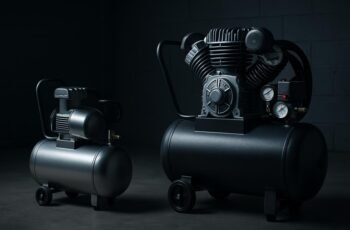
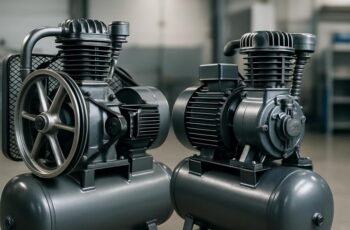
You may not know that small differences in pressure stability can redefine energy use across duty cycles. We’ll compare reciprocating and rotary screw options with an eye on how peak demands, continuous runs, and startup surges shape efficiency and lifecycle costs. By weighing noise, maintenance, and footprint alongside system sizing, we can pinpoint which technology aligns with your load profile—then we’ll outline practical steps to make the choice concrete.
Key Takeaways
- Reciprocating compressors excel at peak demands with high-pressure, lower continuous flow, but generate more impulse noise and vibration in bursts.
- Rotary screw compressors deliver smoother, continuous pressure and better efficiency for steady operation and higher part-load performance.
- Duty cycle and pressure stability guide architecture choice: peak-demand scenarios favor reciprocating, continuous-duty favor rotary screws.
- Energy and maintenance costs differ: reciprocating may incur higher heat and throttling losses at light load; screws offer lower part-load penalties with proper control.
- Size selection and integration matter: match generator/receiver sizing to expected duty cycles and maximum CFM for each design.
Which Air Compressor Do You Need: Reciprocating or Rotary Screw?
When deciding between a reciprocating and a rotary screw air compressor, the key question is: what duty cycle and pressure stability do you require for your application? We evaluate system load profiles, maintenance intervals, and lifecycle costs to determine suitability. Reciprocating units excel at peak demands and lower flow, but exhibit higher impulse noise and vibration in high-load bursts, impacting ambient conditions. Rotary screw designs deliver smoother flow and constant pressure with better efficiency at continuous operation, reducing noise vibration compared with intermittent cycles. Our assessment compares total cost of ownership, footprint, and serviceability, guiding you toward the appropriate architecture. In short, reciprocating vs rotary choices hinge on duty consistency, required pressure stability, and how you balance upfront versus operating expenses.
How They Work: Mechanisms Behind Reciprocating and Rotary Screw
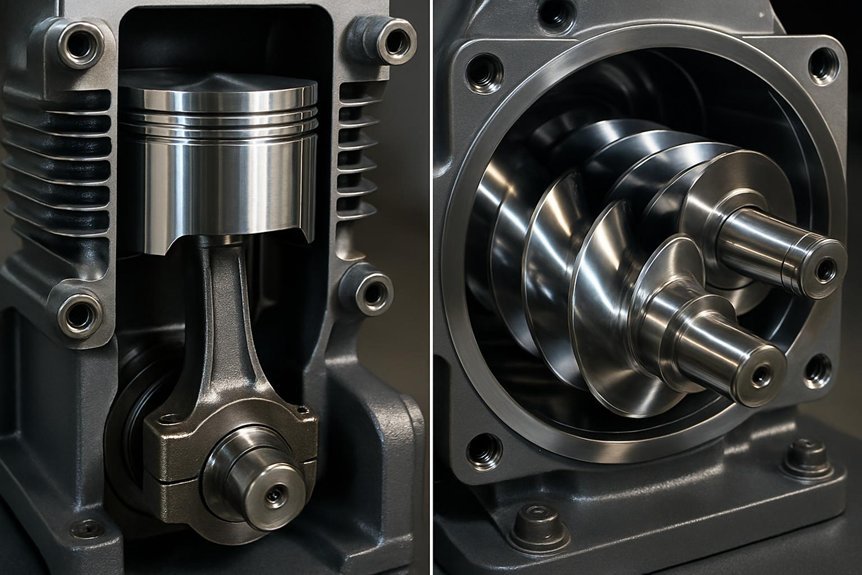
Reciprocating and rotary screw compressors operate on fundamentally different pumping mechanisms, yet both convert electrical energy into compressed air with distinct mechanical paths. We analyze the core actions: reciprocating units use piston-driven cylinders, delivering intermittent, high-peak pressures with single-acting or double-acting stages, while rotary screws rely on meshing rotors to trap and push air continuously. Efficiency hinges on compression ratio, motor sizing, and clearance gaps, which govern heat generation and volumetric efficiency. In our comparison, we emphasize reciprocal versus rotary dynamics, including how intake, compression, and discharge phases differ in timing and load response. Compliance and safety concerns arise from high-pressure exposure, moving parts, and noise profiles, requiring guards, interlocks, and vibration control. Both systems demand electrical protection, correct ventilation, and periodic maintenance to sustain performance.
Pressure and Flow: Matching Your Demands to Each Tech
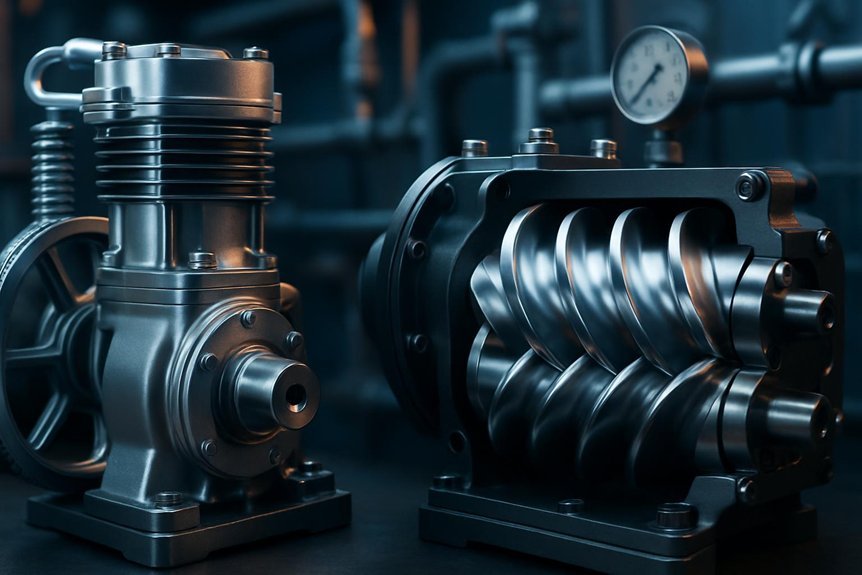
What matters most to match pressure and flow is aligning your system’s demands with each tech’s inherent characteristics. We compare reciprocating vs rotary by examining how each handles pressure spikes, flow stability, and modulation. Reciprocating units deliver high pressure at lower volumes with distinct, stepwise delivery that can demand precise valve actuation. Rotary screws maintain smoother flows, better at continuous duty, yet face limited peak pressures and potential surges during start-up. Our approach focuses on matching generator or receiver sizing to expected duty cycles and maximum CFM, ensuring the system breathes without overworking. Valve sizing challenges arise when control valves must accommodate broad turndown while preserving system stability. We scrutinize valve capacity, response time, and leak thresholds to minimize pressure oscillations and optimize overall performance.
Efficiency and Running Costs: What Impacts Your Bottom Line
We examine how Operating Cost Drivers, Energy Efficiency Metrics, and Maintenance Impact Costs shape the total cost of ownership for reciprocating and rotary screw compressors. By quantifying energy use, part-load performance, and routine maintenance, we identify where small efficiency gains translate into meaningful savings. This baseline lets us compare life-cycle costs and prioritize investments with the strongest bottom-line impact.
Operating Cost Drivers
Operating costs for air compressors hinge on efficiency and running expenses, and these factors can shift dramatically with each technology type. We compare reciprocating vs rotary to identify where costs accumulate and where savings appear, focusing on predictable maintenance, energy use, and part longevity that drive operating costs.
- Weigh energy intensity: energy consumption patterns differ, impacting electricity bills and heat management.
- Assess maintenance cadence: moving parts, seal wear, and lubrication influence downtime and service fees.
- Consider lifecycle economics: purchase price, depreciation, and component replacement shape long-term spend.
Energy Efficiency Metrics
How do energy efficiency metrics shape running costs for reciprocating and rotary screw compressors? We measure efficiency through specific power, volumetric efficiency, and full-load versus part-load performance. Reciprocating vs rotary systems differ in how their compressor stages convert electrical input into delivered air, influencing energy losses at various loads. For a given output, rotary screws typically exhibit lower specific power and steadier efficiency across mid-range demands, while reciprocating units often suffer higher heat and throttling losses under light loading. We assess energy efficiency by compressor controls, pressure droop, and heat recovery potential, then translate those metrics into operating costs. In practice, improved efficiency reduces kWh per CFM, lowers maintenance energy penalties, and sharpens total cost of ownership over system life.
Maintenance Impact Costs
Maintenance impact costs hinge on how well you manage wear, components, and controls across both reciprocating and rotary screw systems. We analyze how maintenance cycles, part quality, and control strategies drive downtime and energy use, highlighting the contrast between myths and reality in each technology: reciprocating myths and rotary screw myths.
- Weighing preventive vs. corrective maintenance shows cost differences in piston rings, valves, seals, and timing belts.
- Proper filter, lubricant, and calibration regimes cut energy waste and extend service life.
- Data-driven condition monitoring reveals subtle inefficiencies before failures, reducing unintended surcharges and downtime.
Ultimately, lower maintenance impact costs hinge on disciplined scheduling, component selection, and accurate performance modeling for both technologies.
Maintenance and Longevity: Upkeep, Downtime, and Repairs
Maintenance and downtime hinge on component design and accessibility, so we’ll compare how maintenance downtime factors, such as service intervals and part availability, differ between reciprocating and rotary screw models. We’ll assess longevity of critical components and the impact of repairability on total lifecycle cost. This will frame how maintenance planning translates to reliability, repair frequency, and overall uptime.
Maintenance Downtime Factors
In evaluating maintenance downtime factors, we focus on how upkeep, component wear, and repair processes collectively influence compressor availability and lifecycle costs. We compare reciprocating and rotary screw units through downtime risk, serviceABILITY, and repair time, not just failure frequency. This analysis informs lifecycle budgeting and maintenance scheduling.
- Time-to-diagnose and triage: rapid fault isolation reduces unplanned downtime and protects production continuity.
- Part accessibility and stock: modular designs shorten servicing windows and limit stockouts.
- Start-up sequencing and noise minimization: controlled startups lessen in-rush, vibration, and wear, improving readiness for maintenance windows.
These factors shape maintenance planning, guide component replacement intervals, and influence total cost of ownership for both technologies.
Longevity Of Components
Across both reciprocating and rotary screw compressors, component longevity shapes downtime risk, service intervals, and total life-cycle cost. We assess durability by analyzing wear mechanisms, material fatigue, and lubrication stability under typical duty cycles. Reciprocating units hinge on piston rings, cylinders, and valves, where seal wear and bore scoring drive maintenance horizons. Rotary screws depend on meshing rotors, end clearances, and bearing integrity, with timing and lubrication quality limiting endurance. We weigh mean time between failures, MTBF, against replacement cycles to quantify risk exposure. Durability concerns focus on heat management, contamination control, and lubricant aging, all affecting performance decline rates. Our conclusion: selecting robust materials, consistent filtration, and proactive monitoring extend uptime, lower replacement frequency, and improve total-cost-of-ownership profiles.
Repair And Serviceability
What drives downtime more: component design or service practices? We evaluate repair and serviceability with a critical, data-driven lens, focusing on maintainability cycles and practical downtime reduction. Our comparison highlights how maintenance planning, access, and part availability shape longevity, beyond raw component durability. Key considerations include lubrication regimes, seal integrity, and wear patterns, impacting reciprocating durability and rotary screw lubrication effectiveness. Practical metrics guide decisions, not theory alone.
- Predictive maintenance schedules informed by vibration, temperature, and pressure data.
- Standardized disassembly and inspection intervals to minimize repair times.
- Spare parts readiness and technician training to reduce non-productive downtime.
Ultimately, serviceability drives reliability as much as inherent design; informed practices maximize uptime and component life.
Noise, Vibration, and Environmental Footprint
Noise, vibration, and environmental footprint are critical differentiators between reciprocating and rotary screw compressors. We analyze how noise comparison and vibration sourcing impact operation, maintenance, and facility compatibility, focusing on source paths, scheduling, and mitigation options. Reciprocating units tend to exhibit higher peak emissions, while rotary screws often present steadier noise profiles, yet they still require enclosure, muffling, and absorptive materials. Vibration sourcing varies with mounting, balance quality, and accessory dampers, influencing base resonance and component wear. Informed comparisons guide selection toward lower total cost of ownership and quieter performance. Table follows highlights relative noise and vibration drivers for each design, aiding design, retrofit, and procurement decisions.
| Column A | Column B |
|---|---|
| Noise drivers | Vibration behavior |
Footprint and Installation: Space, Piping, and Versatility
Footprint and installation efficiency hinge on how space, piping, and configurability align with site constraints and operating goals. We evaluate footprint by comparing how each model integrates with existing plant layouts, service access, and maintenance workflows, focusing on space planning and ease of retrofit. Noise mitigation strategies and vibration control are considered within installation quality to minimize downtime. We emphasize modular configurations, accessibility, and scalable piping runs that reduce installation time and risk. Prospective buyers should map utility connections, exhaust routing, and condensate handling to avoid bottlenecks. 1. Assess 공간 needs and clearance for service doors and maintenance. 2. Plan dedicated piping drops and isolation valves to simplify future changes. 3. Favor compact footprints with adaptable configurations for evolving processes.
Total Cost of Ownership: Capex, Opex, and Depreciation
Total Cost of Ownership (TCO) for reciprocating and rotary screw compressors hinges on initial capital expenditure, ongoing operating costs, and depreciation strategy. We assess capex components, including purchase price, installation, and integration with existing infrastructure. Opex spans energy efficiency, maintenance intervals, parts replacement, lubrication, and consumables, with a focus on reliability metrics. Reciprocating cost tends to be higher upfront in some models but offers predictable maintenance cycles; rotary downtime, conversely, often yields lower energy intensity yet requires more frequent compressor headroom planning in high-demand regimes. Depreciation strategy influences tax advantages and book value trajectory, shaping cash flow projections. Our comparative lens emphasizes lifecycle costs, not merely sticker price, to reveal true economic impact. Ultimately, detailed TCO modeling clarifies which technology minimizes total expenditure over the asset life.
Decision Framework: A Practical Steps to Choose Between Them
How do we systematically select between reciprocating and rotary screw compressors in real-world plants? We present a structured decision framework that emphasizes data-driven steps, measurable criteria, and a clear alignment with operational goals. Our approach focuses on performance consistency, energy efficiency, and maintenance predictability, while avoiding an unrelated comparison that muddies the analysis. By mapping application needs to compressor type characteristics, we create a defensible choice pathway that reduces risk and accelerates buy-in. The following steps guide the discussion ideas we’ve found most practical:
- Define load profile and duty cycle with quantified targets.
- Assess energy impact, maintenance costs, and downtime sensitivity.
- Validate with pilot data and total cost implications before commitment.
Frequently Asked Questions
Which Applications Suit Reciprocating Versus Rotary Screw Compressors Best?
We determine that reciprocating compressors suit high-pressure, intermittent-duty tasks with tight tolerances, while rotary screw excels continuous, steady loads; hence, consider reciprocating efficiency for bursts and rotary texture for sustained output in your system.
How Do Startups Impact Wear and Tear Differently?
Startups impact wear and tear differently: quick scaling stresses components early, accelerating maintenance cycles. We monitor growth strategies and market segmentation to tailor duty cycles, lubrication, and part replacement timing, optimizing reliability while sustaining aggressive growth.
Can Retrofit Options Extend Lifespan or Performance?
Yes, retrofit options can extend lifespan and boost performance. We’ll analyze wear patterns, component compatibility, and control upgrades, detailing retrofit lifespan gains and retrofit performance improvements while maintaining reliability, efficiency, and precise operational data for informed decision-making.
What Maintenance Indicators Signal Imminent Failure?
We monitor maintenance indicators like unusual vibration, rising discharge temperature, fluctuating pressures, and oil degradation to assess imminent failure. Our analysis shows these signals warrant prompt inspection, securing reliability, and preventing costly downtime.
How Do Ambient Temperature and Altitude Affect Performance?
We can’t ignore ambient temperature and altitude: ambient cooling diminishes with heat and altitude effects reduce air density, lowering efficiency and capacity. We analyze, explain, and document how these factors alter performance, guiding our readers precisely and pragmatically.
Conclusion
We’ll spare you the prophecy, but not the punchline: choosing between reciprocating and rotary screw is less magic, more metrics. Think of reciprocating as the drama club — loud, bursts of power, ideal for spikes. Rotary screws are the steady marching band — smooth, efficient, consistent. Assess duty cycle, pressure stability, noise, and total costs, then size components accordingly. In short, match the tech to the load, and avoid the horror of undersized receivers. The chorus thanks you for listening.