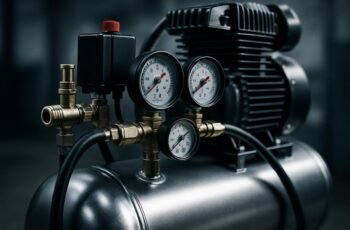
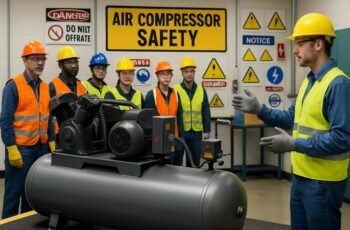
We recognize that stationary air compressors pose hazards from stored energy, moving parts, and high pressure, which is why we implement standardized lockout/tagout, rigorous pre-use inspections, and real-time gauges. Our approach covers workspace security, safe storage and transport, and clear access controls, along with leak checks and pressure-relief validation. We’ll enforce PPE, designate operate-only personnel, and maintain routine maintenance. Join us as we outline procedures and audits that keep operations compliant and safe, step by step, starting at the doorway.
Key Takeaways
- Recognize hazards from stored energy, moving parts, and high-pressure systems; use lockout/tagout and verify zero energy before work.
- Conduct pre-use inspections of pressure relief devices, gauges, hoses, oil levels, wiring, and grounding; document deviations.
- Secure workspaces with clear exits, proper lighting, barriers, and restricted access; implement routine emergency drills and valve/shutoff knowledge.
- Use required PPE (eye, hearing, gloves) and enforce risk-based safety practices; maintain clean work areas and restrict unauthorised personnel.
- Follow documented pressure control procedures, ensure relief devices are sized and tested, and verify shutdown and escalation protocols with manufacturer specs.
What Makes Stationary Compressors Dangerous and How Safety Helps
Stationary air compressors pose specific hazards from stored energy, moving parts, and high-pressure systems; understanding these risks clarifies why safety measures are mandatory. We, as operators and supervisors, identify risk pathways and implement controls that meet regulatory expectations. Stored energy can cause sudden release through valves or hose bursts, so we tag and lockout energy sources and verify depressurization. Moving components pose caught-by and entanglement risks; guards, interlocks, and safe-clearances mitigate exposure. High-pressure circuits threaten rupture and nozzle injury; pressure relief devices, proper tubing, and ongoing maintenance verify system integrity. We stress procedure adherence over idle chatter, balancing focused work with unrelated humor to maintain calibration. Training emphasizes hazard recognition, incident reporting, and corrective action to sustain a compliant, safe operating environment.
Pre-Use Setup: Inspecting the System and Securing the Workspace
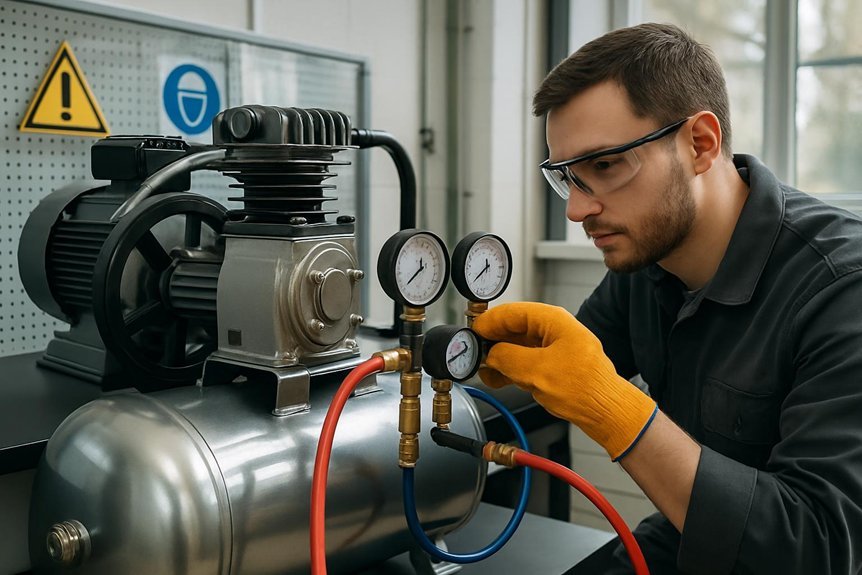
We will start by performing a thorough system inspection to verify pressure relief devices, gauges, hoses, and fasteners are within specification and free of damage. We will then secure the workspace by removing ignition sources, grounding electrical outlets, and establishing clear access routes and ventilation. Our review focuses on documented checks and immediate corrective actions to ensure a safe, compliant pre-use state.
Inspect System Thoroughly
Before using the unit, we perform a thorough system inspection and secure the workspace. We proceed with a systematic check of pressure settings, hopper integrity, belt guards, and couplings, ensuring no signs of wear or damage exist. We verify oil levels, filter condition, and lubrication points, documenting any deviations. Electrical connections are tested for tightness and proper grounding, and the starter, pressure switch, and safety relief valve function are confirmed. Hose assemblies are inspected for cracks and abrasions, and clamps are secure. We confirm tagout status, lockout procedures, and ventilation adequacy. By inspect system and securing workspace, we minimize risk and align with regulatory standards.
| Area | Action |
|---|---|
| Pressure settings | Verify against specs |
| Guards and couplings | Inspect for wear |
| Electricals | Test safety devices |
| Hoses | Inspect for damage |
| Ventilation | Confirm adequacy |
Secure Workshop Space
Securing the workshop space starts with a disciplined setup: we clear the area of clutter, establish a dedicated work zone, and confirm unobstructed access to exits, emergency shutoffs, and the compressor controls. We inspect the surroundings for trip hazards, ensure adequate lighting, and verify that vibration pads and mounting are intact. We implement lockout/tagout procedures as needed and restrict access to trained personnel during setup. We install appropriate barricades and signage, delineating the safe perimeter and emergency exit routes. We integrate routine emergency drills into the pre-use routine, confirming responders know valve locations and shutoff sequences. We address acoustic needs through deliberate noise reduction measures, lowering ambient levels to meet regulatory limits. Clear communication, documented checks, and disciplined housekeeping underpin a compliant, safe workspace.
Safe Operation Practices for Everyday Use
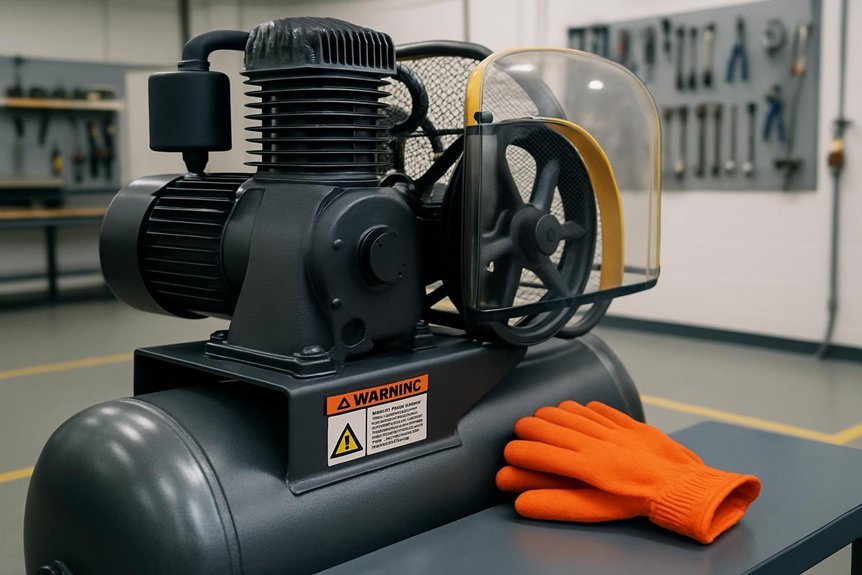
Are you operating a stationary air compressor safely and efficiently every day? We outline practical, regulation-aligned practices for daily use. Begin with pre‑start checks: verify connections, drains, and gauges meet manufacturer specs, and confirm that all safety devices remain functional. Maintain a clean, organized work area to prevent trip hazards and ensure rapid access to shutoffs without delay. Use designated PPE and enforce PPE selection guidelines aligned with risk assessment, including eye protection, hearing protection, and gloves where appropriate. Post clear safety signage near the unit to reinforce operating limits and required behavior. Restrict spectators and unauthorized personnel, ensuring only trained operators perform routine tasks. Document inspections, maintenance, and any deviations to ensure traceability and continuous compliance.
Handling Pressure Relief, Controls, and Shutoff Procedures
How do we reliably manage pressure relief, controls, and shutoff procedures to prevent overpressure and guarantee immediate response? We implement documented, regulator-aligned protocols that specify activation thresholds, sequence logic, and escalation paths. Our approach centers on clearly defined shutoff procedures, validated by manufacturer specifications and applicable codes. We ensure pressure relief devices are appropriately sized, tested, and set within permissible ranges to avert hazardous buildup. Gauges and indicators provide real-time visibility, enabling prompt recognition of abnormal conditions and confirming correct actuator positions during operation and trips. Interlock systems, audible/visual alerts, and remote shutdown capability are integrated to minimize response time. Procedures require routine verification, recordkeeping, and training to sustain consistent, compliant performance under all load scenarios.
Maintenance Routines That Prevent Failures and Injuries
We establish routine inspection protocols and a preventive maintenance schedule to minimize failures and injuries. Our approach is to apply clear, regulator-aligned criteria for tool condition, lubrication, and component checks, with documented intervals and accountability. We invite you to implement these routines now and maintain verifiable records for audit and safety assurance.
Routine Inspection Protocols
Routine inspection Protocols establish a disciplined, preventative maintenance cadence for stationary air compressors. We describe checks that verify component integrity, performance consistency, and compliance with applicable standards. We perform visual examinations of mounting, belts, couplings, guards, and enclosure seals, recording wear indicators and leakage signs. We verify electrical connections, pressure gauges, relief valves, and emergency stop functionality, confirming calibrated readings and fault histories. We document lubrication schedules, filter cleanliness, and cooling system performance, scheduling corrective actions before degradation occurs. We assess vibration levels, noise patterns, and motor temperatures to detect anomalies linked to wear or misalignment. In servicing, we emphasize drill design considerations and noise reduction practices to minimize operational risks, ensure accessibility, and sustain safe, reliable output. Continuous records enable trend analysis and authorized maintenance authorization.
Preventive Maintenance Schedule
Preventive maintenance schedules establish a structured, proactive cadence to avert failures and injuries in stationary air compressors. We implement a documented program detailing task intervals, responsibilities, and acceptance criteria aligned with applicable standards. Regular inspections verify valve integrity, pressure gauges, relief devices, and lubrication points, while preventive tasks address compressor head cooling, belt tension, and drive train alignment to minimize wear. We define calibration intervals for gauges and sensors, ensuring measurement accuracy that supports safe operation under design loads. Our schedule includes heat exchanger and filtration system checks to sustain air quality and reduce contaminants. We implement noise mitigation strategies where applicable and document results to demonstrate compliance. We also address paint storage considerations to prevent corrosion and maintain enclosure integrity throughout service life.
Personal Protective Equipment That Really Protects You
What PPE truly protects you in compressed air environments? We specify protective gear that addresses known hazards without redundancy. Our program emphasizes engineering controls first, then PPE that aligns with compliance, standards, and practical use. For contact risks, we require cut-resistant gloves when handling sharp components and when manipulating hoses and fittings, ensuring gloves protection without compromising dexterity. Hearing protection is mandatory in high‑noise areas, with calibrated devices meeting regulatory attenuation values and fit testing. Eye and face protection is selected to guard against incidental spray, debris, and splash from lubricants, while respirators are reserved for aerosolized or mist conditions only when ventilation proves insufficient. Foot protection, gloves, and eye protection must be inspected before each shift, documented, and replaced per manufacturer instructions and applicable standards.
Electrical Safety and Air-Line Management Best Practices
We implement rigorous Electrical Grounding Practices, maintain proper Air-Line Pressure Management, and enforce Safe Electrical Lockout Procedures to prevent unexpected energization. We will address how each element interfaces with equipment design, system inspection, and operator training to meet regulatory standards. Our goal is clear, enforceable actions that minimize risk during startup, operation, and maintenance.
Electrical Grounding Practices
Electrical grounding is essential for operator safety and system reliability; proper grounding minimizes shock hazards, stabilizes voltage, and provides a clear fault path for protective devices. We address electrical grounding practices to ensure consistent performance and compliance with applicable standards. We verify that the equipment chassis, enclosures, and frames are bonded to the building grounding system, ensuring electrical isolation from nonconductive components does not create inadvertent paths. We document conductor sizing, termination methods, and color-coding to maintain grounding integrity across installations and service changes. We confirm continuity tests, with periodic verification of ground resistance and fault-clearing effectiveness under load conditions. We reserve dedicated grounding conductors for auxiliary circuits and ensure proper isolation from corrosive environments. We maintain traceability for all grounding components and assessment records.
Air-Line Pressure Management
How can we guarantee safe and reliable air-line operation through disciplined pressure management? We approach air-line pressure management with precise procedures, validated fittings, and clear limits. Our focus is on maintaining consistent pressure, rapid fault detection, and compliance with regulatory standards. We implement robust pressure control strategies, monitor fluctuations, and document calibrations to ensure performance and safety. Effective air line management minimizes leaks, reduces tool startup shocks, and protects downstream components from overpressure. Regular training reinforces correct practices and aligns with lockout and tagging protocols where applicable.
- Establish rated pressure setpoints and audible/visual alarms
- Conduct periodic calibration, leak checks, and validation of regulators
- Document changes, maintenance history, and incident investigations for continual improvement
Safe Electrical Lockout Procedures
Have we properly isolated energy sources to prevent unexpected energization during maintenance? We, as practitioners, implement Safe Electrical Lockout Procedures (LOTO) to ensure controlled serves are de-energized, verified, and restrained before any work. We apply standardized steps: identify energy sources, notify affected personnel, isolate equipment, lock and tag per procedure, verify zero energy, and document compliance. We emphasize periodic audits, training, and accountability to reduce fogging hazards and accidental re-energization. We coordinate with electrical and pneumatic systems to prevent cross-activation and unintended startup, while maintaining safe clearance around lines. For noise reduction, we restrict work during operations and utilize decoupled controls. Table below summarizes roles, steps, and verification criteria.
| Role | Step | Verification |
|---|---|---|
| Technician | Lockout | Visual confirmation |
| Supervisor | Permit closeout | sign-off |
| Safety | Training | Competency log |
| Engineer | System review | Post-maintenance test |
Storage, Transport, and Environmental Considerations
Where should we start when considering storage, transport, and environmental concerns for stationary air compressors? We begin with documented storage, handling, and transport criteria, aligned to regulatory standards and manufacturer instructions. We implement storage best practices to protect components, prevent corrosion, and maintain performance while documenting shelf life and ventilation requirements. Environmental compliance focuses on leak prevention, proper drainage, and containment to minimize soil and water impact. Routine inspections verify seals, batteries, and lubricants are intact.
- Storage best practices: labeled cabinets, containment, and temperature control
- Transport considerations: secure mounting, vibration reduction, and shielded connections
- Environmental compliance: spill kits, waste disposal, and compliant labeling
Emergency Response and Incident Prevention Planning
We begin by establishing an emergency response framework that aligns with regulatory requirements and manufacturer guidelines, and we’ll proactively prevent incidents through clear roles, documented procedures, and practiced drills. We communicate promptly during events, define escalation paths, and assure access to essential safety data sheets and contact lists. Our incident response plan specifies notification, isolation, and shutdown sequences for compressor systems, electrical panels, and fuel sources, with delineated responsibilities for operators, maintenance, and management. We perform regular drills, record outcomes, and verify that corrective actions close gaps efficiently. We assess potential risk scenarios, including overpressure, fire, and hazardous leaks, integrating incident prevention into daily operations. Compliance, traceability, and audit readiness remain central to maintaining a robust, recoverable safety posture.
Training, Documentation, and Ongoing Safety Culture
Effective training, documentation, and the sustenance of a proactive safety culture are essential for reliable stationary air compressor operations. We assert that precise training sets baseline competencies, while ongoing refreshers address evolving hazards and regulatory updates. Documentation records prove compliance, enable traceability, and support incident analysis. We emphasize measurable objectives, competency verification, and timely audits to sustain performance.
Effective training, documentation, and proactive safety culture drive reliable stationary air compressor operations.
- precise training ensures consistent technician capability
- documentation records maintain regulatory compliance and incident history
- ongoing safety culture promotes reporting, near-miss learning, and continuous improvement
Frequently Asked Questions
How Do I Choose the Right Stationary Compressor for My Space?
We choose the right stationary compressor by matching airflow and pressure needs to our space, then assess duty cycle, electrical requirements, and footprint, avoiding irrelevant topic ideas and unrelated concepts, while complying with regulatory specs and precise installation guidelines.
What Are Common Noise Hazards and Mitigation Strategies?
We’ve found that 70% of plant workers report prolonged exposure to noise hazards; mitigation strategies include engineering controls and administrative limits, plus vibration control and hearing protection. We’ll implement these precise steps to reduce noise hazards effectively.
Can I Run a Compressor in a Residential Bedroom Setup?
Can we run a compressor in a residential bedroom? No. We’ll prioritize safety, noise, and clearance: we avoid vibration sources near sleeping areas, use proper enclosures, and implement two word discussion ideas, noise reduction, plus regulatory-compliant isolation and monitoring.
How Often Should I Replace Safety Relief Valves and Gauges?
We replace safety relief valves per manufacturer guidance, generally 1–5 years, and gauges annually; ensure valve maintenance and gauge calibration through certified techs, documenting cycles, testing efficiency, and compliance with applicable codes and PPE standards.
What Signs Indicate Potential Air-Line Leaks or Fittings Failure?
There are signs indicating leaks and fittings failure signs we notice: hissing, rising pressure drop, moisture at joints, audible creaks, and tool performance loss; we inspect fittings, tighten or replace components, log findings, and adhere to regulatory standards.
Conclusion
We, as safety stewards, seal our standards with stringent steps: systematic supervision, steadfast lockout/tagout, and steady inspections. We safeguard systems through precise pressure checks, proper PPE, and prompt incident reporting. By benchmarking training, documenting procedures, and conducting regular audits, we reinforce regulatory compliance and risk reduction. Let’s lock in lessons, latch onto lessons learned, and linger on lessons applied—creating a culture of careful, compliant, commendable competence in every compressor operation.