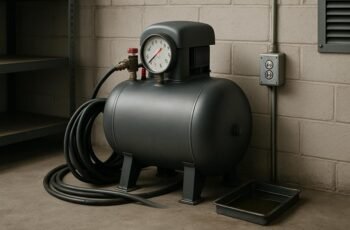
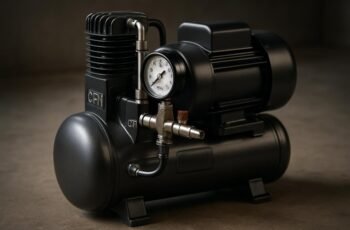
We know stationary air compressors generate noise from motor vibration, pulse within the compression chamber, and cooling air flows, and that noise levels shift with load, maintenance, and enclosure design. We’ll break down dominant bands, assess baseline levels, and compare options for vibration isolation, mufflers, and absorptive barriers. There’s a balance to strike between throughput and quiet operation, all while meeting exposure limits and maintenance schedules. Let’s explore practical paths forward and see how far we can quiet the system without sacrificing performance.
Key Takeaways
- Yes, stationary air compressors produce noise from motor/drivetrain, compression chamber, valves, and cooling/exhaust systems.
- Noise levels vary with load, pulses, and vibration, not just continuous sound, affecting surroundings differently during full-load.
- Mitigation focuses on vibration isolation, mufflers, and compliant enclosures to reduce structure-borne and airborne noise.
- Noise management should align with safety limits, maintenance access, and impact on throughput and cooling efficiency.
- Measurable targets (baseline SPL, post-upgrade checks) guide cost-effective quieting without compromising performance.
Identify Your Noise Needs: Is a Quieter Compressor Worth It?
To determine whether a quieter compressor is worth it, we start by identifying your noise tolerance and the environment in which the unit will operate. We assess how noise affects workflow, safety, and communication, then translate those factors into a practical requirement set. Our approach links noise budgeting to equipment choice, balancing sound levels against critical performance metrics. We compare quiet vs. throughput, acknowledging that precision tools, long runtimes, and duty cycles shape acceptable noise. We quantify acceptable decibel ranges at key operation points and consider enclosure, vibration, and maintenance implications. By framing needs as measurable targets, we prevent overengineering while ensuring reliability. If your site prioritizes minimal disruption, a quieter option can align with both productivity and compliance.
What Makes Stationary Air Compressors Noisy (Main Noise Sources)
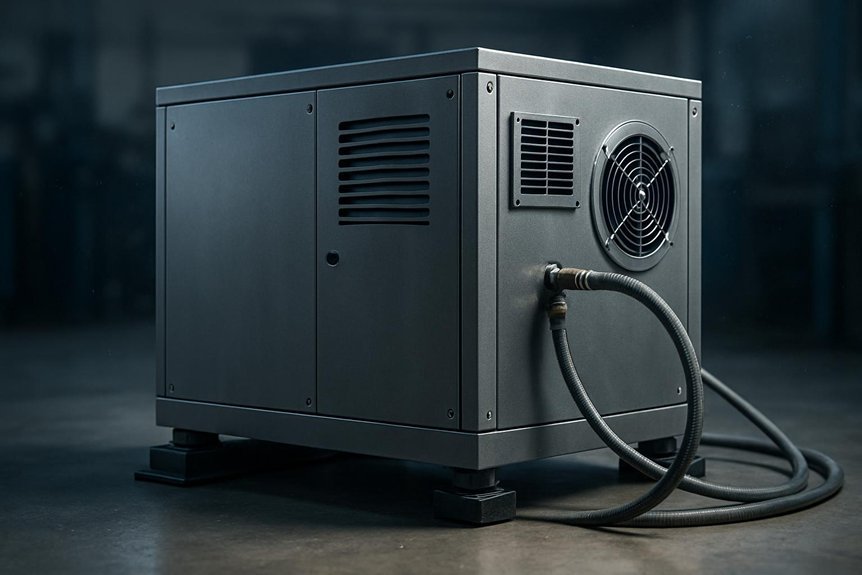
Stationary air compressors generate noise primarily from three sources: the motor and drive train, the compression chamber and valves, and the cooling and exhaust systems. We discuss noise sources by isolating these mechanisms and examining how each contributes to overall sound. The motor and drive train emit rotational and vibrational energy; the chamber and valves produce pressure pulses and valve chatter; the cooling and exhaust systems release hot air and exhaust noise. By comparing these sources, we can identify dominant contributors and potential mitigation paths. This approach helps discuss noise sources with a view toward compliance considerations. Use a structured comparison to inform design choices that align with standards.
| Source | Typical Noise Mechanism |
|---|---|
| Motor/Drive Train | Rotational noise and vibration |
| Compression Chamber/Valves | Pulse noise, valve chatter |
| Cooling/Exhaust Systems | Airflow and exhaust sound |
Measure and Compare Noise Levels: How Loud Is Yours and Why It Matters
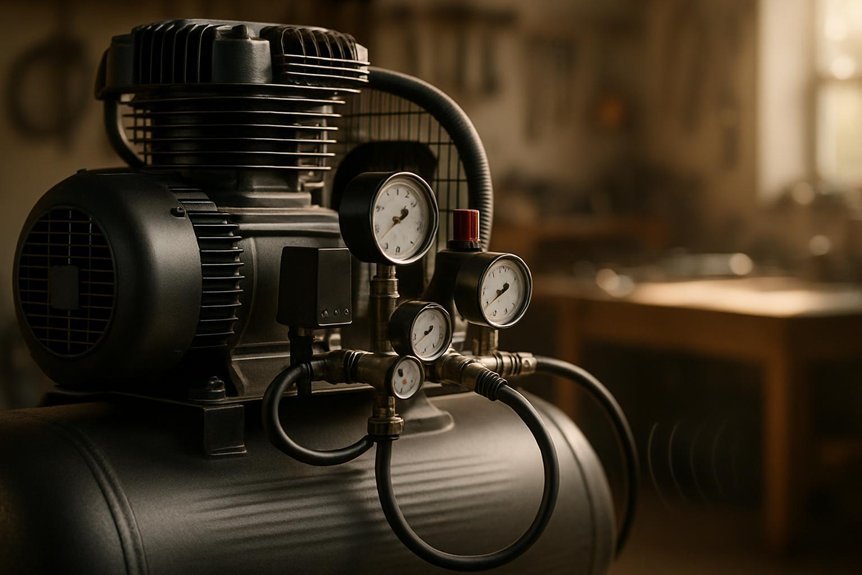
How loud is your stationary air compressor, and why does it matter for performance and compliance? We measure and compare sound levels to quantify impact on operations, safety, and regulatory limits. A systematic approach reveals when noise masks critical signals or disrupts nearby work. We focus on noise comparison across duty cycles, loads, and enclosure conditions, and track changes over time to guard against drift in performance. Consider these factors:
1) Sound pressure level at standard distance
2) Peak vs. steady-state noise during full-load phases
3) Correlation with vibration sources and mounting integrity
4) Environmental constraints and permissible exposure limits
Accurate measurement helps optimize placement, maintenance, and compliance, ensuring efficiency isn’t sacrificed for quieter operation.
Mounting and Design Tricks to Reduce Vibration and Exhaust Noise
We’ll outline how vibration isolation, exhaust noise dampening, and smart mounting frame design interact to cut both vibration and exhaust noise. We’ll assess practical options like isolation pads, tuned mounts, and frame geometries that minimize transmission paths while preserving accessibility and serviceability. By connecting these design tricks to measured outcomes, we’ll show how to optimize steady-state operation and reduce sound signatures.
Vibration Isolation Techniques
What practical steps can we take to minimize vibration and exhaust noise in stationary air compressors? We engage targeted vibration isolation strategies and precise muffler placement to decouple structural paths from the frame and foundation, while maintaining flow.
- Optimize mounting pads and isolators to maximize damping without compromising alignment.
- Align compressor, dryer, and receiver with minimal shared supports to reduce transfer paths.
- Choose calibrated springs or elastomer isolators tuned to operating frequency bands.
- Position mufflers and headers to minimize re-radiation and ensure direct exhaust clearance without backpressure.
These measures reduce structural vibration coupling and control noise propagation, improving stability and long-term reliability. We emphasize vibration isolation as a primary lever and muffler placement as a secondary, complementary design choice to curb nuisance noise.
Exhaust Noise Dampening
Exhaust noise dampening hinges on how we route and terminate flow paths without sacrificing pressure or throughput. We approach exhaust design by minimizing high-frequency emissions through controlled expansion, baffling, and targeted muffling that preserves flow characteristics. We assess exhaust energy across the system, locating restrictive bends and abrupt terminations that amplify noise. Our strategy combines vibration isolation with passive attenuation: isolators decouple radiant and structure-borne noise, while decoupled, tuned outlets reduce resonant coupling. We favor compact, purpose-built silencers and stepped impedance sections to lower exhaust noise without adding backpressure. Material choice matters: acoustic liners, corrosion-resistant housings, and seamless seals maintain performance. In practice, we validate reductions with steady-state and pulsed tests, confirming that quieter exhaust corresponds to predictable, stable pressure and throughput.
Mounting Frame Design
Can a well-tattooed frame reduce both vibration and noise without compromising access or rigidity? Yes, with disciplined mounting frame design. We focus on rigidity, isolation, and serviceability to curb exhaust noise and resonant paths. Our approach blends material selection, joint detailing, and finish cues to minimize transfer while keeping inspection straightforward.
1) Use a stiffer frame alloy paired with compliant mounts to decouple structure from the base.
2) Apply targeted dampers at critical nodes to disrupt vibration paths without occluding access.
3) Employ frame coloration cues (paint and coatings) to identify hot spots and wear zones for stationary maintenance.
4) Design modular sections for rapid access, reducing downtime during servicing and noise verification.
This disciplined framing improves reliability, readability, and acoustical performance.
Effective Sound-Absorbing Add-Ons for Compressors (What Actually Works)
Effective sound-absorption additions for compressors hinge on selecting solutions that target the dominant noise paths: airborne leakage, mechanical vibration, and motor noise. We, therefore, evaluate options by path, not by guesswork. For airborne leakage, enclosures with seals and acoustic gaskets reduce reverberation. For mechanical vibration, resilient mounts and isolation pads damp frame-transmitted noise. For motor noise, reinforced enclosures with low‑noise fans and vibration‑reduction linings help. The table below summarizes likely gains and implementation notes. We, as readers, should consider noise compliance and maintenance scheduling when selecting add-ons.
| Pathway | Recommended Add-On | Expected Benefit |
|---|---|---|
| airborne leakage | acoustic enclosure seals | improved containment |
| mechanical vibration | vibration isolation mounts | lower structure noise |
| motor noise | insulated motor housing | reduced radiated sound |
Quick Upgrades That Quiet Things Down Without Hurting Throughput
We’ll outline quick, low-risk upgrades that quiet our stationary air compressors without sacrificing throughput. We’ll cover practical quiet installation tips, targeted sound-dampening upgrades, and safeguards to prevent throughput losses. Our focus is on clear, data-backed choices that minimize noise while preserving performance.
Quiet Installation Tips
Quiet install is often the simplest path to meaningful noise reduction without compromising throughput. We outline practical steps that preserve performance while cutting decibels, emphasizing measurable impact and cost awareness.
1) Isolate vibration sources with compliant mounts to limit structure-borne noise without altering airflow.
2) Route air lines and cables to minimize contact noise, using compliant clamps and grommets.
3) Position the receiver and condenser away from occupied spaces, balancing duct length and cooling efficiency.
4) Implement enclosure considerations that optimize acoustics while maintaining service access for quiet maintenance and quick troubleshooting, informed by a cost benefit analysis.
These measures support quiet maintenance, deliver predictable acoustics, and help quantify return on investment without sacrificing throughput.
Sound-Dampening Upgrades
Could small, targeted sound-dampening upgrades deliver meaningful noise reductions without compromising throughput? Yes, we think so. We evaluate quick actions that lower sound levels while preserving performance. Key steps include isolating vibrating components, optimizing ducting, and selecting compliant absorptive barriers. We favor materials with low resonance and high damping, paired with precise mounting to prevent chatter. We also consider silent lubrication to reduce gear noise without re-lubricant overhang, ensuring maintenance cycles stay intact. Warranty implications must be reviewed before modifications, as some upgrades can affect coverage. Implementations should be verifiable: measure baseline SPL, apply upgrades, then recheck. Table summarizes options and outcomes below.
| Upgrade | Expected Effect |
|---|---|
| Vibration isolation | Reduced structure-borne noise |
| Absorptive barriers | Lower enclosure sound: power balance |
Throughput Impact Safeguards
How can we quiet a station while preserving throughput? We approach Throughput Impact Safeguards with precise, low-risk upgrades that don’t throttle output. Our focus is on adjustable controls, real-time monitoring, and disciplined maintenance cadence to sustain performance while cutting noise. We outline a practical path:
- Implement adaptive bleed and load/unload cycles to smooth pressure swings.
- Deploy targeted vibration isolation and mufflers tuned to dominant noise bands.
- Integrate noise pricing analysis to balance cost versus benefit across shifts and units.
- Establish a formal maintenance cadence with scheduled inspections, parts replacement, and calibration windows.
These steps reduce audible emissions without sacrificing throughput, enabling quieter operation while preserving system reliability and energy efficiency.
Frequently Asked Questions
How Does Compressor Duty Cycle Impact Perceived Noise Over Time?
We’ll note that higher duty cycle can elevate sustained noise exposure, but perceived loudness may adapt; duty cycle tradeoffs matter, and noise perception dynamics shift with runtime, loading, and enclosure, affecting long-term annoyance and measurement.
Do Ambient Temperatures Affect Stationary Compressor Noise Levels?
Ambient temperature can influence stationary compressor noise levels; higher temperatures often elevate mechanical expansion and vibration, altering noise perception. We analyze data to quantify these effects, noting that ambient conditions interact with cooling and insulation, shaping overall noise output.
Can Service Intervals Influence Ongoing Noise During Operation?
We can say yes: service intervals influence ongoing noise during operation. Our noise reduction depends on proper maintenance scheduling, lubrication, and component alignment, reducing vibration and wear. Regular maintenance minimizes acoustic variances and sustains quieter, more predictable performance.
Are There Industry Standards for Permissible Compressor Noise at Workplaces?
Yes, there are industry standards. We find OSHA and ISO limits guiding workplace compressor noise; many facilities exceed thresholds. We discuss noise mitigation and vibration control, quantify exposure, and propose targeted maintenance to stay compliant and protect workers.
Does Compressor Placement Near Walls or Machinery Alter Acoustic Impact?
Yes, placement near walls or machinery affects acoustic impact; off topic placement increases wall adjacent impact. We analyze spacing, reflectivity, and vibration isolation to minimize noise transmission and ensure OSHA-compliant, acoustically optimized facility layouts.
Conclusion
We balance the push for throughput with the pull of quiet. Juxtaposition shows how performance and silence can occupy the same space: a loud, vibrating boiler vs. a still, isolated chassis; brisk pressure swings against steady, muffled breaths. We measure, compare, and mitigate, revealing noise as a solvable variable rather than an inevitable trait. By targeting sources—vibration, exhaust, enclosure—we gain predictability, compliance, and reliability, all without sacrificing demand. Quieting isn’t a luxury; it’s a design and maintenance discipline.