We operate stationary air compressors when continuous use is required, and we’ll tell you what makes them reliable, steady, and cost-effective. Their higher steady-state CFM, stable pressure, and better cooling reduce overheating and component churn. But success hinges on cooling design, oil lubrication, monitoring, and duty-cycle planning. We’ll outline practical standards and tradeoffs to help you decide if a stationary unit fits your all-day needs, and what gaps you’ll need to fill to keep performance consistent.
Key Takeaways
- Stationary compressors typically deliver higher CFM and stable pressure, reducing heat buildup and supporting continuous operation.
- They offer better cooling and thermal management, lowering risk of overheating and thermal throttling during all-day use.
- Continuous-duty setups align with stationary designs for lower total cost of ownership and fewer component replacements.
- Oil-lubed systems generally provide longer service intervals and smoother, steadier output for continuous running.
- Proper duty-cycle planning, ambient conditions, and monitoring are essential to maintain reliability in stationary, all-day applications.
Do You Need a Stationary Compressor for Continuous Use?
Is a stationary compressor necessary for continuous use, or can a portable unit suffice? We approach this by mapping load profiles to equipment class. We, as practitioners, assess duty demands, duty cycle, and reliability expectations to decide if stationary benefits justify fixed installation. In continuous-use scenarios, a stationary unit often delivers higher CFM at stable pressure with better cooling, reducing overheating risk and thermal throttling. Portable drawbacks—limited runtime, frequent refills, and poorer heat dissipation—can compromise sustained performance. For intermittent spurt work, portability offers flexibility but sacrifices long-run efficiency. If continuous operation governs output, a stationary system typically achieves lower total cost of ownership through fewer replacements and steadier pressure. We guide readers to match their duty envelope with a compressor that aligns with stationary benefits.
How to Read Duty Cycles for Long Runs
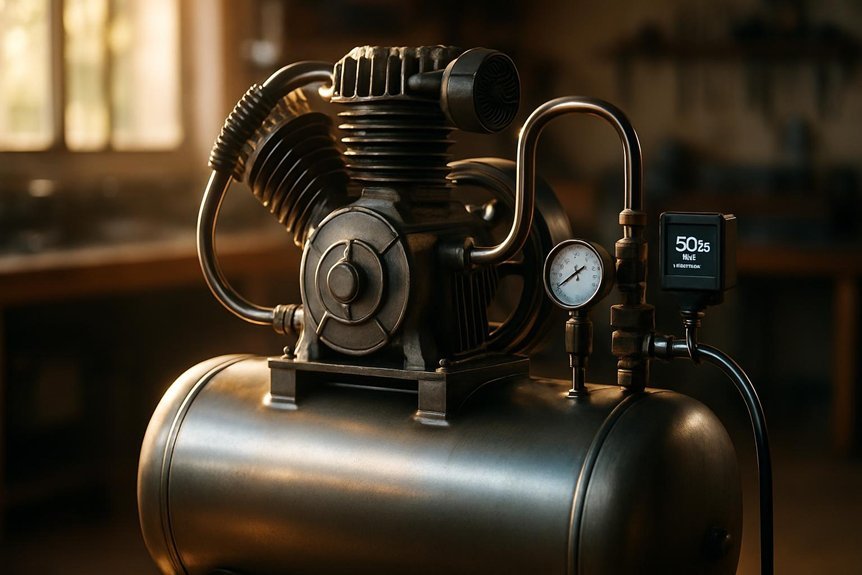
We’ll start by clarifying how to read duty cycles, focusing on the meaning of on, off, and cycle duration for long runs. We’ll translate those timings into practical expectations for continuous-duty components, including run time versus rest periods and cooling needs. From there, we’ll outline how to schedule long runs using the cycle data, referencing Reading Duty Cycles, Interpreting Run Timings, and Scheduling Long Runs.
Reading Duty Cycles
But how do you read a duty cycle for long runs with a stationary air compressor? We read duty by evaluating cycle duration and pressure targets during sustained use, focusing on how each on/off phase supports continuous demand without overheating. Our goal is to quantify thermal and electrical margins, not just the nominal ratio, to prevent premature wear.
- Assess temp rise and cooling intervals between on cycles to maintain steady performance.
- Compare run-time versus rest-time to ensure the compressor clears heat and recovers pressure.
- Track pressure fluctuations and motor load to confirm the system meets continuous demand without tripping.
Interpreting Run Timings
When evaluating duty cycles for continuous use, we start by translating the on/off timings into thermal and electrical margins. We then map these margins onto run timings to assess steady-state viability. Read the cycle in terms of exposure windows: active periods where compressor load is sustained, and rest windows for cooling and electrical recovery. We quantify peak temperatures, duty-factor limits, and voltage headroom to gauge continuous feasibility. Stationary considerations center on how marginal margins behave under variations in ambient conditions, inlet air, and load steadiness. We also compare cooling rate to heat accumulation, ensuring no runaway temperatures during extended runs. By interpreting run timings this way, we establish a clear boundary for continuous feasibility without compromising reliability or component life.
Scheduling Long Runs
Scheduling long runs requires a precise interpretation of duty cycles as they apply to extended operation. We communicate how to read duty cycles for sustained use, focusing on practical thresholds and measurement. Our approach emphasizes predictable behavior, component longevity, and safe margins during continuous performance. We outline how to align run time, cooldown intervals, and load factors to prevent overheating and excessive wear. Readers gain a framework for planning maintenance windows around duty-cycle limits and real-time monitoring. Key considerations include isolation strategies to minimize cross-system interference and vibration mitigation to reduce transient stresses on mountings and piping. Apply these principles to optimize reliability across extended runs.
- Determine continuous load versus rest periods based on manufacturer curves.
- Schedule regular cooldowns and inspections aligned with duty-cycle markers.
- Implement isolation strategies and vibration mitigation for longevity.
Key Cooling Factors for Continuous Operation
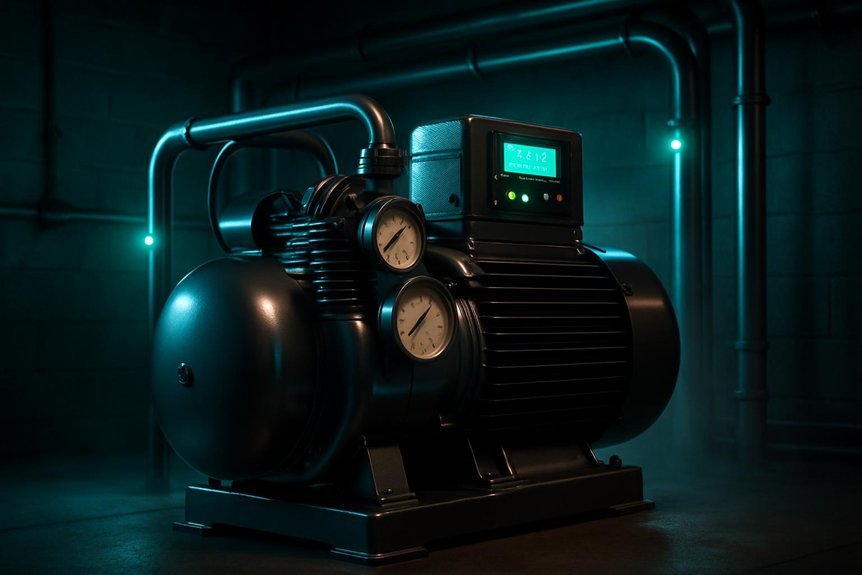
What are the key cooling factors that enable continuous operation of stationary air compressors, and how do they influence performance and reliability? We address cooling as a system feature, not a single component. Effective heat transfer hinges on (1) heat exchanger design and surface area, (2) airflow management through sufficient ventilation and ducting, (3) coolant or ambient air temperature control for jackets and intercoolers, and (4) load matching to prevent overheating spikes. Continuous operation relies on stable oil and component temperatures, minimizing thermal cycling that accelerates wear. Long term cooling is pivotal for sustained efficiency, while ambient considerations determine radiator or condenser effectiveness. We quantify allowable outlet temperatures and monitor real-time delta-T to avoid derating. Proper cooling preserves lubrication integrity, reduces parasitic losses, and extends service intervals.
Oil-Lubricated vs. Oil-Free: Pros, Cons, and Fit
We compare oil-lubed units for longevity with oil-free designs where maintenance tradeoffs matter. Oil-lubed systems offer longer service intervals but require regular oil management, while oil-free setups reduce routine upkeep at the cost of potential wear and filtration needs. We’ll outline how these tradeoffs influence fit for continuous use, guiding you to choose based on maintenance capacity and reliability goals.
Oil-Lubed Longevity Pros
Oil-lubed compressors typically outlast their oil-free counterparts under continuous use, thanks to better bearing support and smoother piston motion that reduce wear. We focus on oil lubricated longevity as a primary durability driver, with a predictable wear profile that supports long duty cycles. Below, we outline concise justifications for selecting oil-lubed designs when our goal is continuous use durability.
- Superior bearing life and reduced metal-to-metal contact under sustained loading.
- Steady lubrication minimizes frictional heat, preserving component geometry over time.
- Established maintenance cadence yields consistent performance and fewer unexpected surges.
This translates to steadier output, lower risk of failure during long runs, and clearer maintenance planning for industrial environments.
Oil-Free Maintenance Tradeoffs
Is the choice between oil-free and oil-lubed designs primarily about maintenance tradeoffs rather than initial cost or output? We argue that oil-free units minimize contamination risk and simplify servicing, but incur distinct maintenance frequencies and material wear patterns. Oil-free tradeoffs include higher piston ring and valve wear potential, and tighter tolerances demand stricter operating conditions. In contrast, oil-lubed designs offer extended component life with lower maintenance frequency, at the expense of periodic oil changes and filter servicing. We present a concise comparison below to aid fit decisions.
| Factor | Impact | Recommendation |
|---|---|---|
| Oil free tradeoffs | Lower contamination risk; higher wear risk | Suitable for clean-air needs, frequent monitoring |
| Maintenance frequency | More frequent inspections | Plan for scheduled checks |
| Noise/temperature | Comparable; oil presence can influence cooling | Consider ambient conditions |
| Filter life | Higher in oil-free | Schedule filter changes |
| Longevity | Oil-lubed typically longer | Align with duty cycle |
Motor Design and Thermal Management for All-Day Runs
How can a motor be engineered for all-day operation without overheating or efficiency loss? We address this by optimizing motor design and thermal management to sustain continuous duty. Our approach emphasizes low-loss materials, conservative insulation classes, and efficient cooling interfaces that minimize hotspot formation during extended runs.
1) Integrated cooling paths: channels, fins, and heat sinks engineered for uniform temperature distribution.
2) Thermal monitoring: sensors and control logic that modulate torque, duty cycle, and cooling response in real time.
3) Loss mitigation: optimized winding layouts, skew, and insulation.
We focus on motor design and thermal management to preserve efficiency and reliability, avoiding peak heat buildup. By combining robust materials with proactive cooling strategies, we ensure steady performance without degradation over all-day operations.
Size, Workload, and Maintenance: Building Your Plan
Sizing the system and planning for workload and maintenance starts with aligning capacity to expected duty cycles while preserving the methods we established for thermal robustness. We describe a plan that ties compressor selection to anticipated run hours, duty factor, and peak intermittent loads, ensuring headroom for surge events without compromising reliability. We define maintenance intervals based on runtime, vibration profiles, and lubricant life, documenting proof of compliance with service thresholds. We assess noise reduction strategies early, integrating enclosure design, mufflers, and intake filtration to minimize acoustic impact on environments with continuous operation. Portability concerns, though limited in stationary setups, guide installation layout, service accessibility, and modularity for future upgrades. Our approach prioritizes predictable performance, repeatable intervals, and traceable maintenance records.
Startup, Operation, and Real-Time Monitoring Practices
Startup, operation, and real-time monitoring practices must be executed with disciplined sequencing and immediate fault awareness; by following a defined start-up procedure, we guarantee safe energization, correct system pressures, and calibrated control loops from the first run. We emphasize repeatable, validated steps that minimize transient surge and avoid pressure fluctuations during ramp-up. Real-time alerts are configured to detect deviations within seconds, enabling prompt corrective actions and reducing wear.
Startup, operation, and monitoring demand disciplined sequencing, rapid fault awareness, and validated procedures from first energization.
- Establish startup strategies that prioritize controlled pressurization, verified by pre-run checks and sensor validation.
- Implement continuous operation controls with real-time alerts for pressure, temperature, and motor current.
- Conduct routine verification post-start to ensure stable output and capture anomalies before escalation.
Frequently Asked Questions
How Often Should I Service a Stationary Compressor Used Continuously?
We should service it every 6 months for continuous operation, adjusting with runtime. Our maintenance scheduling accounts for load and startup cycles, and we monitor component wear patterns to prevent failures and optimize reliability.
What Noise Levels Are Acceptable for All-Day Operation?
We answer: all-day operation demands quiet yet capable performance; noise levels should remain within acceptable thresholds, with a clear noise comparison to peers, while maintaining energy efficiency. We monitor vibration, enclosure, and load for sustained reliability.
Can a Portable Unit Handle Continuous Duty With Boosters?
Yes, a portable unit can handle continuous duty with boosters, but only when you balance continuous duty vs portability, ensuring adequate cooling and duty cycle, and using boosters for portable units to maintain steady performance and reliability.
What Safety Interlocks Protect Long-Running Compressors?
We implement interlock safety to protect long-running compressors, ensuring fail-safe shutoffs during faults for continuous duty. We monitor high temps, low oil, and pressure loss; guards trigger alarms and automatic shutdowns, preventing damage and unsafe operation.
Do Memory-Based Controls Reduce Wear During Continuous Runs?
Yes, memory driven controls can reduce wear during continuous runs. We’ve found that selecting algorithms optimizing duty cycle and thermal response lowers mechanical stress, mitigates frictional wear, and prolongs component life, delivering more reliable, efficient operation over time.
Conclusion
We’ve seen how stationary compressors suit continuous use when cooling, lubrication, and duty cycles align with the workload. It’s not magic—it’s design discipline. The coincidence is that environments demanding steady CFM, stable pressure, and long runtimes naturally push you toward oil-lubed systems with robust monitoring and proper enclosure. When you size, schedule, and maintain correctly, your all-day operation isn’t luck; it’s predictable performance arriving right on schedule.