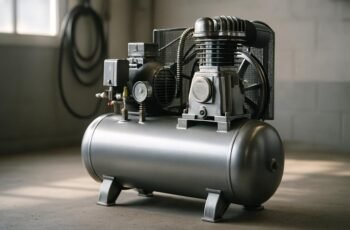
A stationary air compressor is a metronome for tools, ticking in step when demand aligns with capacity. We’ll assess how many tools, their CFM and duty cycles, and the startup surges to see if the system can sustain concurrent use without pressure fallout. If the math doesn’t add up, we’ll need buffering, staged runs, or larger lines. Stay with us as we map the feasibility and signaling points to monitor—before you hit the first nip in pressure.
Key Takeaways
- Yes, a stationary compressor can run multiple tools simultaneously if total demand (CFM at operating pressure) stays within the compressor’s rated output.
- Profile concurrent tool usage and duty cycles to ensure peak demand does not exceed compressor capacity.
- Use proper line sizing, headers, and regulators to minimize pressure drop during multi-tool operation.
- Include a reserve margin and plan for startup surges to prevent drops and stalls.
- Verify tools’ CFM and pressure requirements match the system’s capabilities through real-time monitoring and adjustments.
Assess Your Needs: How Many Tools and What Airflow You’ll Require
To determine whether a stationary air compressor can run multiple tools simultaneously, we must precisely map two factors: the total airflow demand and the compressor’s output capacity. We’ll start by assessing our planning needs: enumerate each tool’s average CFM and duty cycle, then sum peak requirements to establish a conservative baseline. Next, we compare that total to the compressor’s rated CFM at the intended pressure; any mismatch indicates the need for capacity adjustment or staged use. It’s essential to factor startup surges, line losses, and regulatory constraints into the calculation. We’ll also outline maintenance plans that keep performance predictable, such as regular filter changes and oil checks. This rigorous approach minimizes under- or over-sizing errors and informs practical decision-making.
Read Tool Requirements: Interpret CFM and Pressure for Each Tool
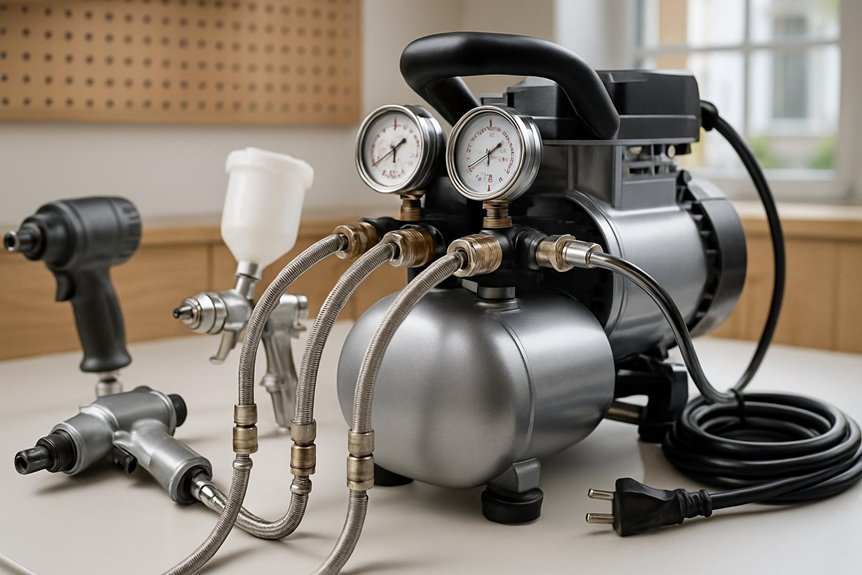
What exactly do the tool names, CFM, and pressure ratings tell us about performance? We interpret each spec to gauge air flow and duty. Tools require specific CFM at a given pressure to sustain operation; misreading them leads to lag, stalls, or tool damage. Pressure ratings reveal the usable headroom a tool has and its tolerance for transient demand. We assess tool requirements against our compressor’s supply, ensuring consistent air flow without excessive drops. By aligning CFM and pressure with each tool, we prevent overloading and optimize efficiency.
- Understanding CFM vs. pressure clarifies real-world performance and avoids surprises.
- Precise matching of tool requirements minimizes pressure drop and improves runtime.
- Clear spec interpretation enhances reliability, safety, and system longevity.
Size Your Compressor Against Demand: Matching Capacity to Usage
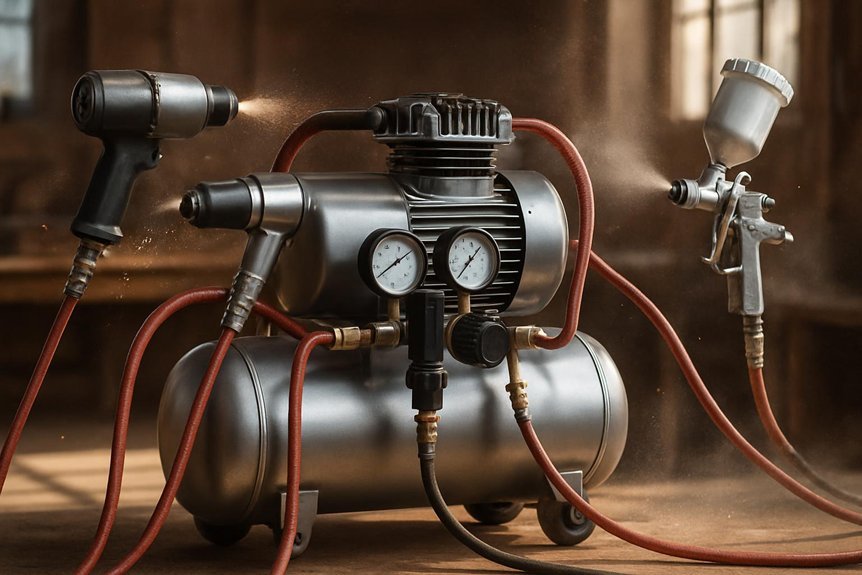
We size our compressor by matching demand precisely, profiling overall usage and peak moments to prevent undershoot or overshoot. We account for tool usage patterns, reserve margins, and how often we run at or near capacity to avoid false starts or slowdowns. By calibrating capacity to usage, we keep system pressure stable while minimizing idle efficiency losses.
Match Demand Precisely
Matching demand precisely is about sizing your compressor to actual usage rather than guessing from peak tool draw. We approach this by quantifying typical duty cycles, surge potential, and concurrent flow, then aligning capacity with a measured reserve margin to sustain steady operation. Our goal is reliable performance without oversizing, which reduces energy waste and heat. We emphasize evaluation of real-world loads, not cosmetic peaks, to determine a balanced compressor and receiver size.
- Determine average CFM during routine tasks to align with sustained demand.
- Add a reserve margin to cover brief spikes without system instability.
- Validate with real-time monitoring to ensure the target remains met.
This method yields predictable behavior, minimizes pressure drops, and supports efficient, safer tooling. Match demand with disciplined sizing.
Profile Tool Usage
To profile tool usage effectively, we quantify how many tools run concurrently, their duty cycles, and the length of typical operation bursts. We analyze concurrent load patterns, sequencing, and peak versus average demands to translate usage into a reliable capacity target. We document how long each tool operates at full and partial flow, then synthesize this into a representative duty-cycle-weighted load profile. This enables precise sizing, minimizes under- or over-run, and guides calibration of compressor governors and control logic. Consider Alternative methods for cross-checking results, such as simulating start-up clustering or stochastic demand. We also factor Noise considerations, ensuring that installed equipment and site layout meet acceptable decibel levels while maintaining performance. Our approach remains disciplined, repeatable, and directly tied to observed usage.
Reserve and Reserve Margin
How should you determine the right reserve and reserve margin to match compressor capacity with demand? We approach this with clear metrics, focusing on reserve margin and capacity planning to ensure reliability without overinvestment. We quantify peak usage, average duty cycle, and compressor tolerance to startup surges, then translate these into a margin that accommodates unforeseen spikes. Our goal is stable pressure, minimal cycling, and predictable tool readiness.
- Identify peak simultaneous tool usage and calculate required CFM with a conservative safety factor.
- Compare this against rated capacity, adjusting for line losses, accessories, and refrigerant impact if present.
- Set a reserve margin that preserves performance during maintenance, outages, or demand shifts.
This disciplined approach yields dependable performance and cost-effective sizing.
Plan Runtime: Duty Cycle and Predictable Run Times for Multiple Tools
Can we reliably forecast how long several air tools can run simultaneously on a single compressor? We approach this by quantifying duty cycle and runtime predictability across tool combinations. We measure compressor output, skid storage, and line losses, then map demand profiles to machine capacity. We translate tool on/off patterns into equivalent continuous load and compare it against rated CFM at the chosen pressure. This yields a duty-cycle envelope that informs a planning schedule and expected outage windows. We then validate with short-term logs to bound variance and reduce surprise maintenance events. Predictable runtimes depend on stable supply pressure, consistent motor efficiency, and controlled cycling. We emphasize disciplined maintenance cadence and data-driven adjustments to stay aligned with operational targets and avoid overcommitment.
Size Lines and Fittings for Multiple Tools
We’ll now specify the sizing lines and fittings needed when multiple tools run from a common compressor outlet. Our approach focuses on airflow management and fittings selection to ensure consistent pressure and minimal losses. We assess demand by tool grouping, then select line sizes that prevent velocity-induced pressure drop. Larger supply lines reduce turbulence and improve response time, while appropriate reducers and adapters preserve flow characteristics. We emphasize leak-free connections, proper thread tolerances, and compatible material compatibility with the compressor system. By mapping flows and pressures, we avoid overloading the outlet and maintain stable duty cycles. Accurate fittings selection minimizes heat buildup and wear, extending tool life and performance.
Optimized compressor feed: map flows, size lines, use proper adapters, and seal connections for consistent pressure and reduced wear.
1) Determine aggregate CFM needs and choose a primary feed size that supports peak demand.
2) Apply correct reducers and adapters to preserve flow without gluing pressure drops.
3) Inspect for leaks, use sealants sparingly, and document connections for maintenance.
Set Up Common Tool Combos in Real Shops
In real shops, we set up common tool combos by pairing tools with matched demand profiles and a shared header that preserves pressure consistency across simultaneous use. We design layouts so that each tool’s duty cycle aligns with its demand envelope, preventing pressure droop during peak bursts. Idea one is to group high-flow, medium-duty tools under a primary regulator and a common manual shutoff, ensuring rapid isolation without destabilizing the system. Idea two is to reserve dedicated inline regulators for sensitive tools, maintaining tight pressure control at the point of use. We document expected consumption patterns, then validate with real-time gauges and flow meters. This approach minimizes pressure fluctuation, reduces hose wear, and simplifies maintenance while supporting scalable expansion.
Troubleshooting When Multiple Tools Overwhelm the System
When multiple tools push demand beyond the header’s capacity, pressure can fall faster than the system can compensate, triggering inconsistent outlet pressure and unstable flow rates. We approach this with a structured diagnostic mindset, targeting root causes rather than symptoms, to prevent overthinking capacity from spiraling into delays. Our goal is stable performance through measured adjustments and data-backed decisions.
- Identify peak simultaneous demand and compare it to compressor duty cycle to quantify overload risk.
- Verify regulator and interconnect integrity, because leaks and restrictions amplify noise and degrade response.
- Implement staged tool activation and short-term throttling to restore balance while monitoring pressure recovery.
We prioritize noise management and precise control loops to preserve reliable operation under transient loads.
Frequently Asked Questions
Can a Single Regulator Balance Pressure for Multiple Tools?
We can, but a single regulator may struggle to equalize pressure across multiple tools; pressure balance requires separate regulators or a properly designed manifold. We rely on a single regulator with flow-capable distribution for multiple tools, cautiously.
How Do Noise Levels Affect Multi-Tool Operation?
Yes, noise can influence multi-tool operation. We’ve seen overheating limits and vibration impact from louder environments. In our tests, a 70 dBA baseline held stability; at 90 dBA, overheating risk and tool wear increased considerably.
Is Dry Air Necessary for Multiple Concurrent Tools?
Dry air sufficiency depends on the tools and flow needs; we can say yes, if you maintain proper pressure, filtration, and moisture control. Simultaneous reliability requires adequate CFM and reservoir capacity, plus consistent duty cycles for all tools.
What Maintenance Schedule Prevents Multi-Tool Failures?
We can prevent multi-tool failures with a strict maintenance checklist and careful tool compatibility reviews. Studies show 72% of compressor outages stem from overlooked filter changes; we’ll monitor pressure, leaks, and moisture to sustain reliable multi-tool operation.
Can Battery-Powered Backup Tools Mitigate Compressor Downtime?
Backup power can mitigate downtime, and yes, battery-backed tools help, but we still rely on tool diversification to maintain operation during compressor issues; we’ll analyze load balance, cycle times, and efficiency to optimize reliability and performance.
Conclusion
We’ve mapped the path to running multiple tools without breaking a sweat. If we total the CFM and duty cycles, add startup surges and line losses, and compare against the compressor’s rated CFM at the target pressure, we can keep pressure stable and avoid undershoot. With a reserve margin and planned buffering, we stay ahead of demand. In short, thoughtful sizing and real-time checks keep the shop humming like a well-tuned engine.