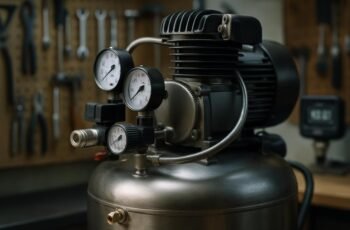
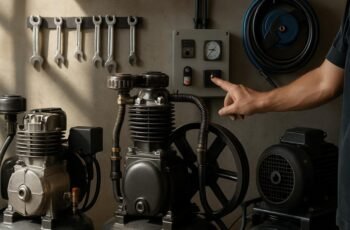
You might not realize that stationary air compressors do more than power a few tools—they provide a centralized, clean, dry air supply that supports entire processes. We rely on them for continuous operation, precise pressure control, and easy integration with dryers, filtration, and central utilities. They enable redundancy, monitoring, and fault isolation to improve uptime and safety. Curious how this translates to specific use cases and maintenance practices? Keep exploring how to match capacity, efficiency, and reliability to your production needs.
Key Takeaways
- Stationary air compressors provide a consistent, high-volume supply of compressed air to power multiple tools and processes simultaneously.
- They deliver reliable, regulated pressure with clean, dry air integrated into central filtration and drying networks.
- They support continuous production by prioritizing uptime, redundancy, and coordinated compressor sequencing.
- They enable energy-efficient, quiet operation through optimized airflow, sound-dampening enclosures, and vibration isolation.
- They are selected and integrated based on load profiles, duty cycles, and maintenance, ensuring scalable, predictable performance.
What a Stationary Compressor Is: and Why It Matters in Your Shop
A stationary compressor is a fixed, purpose-built air power unit designed to supply a consistent, high-volume stream of compressed air to a workshop. We define it by capability and reliability, not just size. In our shop, its role is to power multiple tools simultaneously, minimize setup changes, and maintain uptime under demanding workloads. The key value lies in predictable pressure, air quality, and energy efficiency over time. We prioritize quiet operation and noise reduction through design choices, such as sound-dampening enclosures, vibration isolation, and optimized airflow. By consolidating duties into a single, centralized unit, we reduce maintenance fragmentation and improve safety with controlled commissioning and shutdown procedures. This clarity helps us plan layout, utility needs, and future scalability with confidence.
How to Choose a Stationary Compressor by Application
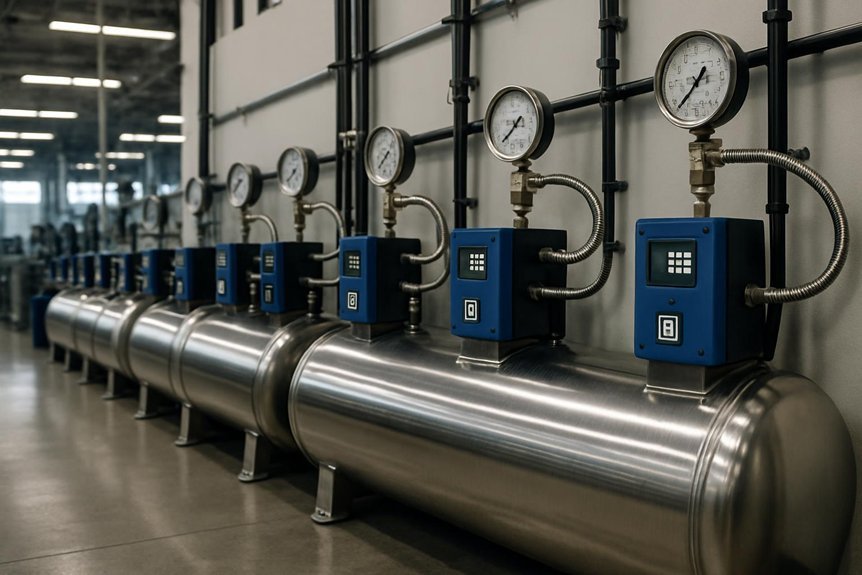
How do we pick the right stationary compressor for a given application? We start with load profile and duty cycle, then match capacity and pressure targets to deliver consistent performance. We assess continuous vs. intermittent use, storage needs, and integration with existing plant systems. Key selection factors include efficient filtration to protect downstream tools, moisture removal, and air quality requirements. We evaluate noise reduction strategies in confined spaces to maintain a safe, compliant work environment. Dynamic lubrication minimizes wear at variable speeds, extending compressor life and reducing maintenance. We quantify energy efficiency through motor efficiency, drive type, and system losses, then compare total cost of ownership. Finally, we verify serviceability, spare parts availability, and vendor support for long-term reliability.
Industrial Use Cases: What Stationary Compressors Power
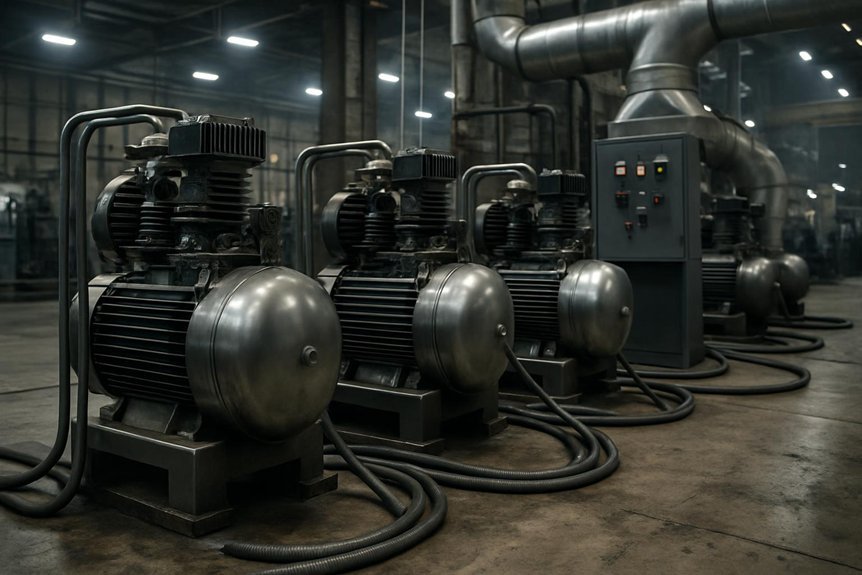
What do stationary compressors power across an industrial setting? We map their role by examining common, high-demand loads that rely on steady air supply. In our view, industrial power comes from reliable, regulated pressure for tools, automation actuators, and process equipment, reducing cycle times and improving uptime. Stationary units support facility integration by tying compressors to central air systems, dryers, and filtration networks, ensuring clean, dry air across floors and bays. We emphasize redundancy and compressor sequencing to maintain continuous operation during demand spikes. Typical use cases include manufacturing lines, pneumatic conveyance, coolant and spray systems, and robotics actuation. Our assessment prioritizes real-time monitoring, energy management, and fault isolation to sustain performance without sacrificing efficiency.
Performance Metrics and Maintenance for Reliability
We connect the industrial uses we outlined for stationary compressors to performance metrics and maintenance by focusing on reliability as the core objective. We monitor performance metrics to quantify efficiency, capacity, and response time, then align maintenance reliability with uptime goals. Our approach ties compressor health to production continuity, reducing unplanned downtime through systematic checks and data-driven interventions.
| Velocity/Pressure | Energy Use |
|---|---|
| Load Factor | Mean Time Between Failures |
We optimize lubrication, filter integrity, and cooling loops to sustain steady output. Predictive care uses vibration analysis and temperature trends to forecast faults before they halt operations. By prioritizing routine inspections and calibrated fault thresholds, we balance cost with reliability, ensuring consistent air supply and reduced operational risk.
Stationary vs. Portable: Which Fits Your Workflow
When deciding between stationary and portable air compressors, the choice hinges on workflow continuity, space constraints, and movability needs. We compare fit by usage pattern, not just capacity, to keep operations efficient and predictable.
1) Stationary options excel in sustained duty cycles and steadier pressure delivery, supporting continuous tooling.
2) Portable units offer flexibility for scattered tasks, quick relocation, and limited space setups.
3) Stationary air quality tends to be more consistent due to fixed intake paths, while noise considerations are more controllable with enclosure or mufflers.
4) Noise reduction strategies matter for both, but are often easier to implement in fixed installations without compromising output.
We assess needs against space, transferability, and tolerance for vibrations, balancing stationary air quality with process noise constraints.
Frequently Asked Questions
How Loud Is a Stationary Air Compressor in Typical Use?
We answer: typical use noise levels range 60–90 dB depending on model; we monitor vibration mitigation, humidity control, and safety clearances to ensure consistent performance and compliance in our setup.
Do Stationary Compressors Require Dedicated Electrical Circuits?
Yes, stationary compressors typically require dedicated circuits due to high current draws; we assess electrical requirements, breakered amperage, and voltage needs to ensure safe startup, continuous operation, and compliance with wiring codes for reliable performance.
Can Stationary Units Run Continuous 24/7 Without Overheating?
“Can stationary units run continuous 24/7 without overheating? In short, yes, with proper cooling and load management. We monitor stationary cooling closely, ensuring continuous operation within rated duty cycles and maintaining adequate ventilation for peak performance.”
What Maintenance Schedules Are Unique to Stationary Compressors?
Stationary compressors require tailored maintenance scheduling, focusing on filter changes, oil analysis, and belt/tan bolt checks; we monitor vibration management daily, calibrate sensors monthly, and perform annual OEM inspections to prevent unplanned downtime.
How Do You Relocate a Stationary Compressor Safely?
“Moving a stationary compressor requires caution.” We, readers, guide you: plan safe relocation with ground protection, disconnect power, secure hoses, drain fluids, lock wheels, use a dolly, and confirm level, then re‑attach and test before operation.
Conclusion
We’ve tested the theory that bigger is always better for reliability, and the truth is nuance matters. Stationary compressors deliver steady, high-volume air critical for continuous processes, but efficiency hinges on proper sizing, filtration, and maintenance. When demand spikes, redundancy and smart controls prevent downtime. In practice, align capacity with duty cycle, monitor performance, and schedule preventative care. The result isn’t just power—it’s predictable, available air that sustains production.