Refrigerated dryers cool air to condense moisture, then desiccate and filter it, while desiccant systems adsorb moisture and regenerate to ultra-low dew points; each path solves dryness in different ways. We’ll weigh cost, reliability, and dew-point targets to see which suits our process stability and budget. The choice isn’t obvious, and the trade-offs become clearer as we examine run costs, maintenance, and application sensitivity. Let’s consider where the line truly lies between practicality and performance.
Key Takeaways
- Refrigerated dryers cool air to condense moisture, then separate water and filter, offering lower upfront cost and simplicity for general humidity control.
- Desiccant dryers achieve ultra-dry air by adsorption with regeneration, delivering much lower dew points for sensitive processes.
- Typical targets: refrigerated −40 to −20 °C; desiccant −40 to −70 °C, with selection tied to condensate risk and maintenance cadence.
- Running costs: refrigerated have lower energy per unit air but may have higher compressor load; desiccant uses more energy but offers stable dew points.
- Total cost of ownership depends on upfront/setup costs, maintenance, energy use, and the required stability of humidity for the application.
Which Dryer Do You Really Need: Refrigerated or Desiccant?
Which dryer you actually need depends on your air quality requirements and system constraints. We evaluate refrigerated versus desiccant options by aligning target dew point, load variability, and start-up dynamics with installed capacity. Refrigerated dryers deliver reliable, low-cost dew point control at moderate flows, excelling in steady, moderate-purity applications. Desiccant systems excel where ultra-low dew points are essential, handling high moisture loads and rapid cycling with robustness. We weigh operational costs, maintenance intervals, and energy consumption, then consider footprint and integration complexity. Our assessment includes underdog efficiency trends, highlighting that smaller, well-tuned refrigerated units can outperform larger desiccants in steady states. Noise considerations also matter: quieter refrigerated models often suit shared spaces, whereas desiccants may require isolation. Informed selection hinges on balancing performance, economics, and environmental constraints.
How Refrigerated Dryers Work and What It Means for Your Air
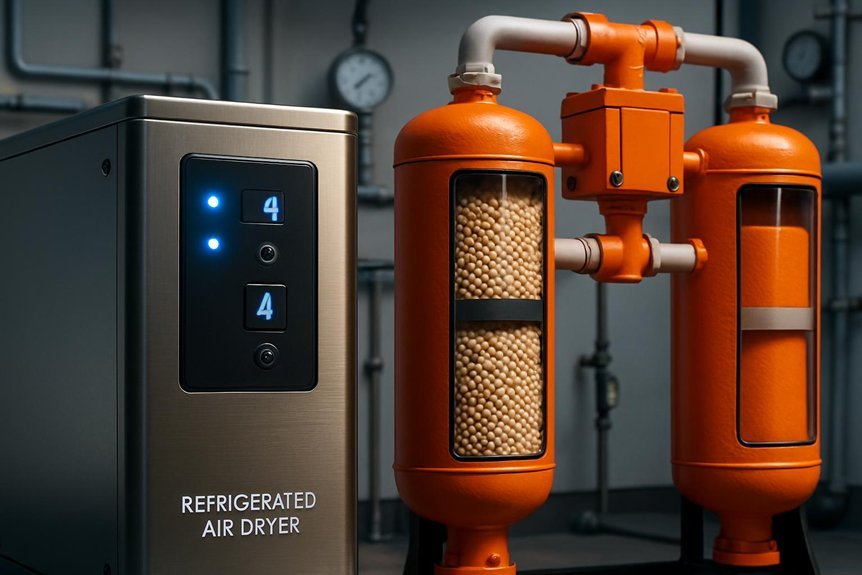
How do refrigerated air dryers shape the quality of your compressed air, and what does that mean for your system? We explain their operation succinctly: a heat-exchanger cools the air, causing moisture to condense, then a separator removes liquid water before a final outlet filter. The cycle repeats as the refrigerant-based cooler maintains a stable temperature, optimizing dryness without excessive energy Use. This setup directly impacts downstream tools, reducing corrosion, contamination, and downtime while improving regulator accuracy and reliability. We quantify benefits by energy balance and dew-point stability, linking cooling mechanisms to consistent air quality and process control. Sustained efficiency hinges on proper sizing, periodic maintenance, and accurate condensate handling.
Refrigerated dryers condense moisture, stabilizing dew point and boosting downstream tool reliability.
- Reduced moisture-related failures
- Consistent dew-point performance
- Lower operating costs through targeted cooling
How Desiccant Dryers Achieve Ultra-Dry Air and Dew Point
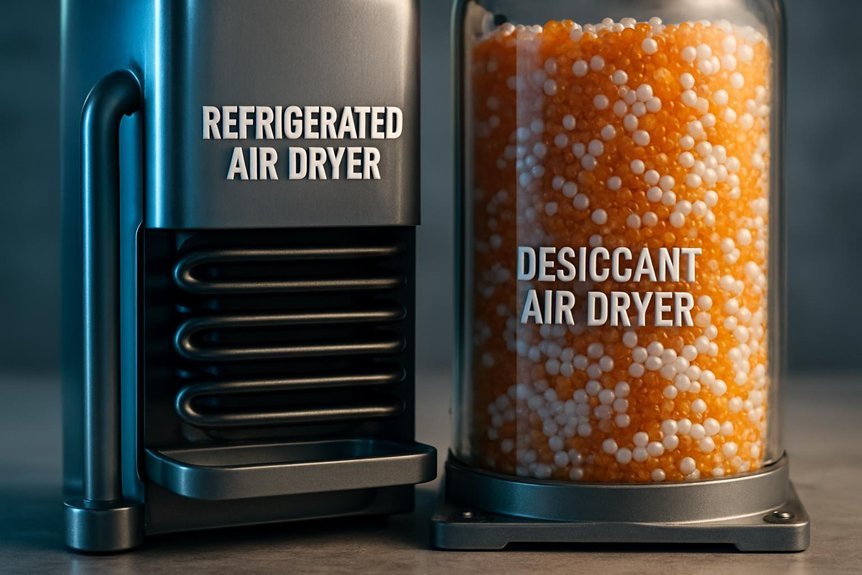
Desiccant dryers reach ultra-dry air by adsorbing moisture onto hygroscopic media and then regenerating that media to release the trapped water. We achieve this through a carefully controlled cycle: adsorption, purge or purge-regeneration, and re-pressurization. The media selection—typically a dual-bed or stacked alternative—is chosen for water affinity and heat tolerance, enabling rapid moisture uptake at ambient conditions and sustained performance under load. We monitor inlet and outlet conditions to ensure consistent dew point control, adjusting cycle times to balance drying efficiency with energy use. Our focus is on maintaining stable pressures and minimizing entrained oil or hydrocarbons that could impair adsorption sites. In practice, achieving ultra dry air relies on precise timing and reliable valve sequencing that preserves bed integrity and repeatable dew point targets. ultra dry air dew point control.
Dew Point Showdown: Typical Targets for Each Dryer Type
Dew point targets vary meaningfully between dryer types, and we focus on clear, comparable targets to guide system design and operation. We compare typical values to set expectations and avoid overdesign. In practice, refrigerated dryers target higher dew points, while desiccant units push lower, reflecting dehydration methods and material performance. Our goal is to balance reliability with energy penalties and retrofit feasibility, acknowledging process tolerance and load variability.
- Refrigerated targets common: -40 to -20 °C
- Desiccant targets common: -40 to -70 °C
- Selection influenced by condensate risk, maintenance cadence, and system footprint
We emphasize precise spec alignment with actual flow, pressure, and ambient conditions to minimize energy penalties while meeting required purity and uptime.
Running Costs and Energy Use: Refrigerated vs Desiccant
Refrigerated dryers typically incur lower upfront energy costs per unit of processed air but may rack up ongoing electricity use due to compressor load and cycling. We compare total running costs by accounting for plant duty cycles, ambient load, and demand charges, not just sticker prices. Desiccant dryers, while generally more energy-intensive during steady operation, can offer stability in dew point and reduced cycling, potentially lowering peak electricity in certain layouts. Energy efficiency hinges on compressor sizing, heat recovery, and control strategies, influencing annual kWh. Noise impact enters the equation where compressors and purge streams operate near personnel or sensitive equipment. We guide readers to quantify energy use per volume of dried air and to align dryer selection with production profiles, compressible air demand, and current energy pricing.
Maintenance and Lifespan: Servicing, Parts, and Downtime
Regular servicing hinges on keeping filtration, valves, and purge circuits clean and within spec, and we prioritize preventative schedules to minimize unexpected downtime. We assess maintenance schedules to optimize uptime and extend lifespan, balancing compressor load with desiccant bed cycles and refrigerated dryer filters. Spare parts availability drives recovery time, so we align stocking with failure modes and vendor lead times, reducing mean time to repair. Our approach is data-driven, documenting corrosion risks, seal wear, and valve seat degradation to forecast service intervals and avoid over-maintenance.
- Predictable downtime reductions through proactive checks
- Readily accessible spare parts minimizing repair delays
- Data-backed timing for valve, filter, and desiccant changes
Upfront Costs, Total Cost of Ownership, and Return on Investment
Upfront costs set the baseline, but total cost of ownership (TCO) and return on investment (ROI) reveal the true value of choosing a refrigerated versus desiccant air dryer. We quantify initial equipment prices, installation, and commissioning alongside energy usage, maintenance, and replacement parts over the system life. Desiccant dryers often incur higher energy and media costs, while refrigerated units may show lower upfront but require more frequent top-offs in humidity control scenarios. The following table frames cost dynamics clearly:
| Column A | Column B |
|---|---|
| Upfront costs | Long-term operating expenses |
| Initial installation | Annual maintenance and energy use |
ROI improves when reliability, downtime reduction, and energy parity align with application demands, guiding informed choices on upfront costs and long-term value.
Choosing Based on Use Case: General Manufacturing, Sensitive Processes, and Budget Constraints
Choosing the right dryer approach hinges on use case: general manufacturing tolerances, sensitive processes, and budget constraints. We frame decision threads around refrigeration metrics and desiccant logistics to match performance with needs, not hype. In general manufacturing, refrigerated systems excel at stable, cost-efficient dew point control and uncomplicated maintenance. For sensitive processes, desiccant dryers offer lower residual moisture and tighter tolerances, at the expense of energy and material handling. Budget constraints drive tradeoffs between capex, operating costs, and downtime risk, guiding a lean selection. Align your choice with production tolerance, contamination risk, and lifecycle costs.
- Stability vs. tightness: pick the balance that minimizes waste and rejects
- Energy vs. material handling: prioritize based on throughput and labor
- Maintenance cadence: ensure reliability within your facility cadence
Frequently Asked Questions
How Do Ambient Temperature and Humidity Affect Dryer Performance?
Ambient humidity raises load on the dryer, reducing effective dew point, while temperature impact alters adsorption or condensate capacity; higher ambient temps can ease cooling but worsen humidity effects, whereas cooler air improves moisture removal efficiency.
Can Hybrid or Dual-Drying Systems Exist?
Yes, we can do hybrid drying, combining desiccant and refrigerated stages for dual drying. We critique efficiency, control, and cost, describing how hybrid drying negotiates dewpoint targets while balancing energy use and system complexity for readers like you.
What Maintenance Pitfalls Reduce Dryer Efficiency?
We practice proactive maintenance, avoiding common maintenance pitfalls that reduce dryer efficiency. Regular filter changes, moisture trap checks, and pressure/temperature monitoring keep performance stable, minimize leaks, and sustain dryer efficiency through accurate diagnostics and timely component replacements.
Which Indicators Signal Dryer Replacement Vs Repair?
We’ll know to replace when reliability indicators worsen beyond repair, not just repairable faults; replace if failure risk spikes or maintenance costs exceed cost implications, and we assess reliability indicators against cost implications before deciding.
How Do Mineral Deposits Impact Desiccant Performance?
Mineral deposits reduce desiccant efficiency by blocking flow paths and accelerating degradation; mineral buildup can cause uneven drying, while desiccant degradation lowers moisture removal capacity, increasing pressure drop and energy use. We monitor, mitigate, and replace as needed.
Conclusion
We’ve weighed the winnowed will of refrigerated and desiccant dryers, and we’ve winnowed what works. In short, choose chilled reliability for budget-conscious basics with steady dew points, and lean into desiccant for ultra-pure processes demanding persistent dryness. Consider costs, contamination tolerance, and downtime risks. We’ll weigh performance, maintenance, and ROI in tandem with your application. For dependable data and decisive direction, decide decisively: match method to must, and margins will multiply.