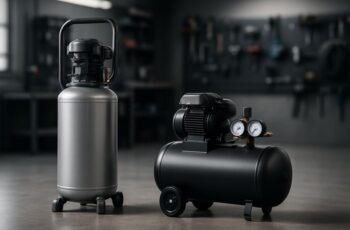
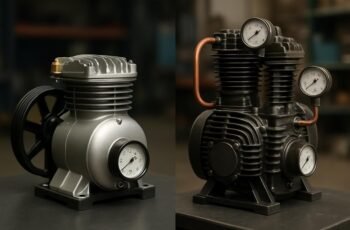
Like a well-tuned instrument, our workshop layout hinges on whether a vertical or horizontal compressor fits best. We’ll weigh footprint, service access, and maintenance against airflow needs, noise, and future expansion. Each design brings trade-offs in stability, hose routing, and front-facing access. The decision sets up how we’ll organize tools, doors, and ventilation. Before committing, we must map our space and workflow, then compare practical implications—the next considerations will steer us toward the optimal choice.
Key Takeaways
- Vertical designs save floor space but require stable mounting and overhead clearance for maintenance and access.
- Horizontal compressors ease service panels and layout planning, at the expense of a broader footprint and potential floor vibration.
- Tank size impacts cycling, heat rejection, and stability; larger tanks reduce cycling but add weight and mounting demands.
- Align layout with workflow: quick access, predictable paths, and adequate clearances for hoses, controls, and maintenance.
- Balance noise, vibration, and durability with use-case: vertical for tight spaces, horizontal for movable or modular shop layouts.
How a Vertical vs. Horizontal Compressor Fits Your Workshop Space
The choice between vertical and horizontal compressors directly impacts how you allocate shop space and how you access the unit for maintenance. We evaluate footprint, clearance, and future reorganization needs to determine space optimization. Vertical models save floor space but require overhead room and stable mounting, while horizontals spread laterally, simplifying layout planning and accessibility for service panels. In practice, we compare ceiling height constraints, door widths, and existing benches to forecast movement of air hoses and tools. We also consider exhaust routing, vibration isolation, and maintenance access from a working position. Toy examples help illustrate scenarios: a compact garage fits a tall, narrow unit; a wide, open shop accommodates a low-profile horizontal setup. Overall, alignment with workflow and future expansion drives selection.
What You Gain and Lose: Layout Implications for Each Design
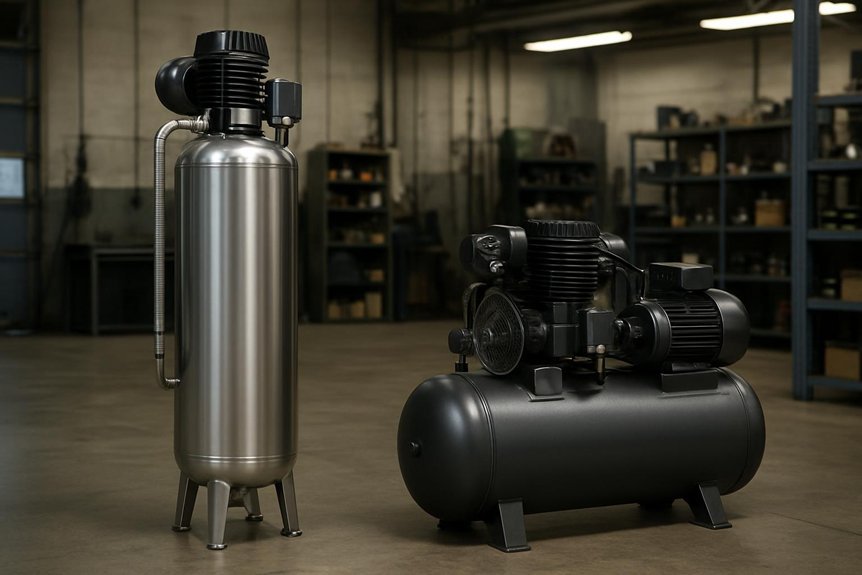
What do you gain and lose when layout constraints shape your compressor choice? We weigh how vertical orientation and horizontal footprint steer workspace flow, tool access, and safety margins. Our analysis remains concise: each design trades reach for footprint, and velocity of setup for long-term maintainability. We balance proximity to power, piping, and noise sensitivity with the need for clear aisle space and material handling. In one path, stacking components saves floor area but complicates service access; in the other, a sprawling footprint preserves visibility and reach but constrains shop circulation. We favor predictable, repeatable layouts that minimize trip hazards and enable quick relocation if needed.
- Impact of vertical orientation on accessibility and serviceability
- Effects of horizontal footprint on aisle width and tool arrangement
- Interaction between layout rigidity and future reconfiguration
How Tank Size Impacts Duty Cycle and Performance
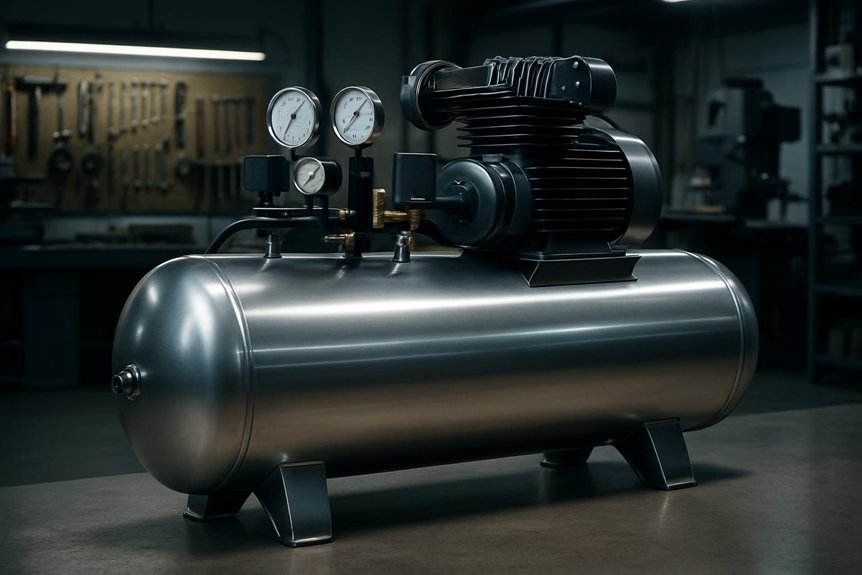
How does tank size dictate the duty cycle and overall performance of a compressor system? We, as engineers, examine(storage capacity) to smooth delivery and extend run-time between cycles. Larger tanks reduce cycling frequency, stabilizing pressure, but add inertia, slower response to demand spikes, and heavier startup loads. Smaller tanks improve responsiveness yet increase compressor cycling and energy use. Vertical considerations and horizontal airflow shape heat rejection and cooling efficiency, influencing motor temperature rise and duty cycle limits.
| Tank size (gal) | Expected duty cycle impact | Performance notes |
|---|---|---|
| 20 | High cycling; frequent starts | Compact footprint; quick heat buildup |
| 40 | Moderate cycling | Balanced run-time and heat management |
| 80 | Low cycling | Best for sustained use; bulkier system |
| 120 | Minimal cycling | Maximum storage; slow response to fast demand |
| 180 | Rare cycling | Industrial-scale stability; weight concerns |
Matching Air Demand: CFM, PSI, and Tool Load Considerations
To match air demand, we must translate tool performance into system requirements by analyzing CFM, PSI, and load profiles. We align discharge characteristics with compressor stage and receiver sizing, ensuring stable pressure and sufficient flow during peak loads. We evaluate whether vertical efficiency or horizontal footprint best preserves performance without overprovisioning. Our aim is to balance demand timing, duty cycle, and line losses so pressure remains within target windows for all tools.
To align tool demand with system capacity, optimize CFM bursts, PSI stability, and layout for scalable efficiency.
- Map CFM bursts to receiver size and compressor speed to sustain steady PSI under peak loads.
- Quantify tool load profiles to avoid mismatches between transient demands and compressor response.
- Assess layout implications on vertical efficiency and horizontal footprint for serviceability and future expansion.
Noise, Vibration, and Durability Across Verticals and Horizontals
Noise, vibration, and durability are critical when choosing between vertical and horizontal compressors. We assess how design geometry impacts sound signature, resonance pathways, and component fatigue, then compare practical implications for workspace comfort and uptime. Verticals typically exhibit lower footprint and centralized mass, which can reduce vibration transmission to surrounding structures, yet chrome-plated fasteners and pipework must be scrutinized for looseness over time. Horizontals often distribute mass more evenly along a chassis, potentially increasing harmonic consistency and stability on concrete floors, but may transmit more floor-borne noise unless isolation is properly implemented. In our view, vertical efficiency matters for compact shops, while horizontal mobility matters for repositioning during workflow shifts. Durability derives from belt drive alignment, cooling efficiency, and access to serviceable parts.
Choosing Based on Use Case: Inflation, Impact Tools, and Airbrushing
When choosing between vertical and horizontal compressors, match the form factor to your use case: inflation, impact tools, and airbrushing each demand different performance priorities. We assess three use-case-driven dimensions to guide selection and optimization.
1) Inflation efficiency: prioritize steady, low-pressure delivery with minimal cycle times to reduce hose sag and tank cycling. 2) Impact tools: demand rapid pressure rise, high CFM bursts, and tool compatibility across accessory standards. 3) Airbrushing: emphasize stable pressure, clean air, and consistent flow to minimize overspray and finish defects.
We balance tank size, duty cycle, and regulator accuracy to achieve reliable performance. In practice, verticals suit compact spaces with modest inflation needs, horizontals excel at higher demand phases, and both require compatible fittings for optimal tool compatibility.
Budget and Maintenance: Long-Term Costs for Each Configuration
How do long-term costs differ between vertical and horizontal compressors, and what maintenance keeps them economical? We break costs into purchase, reliability, energy, and service intervals. Both configurations share core components: pump, motor, tank, and pressure switch, but vertical units often optimize footprint, reducing space costs and improving accessibility for maintenance. Horizontal units may offer longer axle-to-tan k layout for service clarity, potentially easing part swaps. Over time, energy consumption matters: efficient motors and better cooling lower operating hours, while fewer start-stop cycles reduce wear. Maintenance schedules hinge on air filters, moisture traps, and tank inspections; neglect raises corrosion risk and downtime. Consider vertical logistics for space-constrained shops and horizontal ergonomics for easier access to components. Regular scrutiny preserves performance and lowers total cost of ownership.
Setup Tips: Placement, Hose Routing, and Stability for Both Designs
We’ll start by outlining optimal placement, considering floor space, accessibility, and safety clearances for both vertical and horizontal units. Next, we’ll cover hose routing strategies that minimize pressure loss and tangling while keeping outlets reachable and organized. Finally, we’ll examine stability and support needs, including mounting options, vibration isolation, and load distribution to prevent movement during operation.
Placement Considerations
Where should you place a compressor for reliable operation and minimal disruption? We evaluate space, safety, and access, prioritizing stable support and easy service. In vertical orientation setups, we favor corners with solid flooring and minimal vibration transfer. For horizontal footprint models, we seek low-clearance walls and organized ventilation to avoid heat buildup. Across both designs, we emphasize level mounting, cable management, and proximity to power outlets without overreaching hoses. Placement choices impact noise, debris exposure, and maintenance cadence, so we align position with workflow zones and tool accessibility. Consider these factors to optimize performance and safety, regardless of orientation.
- Stability priority: level base, vibration isolation, and anchored mounting when needed.
- Ventilation planning: avoid recirculating heat, maintain airflow, and reduce dust ingress.
- Proximity logic: balance power access with hose routing efficiency and workcell layout.
Hose Routing Tips
Is the path of the hose shaping your workflow as much as the machine itself? We approach hose routing with a focus on efficiency and reliability. Our guidance emphasizes minimal friction and consistent airflow, which means planned paths and clean bends. For both designs, we map routes to avoid pinch points and unnecessary elevation changes. We consider vertical clearance to prevent interference with operators and moving components, preserving safe access and maintenance. We prefer short, direct runs with gentle curves rather than sharp angles that compromise pressure and response. Secure supports keep hoses aligned and prevent sagging, while proper brackets limit vibration. We evaluate routing near control panels to prevent accidental disconnections and heat sources that reduce hose life. In summary, deliberate hose routing enhances performance and durability.
Stability and Support
Stability and support are built into both designs by prioritizing solid placement and reliable hose management. We assess each configuration’s footprint, weight distribution, and anchoring needs to minimize vibration and drift during operation. Vertical stability relies on a low center of gravity, sturdy top mounting, and integrated anti-tip measures, while horizontal support demands reinforced bases, edge guards, and secure fasteners. Proper hose routing reduces pull forces that could loosen connections or shift the unit. We prioritize accessible controls and clear spacing for maintenance, ensuring consistent load paths and reduced stress on fittings. This approach preserves performance and safety across setups, regardless of orientation, by balancing mechanical rigidity with operational practicality.
- Verify anchoring and weight distribution for long-term stability
- Route hoses to minimize torque and pull, with strain relief
- Confirm levelness and vibration damping for both vertical stability and horizontal support
Quick Decision Framework: Decide Between Vertical or Horizontal in 5 Steps
We’ll compare vertical and horizontal options through the lens of primary use and footprint, then assess maintenance and access implications for each design. This quick framework helps you weigh how space needs and service access influence long‑term reliability and uptime. By focusing on these two points, we’ll outline a concise decision path you can apply in 5 steps.
Primary Use Footprint
When evaluating footprint for vertical versus horizontal compressors, we start with the practical constraints: site space, clearance for service access, and mounting options. We assess how each orientation impacts workflow, safety, and future expansion, emphasizing a data-driven read on space efficiency. Our goal is a defensible footprint choice that minimizes wasted area while preserving accessibility and vibration isolation.
- Compare vertical footprint versus horizontal footprint to quantify occupied envelope and adjacen t requirements.
- Evaluate service clearances and access paths, ensuring routine maintenance remains practical.
- Consider confinement, mounting stiffness, and floor loading to support long-term reliability.
This framework yields a clear, actionable choice, aligned with shop layout goals and maintenance feasibility, without overestimating benefits or drawbacks.
Maintenance And Access
Maintenance and access drive our quick decision framework: we compare vertical versus horizontal orientations in five steps to ensure routine service remains straightforward and downtime is minimized. We begin by evaluating vertical clearance: a vertical unit can reduce floor clutter but demands taller service access for filters and gauges. In contrast, a horizontal footprint often occupies more floor space yet simplifies front-facing maintenance points and belt or pulley checks. Next, consider serviceability: modular components, accessible panels, and drain valves should be reachable without disassembly. Alignment and vibration isolation impact fastener integrity over time, so we favor designs with documented torque specs and robust mounts. Finally, accessibility for routine draining, oil changes, and filter swaps determines maintenance cadence. Overall, balance vertical clearance with horizontal footprint to optimize uptime.
Frequently Asked Questions
Do Vertical and Horizontal Compressors Affect Floor Space Differently Long-Term?
We say yes: vertical and horizontal compressors differ in vertical efficiency and horizontal footprint, impacting maneuverability considerations, maintenance access, and heat dissipation; durability concerns and ventilation requirements also vary, while noise footprint and maintenance access influence long-term floor space.
Which Design Handles Mobile Shop Setups Better?
We believe vertical designs suit mobile workspaces best due to easy rolling and stackable footers, improving mobile workflow; horizontal units offer steadier platforms but reduce portability. Portability benefit favors vertical layouts for flexible, on-site, rapid deployment.
Do Height and Reach Impact Accessibility for Maintenance Tasks?
Height accessibility and reach maintenance do impact our ability to service gear; we see obstacles rise with reduced clearance and longer reaches. We’ll quantify limits, optimize placement, and design guards to keep maintenance efficient and safe.
Are There Safety Concerns Unique to Each Orientation?
Yes, there are safety concerns unique to each orientation, particularly around orientation stability. We should assess vibration, tipping risk, and component access, ensuring secure mounting and stable placement to minimize maintenance hazards for either vertical or horizontal setups.
How Do Vibration Feet Influence Lifespan and Stability?
Vibration feet influence lifespan by reducing resonance and transmitted stress, while improving stability during operation. They also affect maintenance accessibility, as stable bases ease component checks and servicing. Our assessment: proper foot design minimizes vibration impact and simplifies maintenance.
Conclusion
We’ve explored how vertical and horizontal compressors fit, perform, and endure in workshop environments. By weighing footprint, serviceability, and airflow needs, you can map your space to the unit that minimizes hassles and maximizes uptime. Think of the choice like matching shoes to terrain: secure, steady footing matters more than style. In short, pick the design that best balances accessibility, maintenance, and expansion potential to keep tools running smoothly.