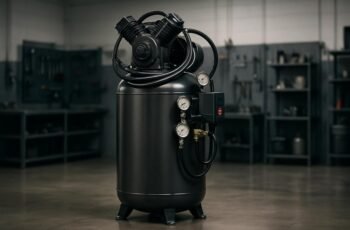
We compare vertical and horizontal air compressor tanks with a measured, methodical approach, weighing footprint, maintenance access, and vibration risk against stability and service practicality. We’ll map how orientation affects space use, drainage, and tool flow, then balance capacity with layout constraints. The choice isn’t universal, and the decision hinges on your shop’s layout and routines. There are concrete tradeoffs to contemplate before you decide which orientation to deploy next.
Key Takeaways
- Vertical tanks save floor space and fit tighter shops by stacking the reservoir height, freeing up aisle and workstation area.
- Horizontal tanks offer easier handling, broader stability, and more accessible drain valves and fittings in low-ceiling areas.
- Vertical orientation typically suits tall compressors and vertical drain access; horizontal suits wide, short footprints with simpler service access.
- Mounting and vibration control differ: vertical tanks concentrate weight higher, requiring solid anchoring; horizontal tanks distribute load along the base.
- Orientation influences piping, draining, and maintenance routes, impacting ease of drainage, valve access, and hose management.
What Defines Vertical vs Horizontal Tanks
Vertical and horizontal air compressor tanks are defined by their orientation and mounting arrangement. We examine how the tank’s orientation—vertical orientation or horizontal orientation—determines geometry, mounting points, and space needs. In practice, vertical tanks stand tall with a narrow footprint, often favoring vertical headers and bottom drains for gravity-assisted drainage. Horizontal tanks lie longwise, distributing stress along the length and simplifying mounting to walls or frames. We assess how mounting arrangement influences accessibility, vibration response, and service clearances. We consider internal baffles, valve placement, and drain positioning relative to orientation. Our focus remains on physical definitions, not operational trade-offs beyond setup. By defining orientation and mounting together, we clarify why a unit is categorized as vertical orientation or horizontal orientation.
Space, Mobility, and Layout Considerations
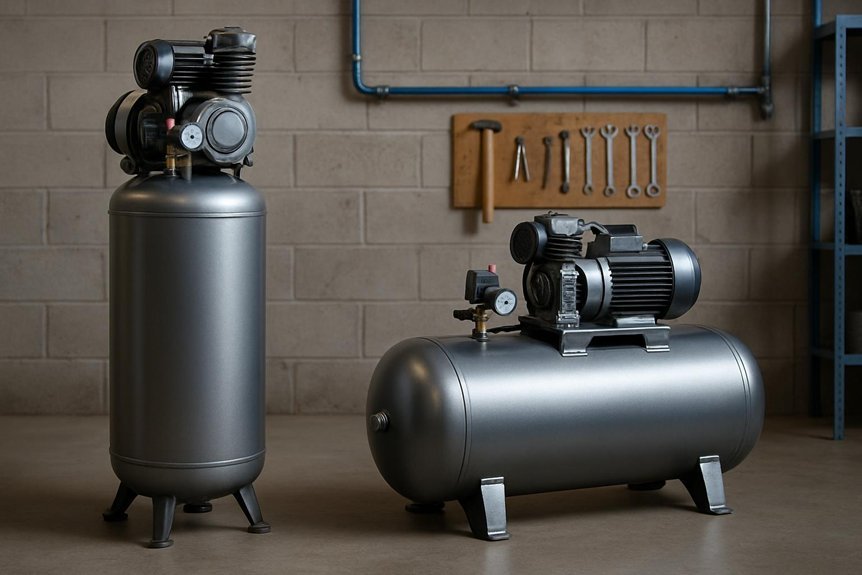
Space, mobility, and layout considerations hinge on how a tank’s orientation and mounting affect footprint, access, and pathing for workflows. We compare vertical and horizontal tanks to reveal how space optimization and portability constraints shape placement decisions, service access, and aisle clearance. Orientation influences the ease of moving units through doors, mounting on carts, and aligning with power or hose reels. We prioritize stable mounting, minimizing vibration transfer, and preserving room for future upgrades. Our approach remains data-driven and procedural, avoiding fluff and ambiguity.
Footprint, access, and aisle planning hinge on tank orientation and mounting.
- Footprint impact on shop floor planning
- Accessibility for routine maintenance and drain services
- Aisle width and door clearance requirements
- Mounting options that reduce vibration
- Transportability within facility constraints
Capacity and Lift Height: How It Impacts Your Day
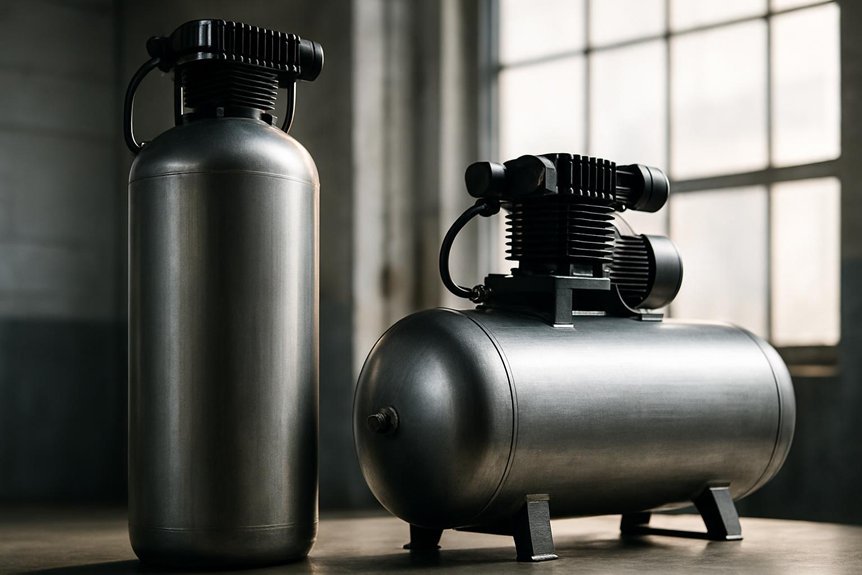
How do capacity and lift height shape our daily operations with a compressor tank? We assess how capacity influences run-time, recovery, and idle periods, while lift height dictates accessibility and hose management. Our capacity analysis quantifies air reserve versus demand, guiding cycling frequency and storage strategy. Lift height impact emerges in reach, mounting choices, and serviceability; higher tanks reduce footprint but demand careful routing. We balance startup surge, continuous duty, and tool timing for predictable workflow. In practice, we map demand curves to tank volume and outlet pressure, selecting targets that minimize unload cycles and pressure drops. The table below visualizes related factors, aiding quick decisions during setup and maintenance.
| Factor | Implication |
|---|---|
| Capacity | Run-time, recovery, idle periods |
| Lift height | Accessibility, routing, serviceability |
Stability, Vibration, and Floor Surface Impacts
Stability, vibration, and floor surface impacts directly influence compressor performance and longevity, so we evaluate mounting options, footing, and isolation measures as a routine part of setup. We compare vertical and horizontal tanks by how weight distribution, frame stiffness, and mounting integrity affect operational stability, aiming to minimize resonance and dynamic load transfer. We address stability concerns through measured guidance, ensuring foundations meet vibration mitigation needs and that pads and isolators align with usage. Our approach stays precise, data-driven, and repeatable, focusing on predictable behavior under cycling pressures and ambient conditions. By documenting surface conditions and shim requirements, we reduce setup variability and extend service life.
- Assess floor flatness and load-bearing capacity
- Select vibration isolation pads and compliant mounts
- Verify torque and alignment of mounting hardware
- Plan for rigid, vibration-aware threading and fasteners
- Record stability checks and pass/fail criteria
Access, Maintenance, and Tool Loading Workflow
To guarantee reliable access, maintenance, and tool loading, we outline a repeatable workflow that minimizes downtime and injury risk. We begin with spatial mapping: identify service points, clearance, and vertical integration opportunities to consolidate tasks into contiguous zones. Next, categorize operations by ergonomics, prioritizing horizontal ergonomics to reduce reaching, twisting, and overhead strain. Access routes should be defined for routine inspections, filter changes, and pressure relief tests, with standardized hand tools stored at reachable heights. Maintenance cadence is synchronized with compressor cycle patterns, ensuring minimal disruption to runtime. We document step sequence, safety checks, and tool inventories, enabling quick recovery from faults. Finally, we review workflow metrics, adjust layouts, and train technicians to uphold consistent, low-risk loading and servicing.
Cost, Availability, and Long-Term Value
What are the true costs, availability trends, and long-term value drivers behind vertical versus horizontal air compressor tanks, and how should these factors guide procurement and lifecycle planning? We analyze total ownership costs, including purchase, installation, space, and potential retrofits, and compare long-run performance and resale value. Availability trends show supplier breadth, lead times, and common model variants, shaping planning buffers. We assess durability, maintenance needs, and compatibility with downstream equipment to establish a clear cost comparison. Our approach prioritizes data, not guesswork, so decisions reflect objective pressure-test results and total-life costs. By aligning tank orientation with site constraints, we optimize return on investment, reliability, and lifecycle value.
- cost comparison
- availability trends
- upfront vs. long-term costs
- lead times and parts availability
- lifecycle value and resale potential
Noise, Heat, and Environmental Footprint by Orientation
Where does orientation matter most when evaluating noise, heat, and environmental footprint for vertical versus horizontal air compressor tanks? We analyze enclosure acoustics, airflow, and surface-area coupling to ambient conditions. Vertical tanks often trap heat near the top, affecting temperature impact differently than horizontal layouts, where extended surfaces can dissipate heat more evenly. Noise reduction depends on mounting, enclosure, and vibration paths, with horizontal configurations sometimes yielding steadier sound profiles in shared spaces. Environmental footprint tracks material use, transport, and lifecycle, where size and volume influence efficiency and teardown.
| Column 1 | Column 2 |
|---|---|
| Noise comparison | Temperature impact |
| Vibration paths | Thermal dissipation |
Best Use Cases: When Vertical Shines and When Horizontal Excels
Vertical tanks excel in space-constrained installations and applications demanding high center-of-gravity stability, while horizontal tanks shine in environments prioritizing average heat dissipation and modular layout. We analyze use cases by aligning form with function, emphasizing vertical efficiency and horizontal balance to guide selection.
- Space-limited shops where footprint matters more than height
- High-duty cycles needing stable vertical buildup under load
- Modular layouts requiring stackable or stack-adjacent configurations
- Environments with consistent heat removal and easy access for service
- Flexible retrofits where components align with horizontal layouts
Measuring Your Shop: A Quick Orientation Fit Checklist
Are you laying out space efficiently? We measure the shop with a focused orientation, mapping functions before form. Our quick fit checklist prioritizes clear sightlines, accessible outlets, and safe clearance, so both vertical capacity and horizontal mobility are preserved. We assess footprint, doorways, and aisle width, then confirm ceiling height for vertical stacks and venting paths. Our method yields repeatable checks, not guesswork.
| Area/Factor | Action Item |
|---|---|
| Floor plan | Sketch scale layout with zones |
| Doorways | Ensure wide access for equipment |
| Aisles | Maintain clearance for movement |
| Vents/obstructions | Note airflow paths and hazards |
| Clearances | Measure around mounted units |
This disciplined approach keeps the setup precise, enabling efficient space use and predictable performance.
Practical Setup Tips for Vertical and Horizontal Tanks
To set up tanks effectively, we start with a disciplined placement plan that matches each tank’s orientation to your shop layout. We focus on access, stability, and air line efficiency, ensuring compact routing and portable mounting options. Vertical and horizontal variants demand distinct clearances and mounting strategies, but share a measured approach: secure anchoring, slope-free bases, and space for maintenance. We prioritize minimized pipe runs, ergonomic valve access, and easy drainage. For vertical tanks, we optimize top-side outlet positioning and vertical clearance. For horizontal tanks, we emphasize end-access ports and horizontal alignment to reduce bending stress. Consistency in installation, labeling, and testing yields reliable performance and safer operation.
Consistent, secure tank layouts optimize access, stability, and maintenance.
- Assess clearance and mounting surfaces
- Plan compact routing for minimal bends
- Choose portable mounting where mobility matters
- Align outlets with least-stress paths
- Verify drainage and valve access before testing
Frequently Asked Questions
How Do Vertical and Horizontal Tanks Affect Air Quality Ratings?
We’d say vertical and horizontal tanks don’t inherently change air quality ratings; the impact comes from filtration, moisture separation, and maintenance. air quality impact hinges on environmental considerations like contaminants, filtration efficiency, and system integrity we monitor closely.
Can Tank Orientation Influence OSHA Compliance and Clearance Rules?
Yes, orientation can influence OSHA compliance and clearance rules. We evaluate Orientation considerations for mounting and access, ensuring adequate space and venting, while Maintenance routines confirm seal integrity, drain accessibility, and hazard minimization during inspections and servicing.
Do Vertical Tanks Require Different Mounting Hardware Than Horizontal Ones?
We say yes: vertical tanks often need different mounting options and anti vibration accessories, but many commons—bolts, vibration pads, brackets—translate to horizontal setups too; careful attention to weight distribution and manufacturer guidelines assure proper, compliant installation.
Are There Inherent Safety Risks Unique to Each Orientation?
Yes, there aren’t inherent safety risks unique to orientation, but vertical safety emphasizes weight distribution and falling hazards, while horizontal mounting focuses on stable footing and vibration control. We prioritize secure assemblies and routine inspections for both.
Which Tank Orientation Offers Easier Future Upgrades or Adds-Ons?
We believe the vertical orientation offers easier future upgradeability and add-on compatibility due to easier access and modular spacing, though loudness considerations and vibration damping must be addressed for both designs during implementation.
Conclusion
We’ve weighed vertical and horizontal tanks with precision, clear criteria, and careful logic. We’ve considered footprint, access, stability, maintenance, and workflow, then mapped these factors to real shop needs. We’ve embraced a methodical approach, not a guess, and kept options concrete. We’ve shown how orientation aligns with space, noise, heat, and environmental realities. We’ve offered a practical fit framework, a concise checklist, and setup tips. We’ve given you a decisive, repeatable path to the right choice.