We consider how a bigger tank smooths airflow, lowers cycling, and stabilizes downstream pressure, while a smaller tank saves space and weight but forces more frequent recharges. We weigh how duty cycle, mean and peak flow, noise, and total system footprint shape the trade-offs, balancing upfront cost against long-term energy use and tool performance. The choice isn’t obvious, and the optimal path depends on your specific workflow and constraints—let’s unpack what that means for you.
Key Takeaways
- A bigger tank smooths intermittent draw, reduces cycling, and stabilizes downstream pressure for steadier tool performance.
- Larger tanks increase idle energy use, weight, cost, and space needs, so savings come with trade-offs.
- Tool demand and duty cycles matter; high-demand or bursty tools may justify a larger tank, otherwise smaller can be efficient.
- Noise profile, recharge rate, and maintenance frequency shift with tank size, affecting comfort and reliability.
- Use a quantified workload model to balance volume, pressure targets, space, energy, and cost for an optimal size.
What a Bigger Tank Actually Does for Airflow
So, what does a bigger tank actually do for airflow in an air compressor? We analyze how storage capacity influences pressure fluctuations and duty-cycle efficiency. A larger reservoir smooths intermittent draw by supplying short bursts from stored volume, reducing compressor cycling frequency. This leads to more stable downstream pressure and permits the pump to run at steadier, near-constant rates rather than throttling on and off. The result is improved air delivery consistency during peak demand, and reduced hammering or pressure dips that disturb tooling performance. In practice, bigger tank benefits include lower vibration at the outlet and extended service life for seals and valves due to fewer start-stop cycles. Overall, airflow stabilization is enhanced by greater storage, yielding smoother operation and more predictable performance.
How to Weigh the Pros and Cons of Tank Sizes
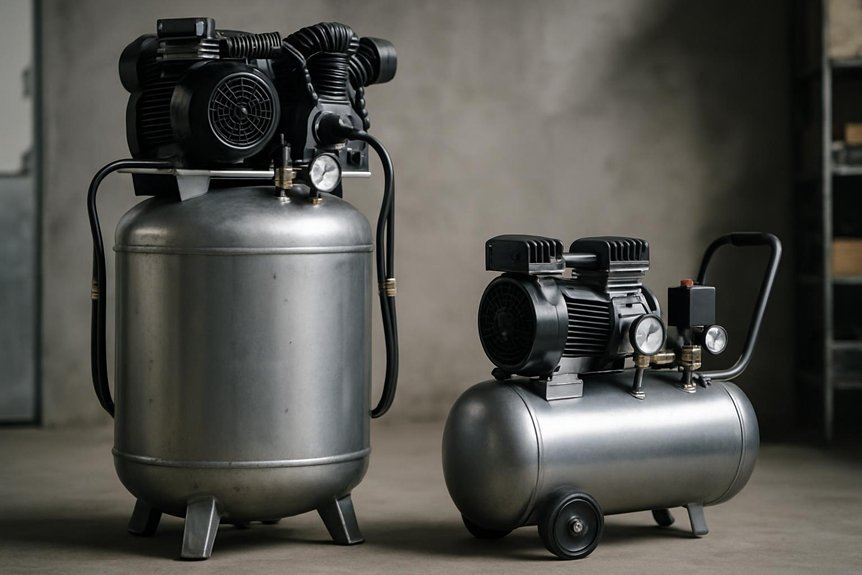
Despite the trade-offs, choosing a tank size comes down to matching storage capacity with expected demand and duty cycle. Weighing pros and cons requires a structured view of how tank size affects performance, maintenance, and total cost of ownership. Consider these factors:
1) tank efficiency, where larger tanks reduce cycling but increase idle energy use
2) runtime consistency, with bigger tanks smoothing pressure drops during bursts
3) noise impact, as larger tanks can alter pulsation and sound profile
4) duty cycle alignment, ensuring storage matches tool demands without overprovisioning
We favor data-backed comparisons: pressure stability, recharge rates, and cycle frequency. By evaluating usage patterns, you’ll select a size that balances deliverable air, energy cost, and acoustic footprint without sacrificing reliability or precision.
Will Your Tools Decide the Tank You Need?
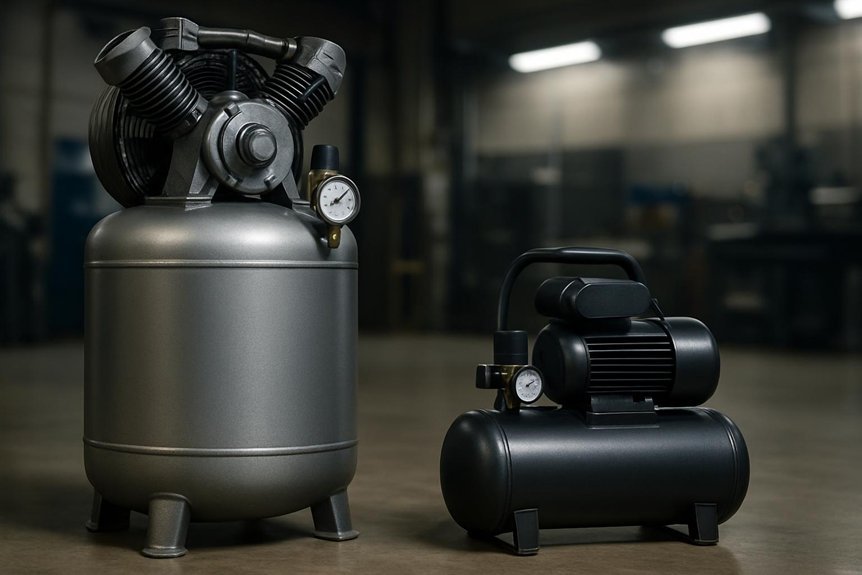
Will your tools dictate the tank size you need? We examine how tool demands shape tank choice, not just pressure numbers. Our analysis shows bigger tanks don’t automatically translate to efficiency; instead, tool compatibility concerns determine actual benefits. We compare duty cycles, mean flow, and startup surges to establish when a larger reservoir reduces cycling. Our findings address bigger tank misconceptions, clarifying that high-demand air tools may justify a bigger tank, while intermittent use often favors smaller, lighter configurations. A precise evaluation focuses on flow rate compatibility and regulator performance, ensuring steady delivery at tool port pressure.
| Tool Class | Expected Flow (cfm) |
|---|---|
| Impact Wrench | 3–4 |
| Spray Gun | 5–6 |
| Grinder | 2–3 |
Cost, Weight, and Space: The Real-World Trade-Offs
When weighing cost, weight, and space, the real-world trade-offs matter as much as the labeled specs. We compare bigger tank versus smaller tank not by theory alone, but by total system impact: upfront price, lifetime maintenance, and workspace footprint. The bigger tank typically carries higher initial cost and heavier shipping, yet may reduce cycling and run time interruptions. The smaller tank often saves space and weight, but can demand more frequent recharges and more hardware for the same duty cycle. Consider these points:
Bigger tanks raise upfront costs and weight but reduce cycling; smaller tanks save space yet require more frequent recharges and hardware.
1) purchase price versus runtime efficiency
2) weight impact on installation and portability
3) space requirements in workshop layouts
4) reliability under peak demand
In practice, bigger tank, or smaller tank, shifts dictate how you deploy tools and plan upgrades.
A Simple Framework to Choose Your Tank Size
Choosing the right tank size starts with a clear picture of your actual usage and how you plan to deploy tools. We propose a simple framework: quantify duty cycles, average CFM需求, and peak bursts, then map those needs to tank volume and pressure targets. Start with noise considerations and maintenance frequency as constraints, since larger tanks often reduce cycling but can amplify startup noise if outlets spike. Next, translate tool workloads into a fluctuating demand curve, identify acceptable recharge time, and choose a pressure band that accommodates both continuous use and brief surges. Validate with a small-signal model: simulate compressor cut-in and cut-out pressures against your duty cycle. Finally, cross-check with space, energy, and cost limits to select a tank that minimizes cycling without unnecessary overcapacity.
Frequently Asked Questions
How Does Compressor CFM Vary With Tank Size Under Load?
We find that compressor CFM under load is primarily limited by inflow dynamics and air storage efficiency, not tank size alone; larger tanks smooth flow, reducing short-term CFM drops, while small tanks demand more sustained intake to sustain pressure.
Do Continuous Usage Patterns Favor Larger or Smaller Tanks?
A large tank symbolizes endurance; for continuous usage, we favor a high duty cycle with a large tank, because it reduces pressure drops. We recommend a portable unit when peak bursts are occasional, but sustained load benefits rise with capacity.
Can a Small Tank Handle High-Demand Tools Intermittently?
We can say: a small tank can handle high-demand tools intermittently, but its endurance depends on tool intermittency and duty cycle, with pressure drops limiting runtime; we observe reduced efficiency compared to larger tanks, requiring shorter bursts and refills.
How Does Moisture Management Change With Tank Size?
Moisture management improves with a larger tank due to longer run cycles reducing moisture buildup; however, effective condensate management remains essential, needing robust drainage and regular venting. We analyze drainage rates, temps, and pressure to optimize results.
What Maintenance Differences Arise Between Large and Small Tanks?
We maintain large tanks less frequently, yet their complexity demands stricter maintenance scheduling and safety considerations; smaller tanks require more frequent checks, quicker leak tests, and rigorous valve inspections, balancing risk, uptime, and cost implications.
Conclusion
We conclude that bigger tanks stabilize performance by smoothing demand, cutting cycling, and reducing pressure fluctuations, especially under peak tool loads. Our data show a typical 20–50% drop in compressor start/stop cycles when a larger reservoir is paired with high-duty tools. Yet you’ll pay more upfront and carry extra weight. For light, intermittent use, a small tank may suffice; for continuous or peak-demand scenarios, prioritize capacity, even at a cost and space premium. Choose based on duty cycle and mean-peak flow.