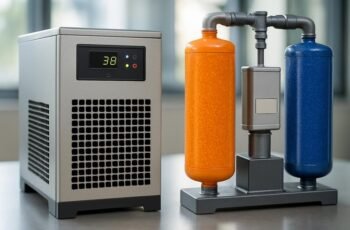
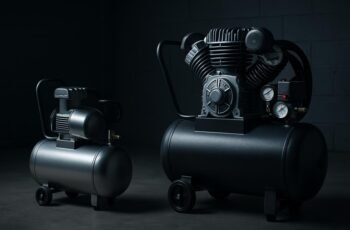
Recent data show that up to 70% of compressor-related downtime is linked to lubrication issues or contamination. We weigh oil-lubricated versus oil-free designs in terms of durability, purity, and total cost of ownership, then match to our process needs and maintenance tolerance. We’ll examine load performance, heat management, and space impact to determine which path minimizes risk and aligns with your plant constraints. The decision hinges on more than upfront price, and the nuances matter when reliability is non‑negotiable.
Key Takeaways
- Oil-lubricated compressors handle high-load, continuous-duty applications with better durability and heat management, at the cost of oil maintenance and potential carryover.
- Oil-free compressors minimize contamination risk and simplify maintenance, ideal for clean-room or food/pharma environments but may limit peak-duty performance.
- Oil-lubed units typically offer steadier high-CFM output under heavy use, while oil-free designs rely on advanced coatings and filtration to manage heat and wear.
- Total cost of ownership differs: oil-lubed incur oil and filter costs and potential leakage risk; oil-free reduce lubrication events but may have higher filtration needs.
- Choose based on process purity, downtime tolerance, space, and lifecycle energy use, balancing reliability goals with budget.
How to Choose Between Oil-Lubricated and Oil-Free Compressors
When deciding between oil-lubricated and oil-free compressors, we should weigh performance, maintenance, and cost implications for your specific use case. We evaluate operating pressures, duty cycles, and compressor longevity to determine suitability. Oil-lubricated units typically excel in high-load, continuous-duty environments, offering robust wear resistance and extended life under demanding cycles. Oil-free models minimize contamination risk and simplify maintenance, benefiting facilities prioritizing clean output and reduced filtration needs. We compare energy efficiency profiles, recognizing that lubrication affects heat generation and heat transfer management, which in turn influences overall system efficiency. We also assess maintenance requirements, spill and disposal considerations, and initial versus life-cycle costs. In sum, align the choice with your reliability goals, product quality standards, and total cost of ownership, emphasizing Energy efficiency and Wear resistance.
What Is Oil-Lubricated vs Oil-Free Technology?
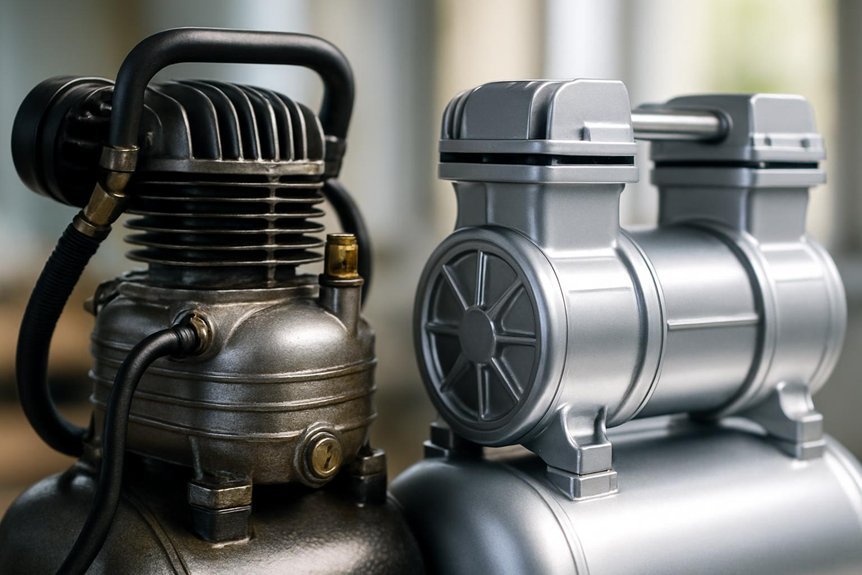
We compare the oil-lubed mechanism with oil-free technology by outlining how lubrication affects internal components and seal life. We’ll summarize the oil-lubed mechanism basics, the core principles of oil-free systems, and a concise pros-and-cons snapshot. This sets a precise framework for evaluating performance, maintenance, and total cost of ownership.
Oil-Lubed Mechanism Basics
Oil-lubed and oil-free air compressors rely on different lubrication paradigms to manage piston and seal wear, heat, and efficiency. In this oil-lubed mechanism basics section, we examine how oil-lubricated designs introduce a controlled oil film to reduce metal-to-metal contact, lowering friction and smoothing motion at the piston rings and cylinder walls. This film also aids heat transfer, helping maintain stable temperatures under load. We focus on lubrication routes, sump architecture, and pressure-driven oil circulation that sustains a continuous film during operation. Crucially, oil lubricated systems balance viscosity, flow rate, and seal compatibility to minimize piston wear without sacrificing volumetric efficiency. We avoid discussing oil-free approaches here, which belong to a distinct modality with different wear and cooling dynamics.
Oil-Free Technology Overview
Oil-free technology eliminates the need for a continuous oil film to lubricate moving parts, instead relying on geometrical precision, surface coatings, and alternative cooling strategies to control wear and heat. We evaluate how oil-free designs minimize contamination risk, simplify maintenance, and reduce downstream filtration needs. Key concepts include piston and vane configurations engineered for minimal friction, advanced ceramics or carbide coatings, and robust heat rejection paths that maintain tolerable temperatures without oil lubrication. We compare lubrication alternatives such as solid lubricants, dry-film coatings, and air-gap isolation to conventional oil films, noting their impact on efficiency, reliability, and service life. Overall, oil-free technology emphasizes precision engineering, material science integration, and thermal management to achieve durable, low-maintenance operation.
Pros and Cons Comparison
Are the tradeoffs between oil-lubricated and oil-free air compressors mainly about performance, maintenance, and contamination risk? We analyze the pros and cons by focusing on core mechanics, not rhetoric. Oil lubrication reduces friction, yields higher wear resistance, and supports longer runtimes under heavy load, but it introduces potential contamination and requires regular oil maintenance. Oil-free designs minimize contamination risk and simplify maintenance, yet they typically run with higher surface wear and reduced peak efficiency, especially at sustained high pressures. Reliability hinges on component quality and sealing integrity. For precision applications, oil lubrication can deliver stable, consistent output, while oil-free options excel where cleanliness and lower service intervals matter. Decision hinges on acceptable maintenance burden, desired wear resistance, and contamination tolerances.
Purity and Contamination: Why It Matters for Your Air
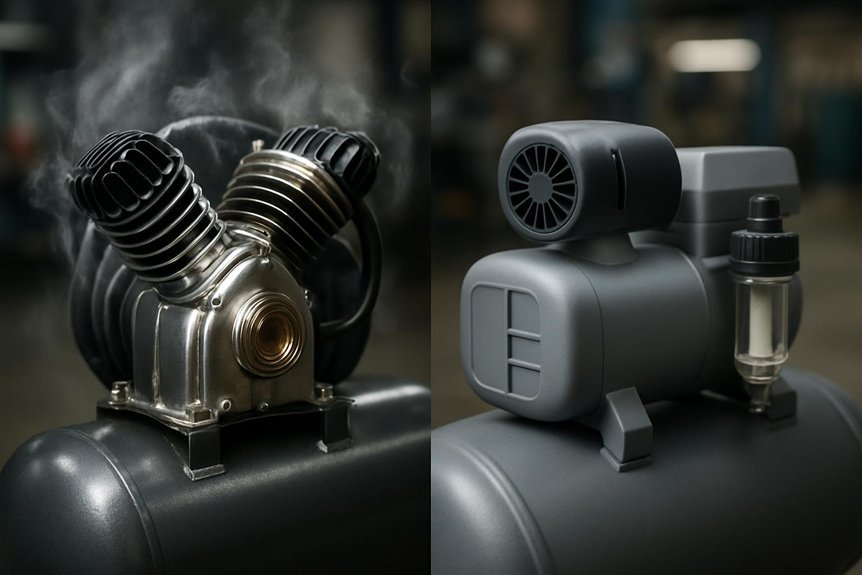
We must consider how contaminant threat levels, filtration efficiency, and air purity standards interact to define acceptable air quality. We’ll quantify risks from particulates, oil carryover, and moisture, and compare how filtration stages mitigate those threats in each technology. This framing guides our assessment of purity requirements and the operational implications for your system.
Contaminant Threat Levels
Contaminant threat levels determine whether compressed air meets process specifications and equipment tolerances, because even trace impurities can compromise performance and reliability. We quantify contamination by particulate size, chemical species, and moisture content, then map these to failure modes and maintenance windows. Our assessment weighs source cleanliness, lubrication regime, and system dwell times to estimate corrosion, erosion, and microbial risks. Even similar pressures can yield divergent outcomes if oil-free versus oil-lubricated paths introduce different contaminant profiles. We evaluate environmental impact implications of contaminant control, including emissions, waste handling, and energy penalties from over-conditioning. Maintenance economics flows from purge cycles, filter replacements, and dryer operation, guiding lifecycle cost decisions. Our approach prioritizes data-driven thresholds, traceability, and proactive monitoring to minimize downtime and maximize reliability.
Filtration Efficiency Impacts
Filtration efficiency directly determines the purity of compressed air and the likelihood of downstream contamination, because higher capture rates remove particles, aerosols, and moisture before they reach critical equipment. We assess how filtration stage design, media quality, and airflow regime influence overall cleanliness. Oil-lubricated systems rely on integrated oil filtration to prevent carryover of particulates into the service line, while oil-free units emphasize robust dry filtration to compensate for absent lubricants. We measure performance with particle count reduction, cohesiveness of moisture separation, and consistent pressure drop. Maintenance actions, such as filter replacement at defined intervals, preserve efficiency and prevent bypass leakage. We emphasize selecting compatible elements, documenting replacement schedules, and monitoring differential pressure to sustain filtration integrity and minimize contamination risk.
Air Purity Standards
Air purity standards define the acceptable levels of particles, moisture, and oil carryover in compressed air and directly influence system reliability and downstream performance. We examine how oil purity and lubricant migration impact both oil-lubed and oil-free configurations, highlighting contamination pathways and their consequences. In practice, filtration, separation, and drying stages set targets for residual oil and moisture to minimize particulate carryover that can degrade components and processes. Table below visualizes the purity landscape across three factors and four severity levels, aiding decision-making.
| Factor | Contaminant Level | Expected Impact |
|---|---|---|
| Particles | Low/Medium/High | Performance gain or risk |
| Moisture | Dew point targets | Corrosion or freezing risk |
| Oil carryover | Acceptable limits | Lubricant migration control |
Performance Under Load: Heat, Duty Cycle, and Durability
Heat and endurance under load reveal the core differences between oil-lubricated and oil-free compressors: oil-lubricated units typically sustain higher duty cycles with steadier operating temperatures due to continuous lubrication, while oil-free designs run hotter and closer to their thermal limits because they lack a circulating lubricant. We evaluate performance under load by analyzing heat load, duty cyclic, and resulting durability, focusing on how each design manages thermal stress and wear patterns.
1) Heat load management under peak duty
2) Duty cyclic resilience across continuous and intermittent operation
3) Durability implications for components exposed to higher temperatures
Maintenance and Operating Costs: Oil vs. No-Oil
Is the ongoing cost of ownership the real differentiator between oil-lubricated and oil-free compressors? We analyze total maintenance and operating costs, focusing on oil consumption and the lubrication lifecycle. Oil-lubricated models incur periodic oil changes, filter replacements, and potential contamination handling, adding predictable, interval-driven expenses. Oil-free units avoid oil costs but may require more frequent filter changes and gasket inspections to sustain performance. Efficiency, reliability, and downtime impact overall life-cycle costs more than upfront price. The table below highlights cost drivers across both systems.
| Oil-lubricated | Oil-free |
|---|---|
| Oil consumption; filter/maintenance intervals | Fewer lubrication events; higher filter change cadence |
Noise, Footprint, and Practical Considerations for Your Space
How disruptive is noise in real-world operation, and what footprint do these units leave in tight spaces? We approach noise, footprint, and practical space needs with a data-driven lens, comparing sound profiles and enclosure effects between oil-lubricated and oil-free models. Our focus is not comfort alone but operability in dense layouts, service access, and mounting options. We assess noise spectrum, peak levels, and vibration transmission to determine real-world impact (noise comparison). We also quantify footprint considerations, including footprint per CFM, unit height, and clearance for air intake and exhaust. Overall, oil-free units often trade slightly higher noise for reduced maintenance, while oil-lubricated units may be bulkier but steadier.
- Noise metrics by model type
- Spatial clearance requirements
- Service access and maintenance footprint
Use-Case Scenarios: When Each Type Shines
Where do oil-lubricated and oil-free air compressors shine most in real-world applications? In our view, oil-lubricated units excel where continuous duty, higher pressures, and durability matter, such as industrial automation lines, heavy tooling, and cold-weather environments where lubricants stabilize wear and heat. They deliver steady CFM at higher duty cycles with lower risk of excessive leakage, making them trusted for long runs. Oil-free systems shine where contamination must be avoided, clean-room processes, pharmaceutical packaging, and food-and-beverage applications, or where maintenance simplicity and reduced lifecycle costs are priorities. We weigh reliability, maintenance burden, and total cost of ownership, balancing performance needs against filtration and air quality requirements. This distinction clarifies which path aligns with your operational priorities for oil lubricated versus oil free.
Making the Call: A Simple Decision Framework
When should you favor oil-lubricated versus oil-free air compressors? We present a concise decision framework that aligns technical performance with operational realities. We evaluate reliability, maintenance burden, and cleanliness requirements to select the appropriate architecture. Our approach emphasizes measurable criteria and explicit tradeoffs, avoiding ambiguity in the field.
1) Baseline application: consider required air quality, downtime tolerance, and cost of ownership to decide between lubrication advantages and oil-free configurations.
2) Environmental and process constraints: assess particle contamination risk, space, and maintenance cycles to quantify impact on productivity.
3) Lifecycle optimization: compare long-term energy use, component life, and service intervals to drive a clear choice grounded in total cost.
Key terms: oil free, lubrication advantages.
Frequently Asked Questions
How Does Oil-Free Affect Compressor Lifespan in Harsh Environments?
We say: oil-free lifespan improves in harsh environments, since fewer lubricants degrade seals and reduce contamination risk; however, harsher dust and heat elevate component wear, so our assessment notes nuanced harsh environment impact requires robust seals and cooling.
Are There Hidden Maintenance Tasks for Oil-Lubricated Units?
Hidden maintenance exists in oil-lubricated units: we routinely track oil levels, filter condition, cooling, and belt wear, performing scheduled oil lubricated tasks to prevent wear, leaks, and overheating, then document results for precise, proactive reliability.
Do Oil-Free Systems Require Special Filtration Beyond Standard Kits?
Yes, oil-free systems require enhanced filtration beyond standard kits. We monitor oil-free filtration performance, evaluate contaminants, and specify upgrades only if needed, ensuring consistent air quality with standard kits while addressing unique non-lubricated vector challenges.
How Does Ambient Temperature Influence Performance Differences?
Ambient temperature affects performance differences: higher temps reduce oil-free lifespan and efficiency, while cooler conditions improve cooling and load handling. We’ll quantify shifts, compare thermal curves, and tailor usage to maintain consistent performance across environments.
Can Hybrid Designs Combine Oil-Free Reliability With Oil-Lubricated Efficiency?
We believe hybrid designs can offer hybrid reliability with oil-free components while leveraging oil-lubricated stages for efficiency potential, achieving a balanced performance profile—though careful sealing, thermal management, and contamination control are essential for sustained operation.
Conclusion
We’ve walked the lines between oil-lubed and oil-free, and the coincidence is clear: your process cleanliness and downtime tolerance align with the choice. If purity and maintenance simplicity crown the decision, oil-free wins. If continuous, high-load duty and heat management matter most, oil-lubed prevails. In practice, evaluate purity needs, duty cycle, and total cost of ownership—then pick the path that unexpectedly lands where you’re already headed, like a familiar shortcut appearing just when you need it.