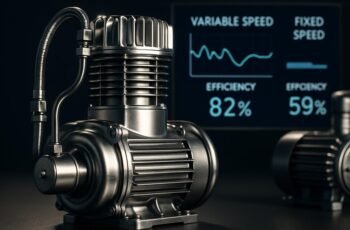
We should question whether a single formula fits all compressing tasks: do rotary screw and reciprocating machines truly serve the same duty cycles or do their strengths lie in distinct profiles? We’ll compare steady, high-volume flow against high-peak, low-cycle bursts with attention to cost of ownership, maintenance, and control integration. The nuances in lubrication, seals, and part life matter, yet the right choice hinges on your specific demand pattern. Let’s weigh the tradeoffs as we consider best-fit scenarios.
Key Takeaways
- Rotary screws provide smoother, higher CFM at steady speeds, with continuous compression and typically lower vibration than reciprocating units.
- Reciprocating compressors deliver higher peak pressures and handle intermittent loads, but with pulsating flow and greater wear-prone components.
- Screw machines excel in continuous, moderate pressures and efficiency; reciprocating units are favorable for short, burst-demand tasks and lower upfront cost.
- Maintenance differs: screws emphasize oil management and seal integrity; reciprocating units focus on piston rings, valves, and crankcase parts.
- Total cost of ownership favors screws for steady demand due to energy and maintenance savings, while reciprocating units can be cheaper initially for variable or low-duty needs.
What Are Rotary Screw and Reciprocating Compressors?
Rotary screw and reciprocating compressors are two foundational types of positive-displacement machines used to generate compressed air. We analyze their core distinctions for clarity. In rotary compressors, continuous meshing screws trap and move air, delivering smooth, high-volume flow with low pulsation. Reciprocating units employ pistons within cylinders, creating high pressure through intermittent, stroke-based displacement. We compare efficiency profiles, maintenance demands, and operating envelopes to illuminate rotary vs reciprocating differences. For steady, moderate-demand systems, screw units often excel in longevity and reduced vibration, while reciprocating models deliver robust peak pressures and precise control at variable loads. Noise, cooling needs, and footprint influence selection as well. Our focus remains on functional roles, avoiding mechanism-level digressions, to guide informed decision-making and proper matching to application requirements.
How They Each Work: Core Mechanics Compared
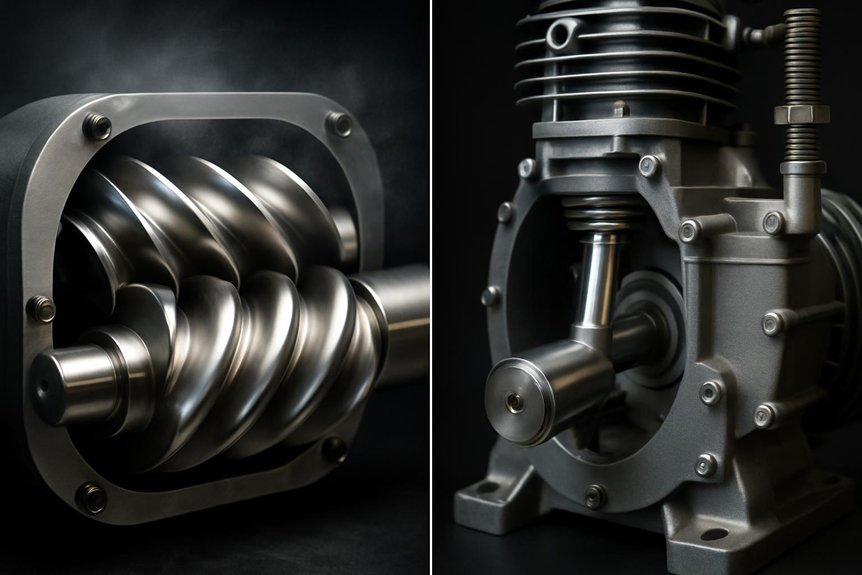
We compare the core mechanics by examining piston versus rotor dynamics, focusing on how each device traps and moves air. We analyze how reciprocating pistons create discrete compression cycles, while rotary screws generate continuous displacement with meshing rotors. In this discussion, we’ll assess efficiency, pressure behavior, and load response to highlight the fundamental differences and their practical implications.
Core Mechanism Differences
Both rotary screw and reciprocating air compressors rely on distinct mechanical actions to compress air, but their core mechanisms differ fundamentally. We examine fundamental actions to contrast efficiency, load response, and thermal behavior without delving into piston-rotor dynamics.
- Rotary screws trap and shear air via meshing rotors, creating continuous compression zones.
- Reciprocating pistons generate discrete compression strokes with crankshaft-driven pressure swings.
- Sealing approaches differ: helical rotors rely on timing gaps; pistons use piston rings and cylinder walls.
- Lubrication strategy and rotor wear influence long-term rotor-failure risk and efficiency.
This framing guides performance expectations, emphasizing reliability, cooling, and maintenance. We avoid rotor-dynamics specifics here, focusing on core actions and their implications for efficiency, durability, and service intervals.
Piston vs Rotor Dynamics
How do piston and rotor dynamics compare in the moment-to-moment action that actually compresses air? We examine the core mechanics: piston systems rely on reciprocating volume change, generating high-pressure pockets during the compression stroke, while rotor systems use meshing lobes to trap and advance air in discrete pockets. In piston dynamics, clearance, rod mass, and crankshaft throw define pressure rise and heat generation, with valves dictating intake and exhaust timing. In rotor dynamics, tooth geometry, rotor speed, and lubrication govern seal integrity and volumetric efficiency. The dynamics comparison shows distinct load paths: pistons tensilely with crank-driven force transfer; rotors shear air via continuous, rolling compression. Overall efficiency hinges on sealing accuracy, heat management, and mechanical losses, not merely displacement.
Key Performance Differences: Flow, Pressure, and Efficiency
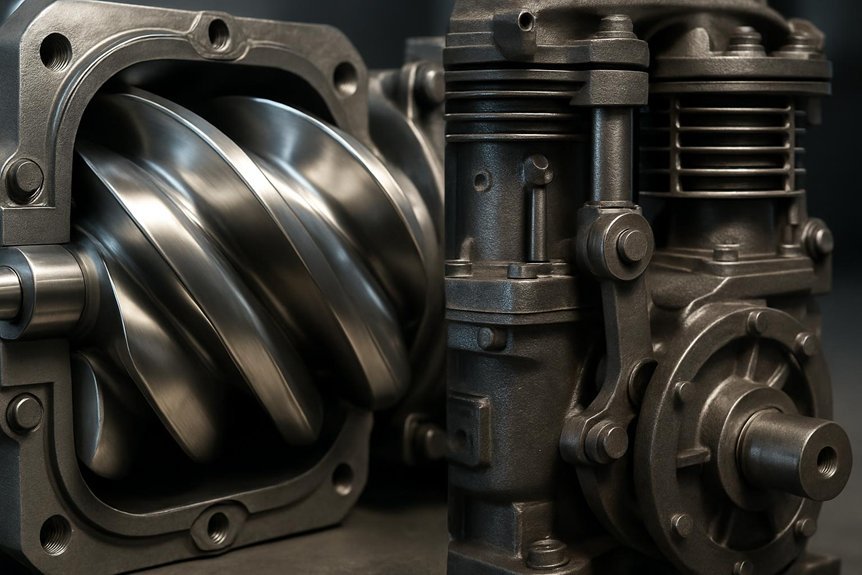
What key performance differences define how rotary screw and reciprocating air compressors handle flow, pressure, and efficiency? We compare dynamics across three axes, focusing on flow stability, pressure range, and overall efficiency for both technologies. Our assessment targets newcomer guidance and market trends to illuminate practical decisions.
- Flow: rotary screws deliver smoother, higher CFM at steady speeds; reciprocating units exhibit pulsation and lower constant flow.
- Pressure: screws excel at continuous moderate pressures; pistons achieve higher peak PSI but with greater duty-cycle variation.
- Efficiency: screw units maximize specific power at continuous loads; reciprocating units trend toward higher energy use under light loads.
- Load matching: rotary systems respond well to varying demands; reciprocating systems require staging or controls for efficiency.
These points frame market considerations and practical sizing.
Maintenance Demands: Longevity, Parts, and Downtime
Maintaining performance consistency across rotary screw and reciprocating systems hinges on predictable wear patterns, component lifespans, and downtime impacts. We approach maintenance demands with a data-driven lens, comparing total cost of ownership through service intervals, parts availability, and failure modes. Rotary screw units emphasize continuous lubrication regimes and seal integrity, influencing oil management strategies and filter purity to avert varnish and bearing wear. Reciprocating compressors rely on precise piston rings, valves, and crankcase components, where routine part replacement and compressor head maintenance drive reliability. Both designs benefit from disciplined maintenance scheduling, guardband planning, and proactive diagnostics to minimize unscheduled downtime. We quantify remaining life, prioritize critical spares, and align oil changes with operating hours to sustain efficiency and longevity.
Noise, Vibration, and Footprint: Site Considerations
Noise, vibration, and footprint considerations directly affect site suitability and operational efficiency for both rotary screw and reciprocating air compressors. We assess environmental and structural factors to quantify performance impact and determine appropriate layouts. Our approach highlights how noise concerns and vibration mitigation strategies influence equipment selection, room design, and compliance with local regulations. Each choice affects maintenance access, serviceability windows, and safety margins, ultimately shaping uptime and reliability.
- Noise profiling and attenuation options
- Vibration isolation methods and mounting schemes
- Footprint optimization for airflow and accessibility
- Acoustic zoning and regulatory compliance considerations
Total Cost of Ownership: Purchase, Operation, and Servicing
Total cost of ownership (TCO) for rotary screw and reciprocating compressors encompasses purchase price, energy consumption, maintenance, parts replacement, downtime, and residual value over the equipment life. We approach TCO by quantifying initial capital outlay, then projecting annual operating expenses and maintenance intervals. Energy intensity, part wear, and service cadence drive long-term costs. In our analysis, rotary screw units typically offer higher initial cost but lower hourly energy use and reduced maintenance visits, while reciprocating systems often incur lower upfront prices yet higher energy and lubrication demands. Downtime impact, compressor control strategy, and preventative servicing schedules substantially influence total expenditure. We compare residual values after depreciation, and consider retrofit potential. Overall, precise cost modeling clarifies whether rotary screw or reciprocating aligns with the user’s total ownership risk and budget.
Best Use Cases: When to Choose Rotary Screw vs Reciprocating
Which compressor type is right for a given duty cycle and load profile often boils down to runtime characteristics and control strategy. We present practical use cases to guide selection, focusing on objective performance rather than irrelevant comparison or unrelated metrics.
1) Continuous high-volume output with steady demand favors rotary screw for efficiency and reduced part wear.
2) Intermittent or fluctuating loads suits reciprocating units when capital cost and simple startup are priorities.
3) Low-pressure, high-flow scenarios benefit screws due to smoother operation and lower leakage impact.
4) Spare capacity for peak events favors mixed fleets or staged controls to balance equity of runtime and maintenance.
Our assessment emphasizes measurable metrics over hype, aligning choice with duty profile, control logic, and operational costs rather than irrelevant comparison.
How to Evaluate Your Air Demand: CFM, PSI, and Duty Cycle
How do you quantify your plant’s air demand, and why do CFM, PSI, and duty cycle matter in selection and control? We approach this analytically: map peak and average CFM requirements across all zones, then verify acceptable pressure (PSI) margins for tools and processes. CFM defines delivered flow, PSI defines usable pressure at the point of use, and duty cycle reveals how often the compressor must run versus idle. We translate demand into a duty profile and align it with compressor capability, avoiding undersize during startup surges and oversizing that wastes energy. Two word discussion ideas: energy efficiency, startup surge. By documenting variation, we expose underserved loads, prevent pressure drops, and tune controls for stable operation, lower energy use, and predictable maintenance windows.
Matching Controls and Accessories: VSDs, Dryers, and Filtration
When we match controls and accessories to our demand profile, VSDs, dryers, and filtration become concrete levers for stability and efficiency. We approach this with causal inference in mind, linking control choices to observed pressure and flow outcomes across segments. Our analysis aligns with market segmentation to tailor equipment behavior, avoiding one-size-fits-all assumptions. The goal is to minimize wasted loads, moisture, and contaminants while preserving response time.
- VSDs modulate compressor speed to stabilize pressure and optimize energy use.
- Dryers control dewpoint to reduce corrosion and product spoilage downstream.
- Filtration targets particulate and oil aerosols, preserving sensor accuracy.
- Data integration ties performance metrics to operating regimes for continuous optimization.
Decision Framework: Quick Checklist to Pick the Right Type
To pick the right compressor type efficiently, use this quick decision framework to align mechanical characteristics with your demand profile and constraints. We begin by mapping load inertia, duty cycle, and pressure range to compressor topology: rotary screw favors steady, moderate- to high-volume needs; reciprocating suits lower, intermittent bursts and ultra-low downtime costs. Next, evaluate efficiency, maintenance cadence, and lifecycle costs; consider start-up power, lubrication, and cooling demands. Align noise, footprint, and installation constraints with available space and zoning. Then assess control strategies, reliability history, and vendor support. Finally, identify risk factors: start up myths and maintenance myths can skew expectations—validate with field data, MTBF figures, and confirmed performance curves. Use this checklist to inform procurement, commissioning, and ongoing optimization decisions.
Frequently Asked Questions
How Do Startup Costs Differ Between Types and Configurations?
We estimate startup costs vary by configuration: fixed-speed reciprocating units cheaper upfront but higher electrical/installation costs; rotary screw packages cost more initially but lower installation complexity. Configuration differences influence maintenance budgeting and perils of efficiency, accelerating total cost of ownership.
Which Compressor Type Scales Best for Peak Demand?
We’ll answer: for peak demand, a rotary screw scales best. We monitor rotary efficiency and reciprocating durability, noting screw units maintain steady flow longer, while reciprocating tends to spike maintenance. We’ll guide you to optimal sizing.
What Maintenance Skills Are Required for Each System?
We perform maintenance basics for rotary screws and maintenance basics for reciprocating compressors, detailing inspection, lubrication, filter changes, belt/tuel alignment, vibration checks, and safety shutdown procedures; we emphasize diagnostics, recordkeeping, and routine preventive tasks for reliability.
How Do Environmental Conditions Affect Performance?
Environmental conditions affect performance via temperature, humidity, and ventilation, reducing efficiency when limits are exceeded. We assess environmental resilience and noise considerations to quantify derating, cooling needs, and enclosure impact, then optimize spacing, filtration, and acoustics for reliability.
Can You Retrofit Accessories Across Models?
We can retrofit accessories across models only when retrofitting compatibility is confirmed and wiring/ports align; otherwise, retrofit projects fail. We pursue accessory standardization to simplify upgrades, reduce variability, and ensure predictable performance across equipment families.
Conclusion
We’ve laid out the chord progressions of screws and pistons, and now we see the cadence you need. If your load stays steady and you crave efficiency, the rotary screw plays a long, quiet aria. If you need bursts and lower upfront cost, the reciprocating unit trades steadiness for responsiveness. Evaluate demand, duty cycle, and total cost of ownership, then tune with appropriate controls. In short: match profile to demand, and efficiency will follow.