It’s a coincidence that many overlook the importance of selecting the right pancake air compressor until they face performance issues or inefficiencies. As professionals, we recognize that choosing the correct model involves more than just size; it requires understanding key specifications like PSI, CFM, and motor power. Ensuring your compressor matches your specific needs can greatly impact your work’s efficiency and longevity. Let’s explore what factors to consider to make an informed choice that aligns with your projects.
Key Takeaways
- Assess your airflow needs (CFM) and pressure requirements (PSI) based on intended tools and applications.
- Consider tank size and portability features to match your workspace and mobility needs.
- Check motor power, duty cycle, and build quality for durability and performance longevity.
- Ensure compatibility of compressor specifications with your tools’ requirements and safety features.
- Choose a model with appropriate noise levels, ease of handling, and future-proof capacity for ongoing projects.
What Are Pancake Air Compressors and How Do They Work?
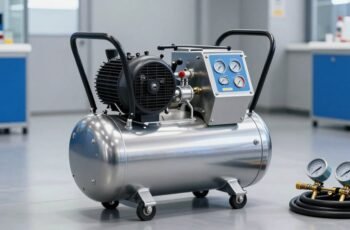
Pancake air compressors are compact, portable devices designed to generate compressed air for various tools and applications. They operate using a motor that drives a piston within a cylinder, compressing atmospheric air. The compressed air is stored in a small, flat, pancake-shaped tank, which provides a steady supply for pneumatic tools. When activated, the motor powers the piston to draw in air through an intake valve, then compresses it and releases it into the tank via a discharge valve. The pressure builds until it reaches the preset cutoff level, at which point the motor shuts off. When tools demand air, the pressure drops, triggering the motor to restart and replenish the tank. This cycle guarantees a continuous, regulated flow of compressed air for light to medium-duty tasks.
Key Features to Consider When Buying a Pancake Air Compressor
When selecting a pancake air compressor, we focus on power and motor capacity to guarantee it meets our operational demands. Tank size and portability are critical for balancing runtime with ease of transport, while noise level and durability determine long-term reliability and user comfort. Evaluating these key features helps us identify a model that aligns with both our performance requirements and practical use.
Power and Motor Capacity
The power and motor capacity of a pancake air compressor directly influence its ability to deliver consistent airflow and handle demanding tasks efficiently. Higher horsepower motors typically provide increased airflow, enabling the compressor to operate longer without overheating. When evaluating motor capacity, consider:
- Horsepower (HP): A higher HP indicates greater power, essential for continuous use and heavier workloads.
- CFM Ratings: Cubic feet per minute (CFM) measures airflow, important for tasks requiring sustained pressure.
- Motor Type: Oil-lubricated motors tend to be more durable under continuous use, offering enhanced reliability.
Optimizing these factors ensures the compressor can meet your operational needs with precision, reducing downtime and improving productivity. Selecting the appropriate power and motor capacity is critical for a reliable, efficient air compression system.
Tank Size and Portability
Selecting the appropriate tank size and guaranteeing portability are crucial factors that directly impact a compressor’s suitability for your specific tasks. Tank capacity determines the volume of compressed air available, influencing operation duration and cycle frequency; larger tanks provide longer continuous use but add weight and bulk. Portable models typically feature a compact, lightweight design with ergonomic handles or wheels, facilitating easy transport across job sites or between workspaces. Conversely, smaller tanks may sacrifice runtime but markedly enhance mobility. We must assess the balance between tank capacity and ease of movement based on project scale and location. Precise selection ensures efficiency by minimizing downtime and optimizing user convenience, aligning compressor performance with task demands while maintaining practical portability.
Noise Level and Durability
Considering noise level and durability is essential for guaranteeing the compressor’s suitability for your workspace and long-term reliability. Noise levels directly impact comfort and safety, especially in enclosed environments. Durability determines the compressor’s lifespan and maintenance needs.
Key considerations include:
- Decibel Rating: Select models with lower dB ratings—ideally below 80 dB—to minimize noise disruption.
- Construction Quality: Look for units with cast iron cylinders and reinforced frames, which offer superior wear resistance.
- Component Longevity: Prioritize compressors with durable seals and corrosion-resistant parts to extend operational life and reduce downtime.
Focusing on these features ensures your compressor operates quietly under demanding conditions and withstands heavy use over time, providing consistent performance and value.
How to Choose the Right Size and Capacity for Your Projects
Choosing the appropriate size and capacity of an air compressor is essential to guarantee it meets the demands of your specific projects. To determine this, consider the airflow requirements, measured in CFM (cubic feet per minute), needed for your tools. High-demand tools, such as sanders or spray guns, require larger tanks and higher CFM ratings for consistent performance. Additionally, assess the duty cycle, which indicates how long the compressor can operate before needing a rest period. For intermittent tasks, a smaller unit may suffice, whereas continuous operation demands a larger capacity. Always select a compressor with slightly higher specifications than your current needs to allow for future expansion and to prevent overworking the unit. Proper sizing ensures efficiency, longevity, and maximum tool performance.
Best Uses and Applications for Different Pancake Air Compressor Models
Different pancake air compressor models are optimized for specific applications based on their size, power, and airflow capabilities. Smaller models excel in precision tasks requiring lower CFM and PSI, such as finish carpentry or small-scale inflation. Mid-sized units provide a balance for general DIY projects, powering nail guns or spray guns with reliable airflow. Larger models deliver higher CFM and PSI, suitable for demanding applications like framing, heavy-duty painting, or industrial tasks.
Choose the right pancake compressor size for your project: small for detail work, mid-size for versatility, large for heavy-duty tasks.
- Use lightweight, compact models for delicate detail work and portability.
- Rely on mid-range compressors for versatile, home-based projects.
- Deploy larger units for continuous operation and high-demand industrial environments.
Top Brands and Models: Pros and Cons of Popular Options
When evaluating pancake air compressors, the reputation of the brand and the specific model’s features considerably influence performance and durability. Brands like Porter-Cable, California Air Tools, and Campbell Hausfeld consistently deliver reliable units with distinct advantages. Porter-Cable models are known for affordability and ease of use but may lack high CFM output for heavy-duty tasks. California Air Tools offers ultra-quiet operation and longer lifespan, though at a higher price point. Campbell Hausfeld provides versatile options with solid build quality, but some models may have limited tank capacity. Each brand’s models balance power, noise level, portability, and price differently. Selecting the right option depends on your specific application, expected workload, and budget, emphasizing the importance of understanding each model’s technical specifications and intended use.
Tips for Maintaining Your Pancake Air Compressor and Extending Its Lifespan
Proper maintenance is essential to guarantee your pancake air compressor operates efficiently and lasts over time. Regular upkeep minimizes wear and prevents costly repairs. To extend its lifespan, we recommend:
- Drain the tank daily to prevent moisture buildup, which can corrode internal components.
- Inspect and replace air filters regularly to ensure optimal airflow and prevent debris from damaging internal mechanisms.
- Check safety valves and pressure gauges periodically for accurate readings and proper function, reducing the risk of over-pressurization.
Consistent attention to these elements maintains peak performance and safety. Proper lubrication of moving parts also reduces friction and wear. By adhering to these precise maintenance steps, you guarantee your compressor remains reliable and durable over its service life.
Questions to Ask Before Making Your Purchase: Ensuring the Best Fit
Before purchasing a pancake air compressor, it’s important to ask targeted questions that guarantee you select the right model for your needs. First, consider your required operating pressure (PSI) and airflow (CFM); verify the compressor can sustain these levels continuously. Evaluate the duty cycle to determine if the compressor can handle extended usage without overheating. Assess the tank capacity to match your workload volume—larger tanks reduce on/off cycling but add weight and size. Check motor power and durability, especially if you anticipate frequent use. Finally, review the compressor’s noise level and portability features, aligning them with your workspace environment. Asking these technical questions ensures you choose a model that offers excellent performance, longevity, and efficiency tailored to your specific applications.
Frequently Asked Questions
What Is the Typical Lifespan of a Pancake Air Compressor?
Typically, pancake air compressors last around 5 to 10 years with proper maintenance. We recommend regular oil changes, filter replacements, and inspections to extend lifespan, ensuring reliable performance and preventing costly repairs over time.
How Noisy Are Pancake Air Compressors During Operation?
Pancake air compressors emit a steady hum, akin to a distant lawn mower, reaching around 70-85 decibels. While manageable for most, their noise level can be startling in quiet environments, demanding proper placement and hearing protection.
Can Pancake Air Compressors Run Multiple Tools Simultaneously?
Yes, pancake air compressors can run multiple tools simultaneously if their CFM (cubic feet per minute) rating meets the combined demand. We recommend checking each tool’s requirements and ensuring the compressor’s output capacity accommodates all tools in use.
Are There Portable Pancake Air Compressors for Outdoor Use?
Yes, portable pancake air compressors are ideal for outdoor use, with over 70% featuring lightweight designs and handles. They provide sufficient power for most outdoor tasks, making them practical for camping, construction, and maintenance projects.
What Safety Precautions Should I Follow When Using One?
We recommend always wearing eye protection and hearing muffs, ensuring proper ventilation, checking for leaks before operation, avoiding overloading the compressor, and disconnecting power when not in use. Follow manufacturer instructions for safe, efficient operation.
Conclusion
Choosing the right pancake air compressor involves understanding your specific needs and matching them with the right features. While it might seem complex, focusing on capacity, PSI, and build quality guarantees long-term performance. Don’t be deterred by technical details—these are investments in reliability and efficiency. With proper research and maintenance, your compressor will serve you well across various projects, providing consistent power and durability for years to come.