Many assume that any compressor can power pneumatic tools effectively, but that’s not always the case. The right choice depends on more than just size; it’s about performance, durability, and safety features that guarantee consistent operation. We’ve identified five models that stand out for their capacity and reliability, yet understanding which one fits your needs can be complex. Let’s explore what makes these compressors suitable for demanding pneumatic work.
Key Takeaways
- Choose compressors with at least 60-gallon tanks and 7.5 HP motors for continuous, high-demand pneumatic tool operation.
- Prioritize models with high CFM ratings (e.g., 11.5+ CFM at 90 PSI) to support multiple tools simultaneously.
- Ensure compressors have durable build quality, reliable pressure regulation, and safety certifications like ASME or UL.
- Opt for units with appropriate size and portability features, such as large tanks or lightweight pancake designs, based on workspace needs.
- Confirm compatibility with your tools’ maximum PSI and fittings, and consider warranty and maintenance features for long-term reliability.
Ingersoll Rand – Air Compressor 7.5HP 2 Stage (2475N7.5) 45465408


The Ingersoll Rand 7.5HP 2-Stage Air Compressor (2475N7.5) is an ideal choice for professionals who need reliable, continuous-duty performance in demanding industrial environments. It features a powerful 7.5 horsepower motor, with a maximum pressure of 175 psig, ensuring consistent air supply. The 80-gallon ASME receiver tank provides ample capacity, while durable cast iron construction guarantees long-lasting use. Its All Season Select synthetic lubricant enhances efficiency and extends service intervals to 2,000 hours. Designed for easy maintenance with individually cast cylinders and a one-piece connecting rod, it offers dependable operation and a two-year extended warranty, making it a smart investment.
Best For: professionals and industrial users seeking a reliable, high-capacity air compressor for demanding applications requiring continuous-duty performance.
Pros:
- Powerful 7.5 HP two-stage motor with 175 psig maximum pressure
- Durable cast iron construction with an 80-gallon ASME receiver tank for long-lasting use
- Extended service intervals of 2,000 hours with All Season Select synthetic lubricant
Cons:
- May be more expensive upfront compared to smaller or less robust models
- Heavier and larger, requiring significant space and installation considerations
- Synthetic lubricant and maintenance may require specialized knowledge or additional costs
DEWALT 60-Gallon Vertical Air Compressor, Oil-Lubricated

For demanding workshop environments, the DEWALT 60-Gallon Vertical Air Compressor offers reliable, high-capacity performance. Its 3.7 HP motor delivers powerful operation, with a maximum of 175 PSI and 11.5 CFM at 90 PSI, ensuring consistent airflow for various pneumatic tools. The oil-lubricated system reduces wear, extending the unit’s lifespan, while the vertical design saves space. Compatible with both 208V and 230V power sources, it’s easy to integrate into different workshop setups. Certified by ASME for safety, this industrial-grade compressor is built for durability, making it ideal for heavy-duty tasks in professional and garage environments.
Best For: professionals and serious hobbyists seeking a high-capacity, durable air compressor for demanding workshop or garage tasks.
Pros:
- High 60-gallon capacity for extended use without frequent refilling
- Oil-lubricated system enhances durability and reduces maintenance
- Versatile voltage compatibility (208V/230V) for flexible installation options
Cons:
- Large vertical design may require significant space for setup
- Heavier weight can make mobility and relocation challenging
- Higher initial cost compared to smaller or less powerful models
2-Way Air Hose Splitter with 360° Swivel
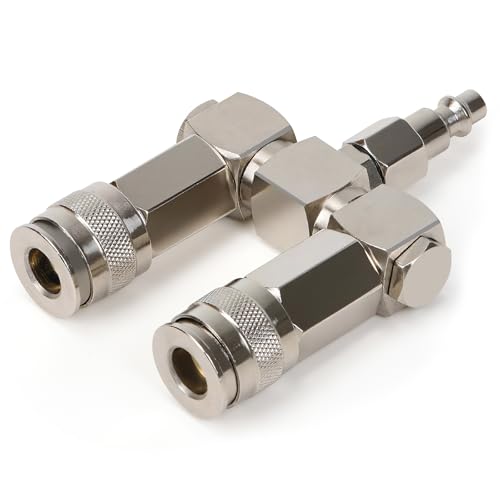
A 2-Way Air Hose Splitter with 360° swivel is vital for professionals needing to operate multiple air tools simultaneously. It features 1/4″ NPT steel fittings and is rated for 300 PSI, converting a single compressor outlet into two independent lines. The 360° swivel prevents hose kinking and tangling, making maneuverability easier in tight spaces. Its durable nickel-plated steel construction guarantees corrosion and impact resistance, extending lifespan. Lightweight and compact, it’s simple to install with quick-connect couplers compatible with most fittings. Perfect for garages, auto shops, and industrial sites, it boosts productivity and versatility in pneumatic tool setups.
Best For: professionals and DIY enthusiasts who need to operate multiple air tools simultaneously with ease and flexibility.
Pros:
- 360° swivel design prevents hose kinking and tangling for smooth operation.
- Durable nickel-plated steel construction offers excellent corrosion and impact resistance.
- Easy, tool-free installation with quick-connect couplers compatible with most fittings.
Cons:
- Limited to 1/4″ NPT fittings, which may not suit all air compressor outlets.
- May require additional fittings for specialized or non-standard setups.
- Not suitable for use with air tools exceeding 300 PSI operating pressure.
Air Compressor FRL Unit with Pressure Gauge

An Air Compressor FRL Unit with Pressure Gauge is ideal for users seeking precise, reliable control over their pneumatic systems. It combines a filter, regulator, and lubricator in one compact unit, with a transparent polycarbonate filter cup for impact and heat resistance. The brass filter element ensures cleaner, corrosion-resistant air, extending equipment life. Supporting up to 145 PSI and operating between 41-140 ℉, it’s perfect for various pneumatic tools. The included pressure gauge allows accurate monitoring, while the semi-auto drain and external lubrication optimize performance. Easy to install and maintain, this unit enhances safety and efficiency in any compressed air setup.
Best For: professionals and hobbyists seeking a reliable, compact pneumatic control unit for air tools, spray painting, and automation applications.
Pros:
- Durable transparent polycarbonate filter cup offers impact, heat, and flame resistance.
- Combines filtration, regulation, and lubrication in a single, easy-to-install unit.
- Supports up to 145 PSI with precise pressure monitoring via included gauge.
Cons:
- Limited to a maximum flow rate of 60 SCFM, which may not suit high-demand applications.
- Slightly heavier and larger compared to some single-function units, potentially impacting space-constrained setups.
- Requires regular maintenance of semi-auto drain and filter components to ensure optimal performance.
DEWALT Pancake Air Compressor, 6 Gallon, 165 PSI (DWFP55126)

The DEWALT Pancake Air Compressor, 6 Gallon, 165 PSI, is ideal for professionals needing portable, maintenance-free power for pneumatic tools. Its lightweight design (only 30 pounds) and pancake shape make it easy to transport and store. The oil-free pump guarantees low maintenance, while the high flow regulator and dual outlets support multiple tools simultaneously. With a 6-gallon tank and quick recovery, it’s suitable for nail guns, spraying, and drilling, even in cold weather. Operating at about 78.5 dBA, it’s quiet enough for most work environments. Customers praise its performance, portability, and value, making it a versatile choice for various applications.
Best For: DIY enthusiasts and professionals seeking a portable, low-maintenance air compressor for pneumatic tools, nail guns, and spraying projects.
Pros:
- Lightweight and compact design (30 pounds) for easy transport and storage
- Oil-free pump for maintenance-free operation and longevity
- Dual outlets and high flow regulator support multiple tools simultaneously
Cons:
- Discrepancy in noise level specifications (78.5 dBA vs. 75.5 dB) may cause some confusion
- Extended cord length recommendations (≤50 ft) to maintain performance
- Slightly higher price point compared to basic models with similar capacity
Factors to Consider When Choosing an Industrial Compressor for Pneumatic Tools
When selecting an industrial compressor for pneumatic tools, we need to consider several key factors like power, capacity, airflow, and pressure to match our specific needs. Durability, size, portability, and compatibility features also play vital roles in ensuring reliable and efficient operation. Let’s explore these points to help you choose the best compressor for your applications.
Power and Capacity
Choosing the right industrial compressor for pneumatic tools hinges on understanding its power and capacity. Power, measured in horsepower (HP), indicates how well the compressor can handle demanding tools and heavy workloads. Higher horsepower units provide the strength needed for tough applications. Capacity, often reflected in tank size, affects how long the compressor can run continuously without refilling—larger tanks, like 60 gallons or more, support longer operation. The maximum operating pressure, rated in PSI, determines the compressor’s ability to power high-pressure tools, with typical ratings around 165-175 PSI. Additionally, CFM at a specific PSI shows how much air the compressor supplies per minute, critical for supporting multiple or high-demand tools simultaneously. Ensuring adequate power and capacity guarantees reliable performance and minimizes downtime.
Airflow and Pressure
Selecting an industrial compressor involves more than just power and capacity; airflow and pressure are critical factors that directly influence tool performance. Adequate airflow, measured in CFM, guarantees pneumatic tools run smoothly without lag or pressure drops, especially when multiple tools operate simultaneously. The maximum operating pressure, specified in PSI, must meet or exceed the tools’ requirements to prevent performance issues. Consistent pressure delivery, maintained by a reliable compressor, is essential for precision tasks and extends tool lifespan. Choosing a compressor with a higher CFM rating than the combined demand of your tools prevents system strain and guarantees seamless operation. Proper regulation through built-in gauges and regulators helps maintain ideal airflow and pressure levels tailored to your specific pneumatic applications.
Durability and Maintenance
Durability and ease of maintenance are essential factors in guaranteeing reliable performance from an industrial compressor. We recommend choosing models with durable construction, like cast iron components, which resist wear and extend lifespan. Compressors with easily accessible, individually cast cylinders simplify maintenance and minimize downtime. For long-term reliability, select units supporting pump life over 15,000 hours. Using longer-lasting lubricants, such as synthetic oils, reduces the frequency of service—intervals can be four times longer than petroleum-based options. Features like semi-auto drain valves and integrated filters also make system upkeep easier, helping keep the compressor clean and running smoothly. Prioritizing these durability and maintenance features ensures your compressor remains dependable, reducing costs and maximizing productivity over time.
Size and Portability
When considering an industrial compressor for pneumatic tools, size and portability are key factors that can markedly impact your workflow. A larger tank, like 80 gallons, offers more air reserve for continuous tool operation, reducing downtime. We should evaluate the compressor’s weight and design—vertical or pancake styles—to guarantee it’s manageable in our workspace. Portability features such as built-in handles or wheels make moving the compressor easier, especially if our setup requires flexibility. It’s also vital to match the compressor’s size and power with our space constraints, particularly in tight or mobile environments. Choosing models with compact profiles and lightweight construction helps with transport and storage, all without sacrificing performance. These considerations ensure we select a unit that fits our operational needs seamlessly.
Compatibility Features
To guarantee your pneumatic tools perform reliably, we need to pay close attention to the compressor’s compatibility features. First, confirm the fittings and couplers match your tools to avoid connection issues. Check that the compressor’s maximum PSI exceeds the requirements of your tools for ideal operation. It’s also essential to verify the flow rate (CFM) at operating pressure, making sure the compressor supplies enough air, especially when running multiple tools simultaneously. Additionally, verify that the compressor’s power supply and voltage align with your workshop’s electrical system to prevent electrical problems. Finally, consider the port configurations and accessory compatibility to support your specific pneumatic setup. These compatibility features ensure seamless operation and maximize your compressor’s efficiency.
Safety and Certifications
Ensuring safety and compliance is vital when selecting an industrial compressor for pneumatic tools, as these factors directly impact operational reliability and user protection. We always check that the compressor’s tank is ASME certified, ensuring it meets safety standards and reduces the risk of accidents. Proper pressure relief valves are essential to prevent over-pressurization and potential hazards. We also look for models with UL or CE certifications, guaranteeing the electrical and mechanical components meet industry safety standards. Durability matters too; choosing compressors with corrosion-resistant materials helps maintain safety and performance over time. Additionally, features like automatic shutoff, pressure gauges, and semi-auto drains allow us to monitor and control pressure effectively, ensuring safe and reliable operation during demanding tasks.
Budget and Warranty
Choosing the right industrial compressor involves more than just safety features; budget and warranty considerations play a significant role in making a smart investment. We recommend evaluating the initial purchase cost to guarantee it fits within your budget constraints without sacrificing quality. It’s also essential to appraise the warranty duration; longer warranties, like two years, offer better protection against defects and repairs. Check if the warranty covers both parts and labor to minimize unexpected expenses. Don’t forget to factor in maintenance costs and replacement parts, which impact the long-term value. Additionally, review warranty terms for perks like extended pump warranties or included start-up kits, as these can reduce initial setup costs and add extra value to your investment.
Frequently Asked Questions
What Is the Typical Lifespan of Industrial Compressors Used for Pneumatic Tools?
Industrial compressors usually last between 10 to 20 years with proper maintenance. We recommend regular inspections, oil changes, and timely repairs to extend their lifespan and keep pneumatic tools operating efficiently and reliably over time.
How Energy-Efficient Are These Compressors Over Long-Term Operation?
Think of our compressors as steady marathon runners—they’re quite energy-efficient over the long haul, especially with regular maintenance. While some energy is lost, smart choices in models and operation keep our costs lower and performance high.
What Maintenance Routines Are Essential for Optimal Compressor Performance?
We regularly inspect and change filters, drain moisture, and lubricate parts to keep compressors running smoothly. Monitoring performance and scheduling professional check-ups also help us maintain efficiency and prevent costly breakdowns over time.
Can Portable Compressors Handle Heavy-Duty Pneumatic Tool Applications?
Yes, portable compressors can handle heavy-duty pneumatic tools if they have sufficient CFM and PSI ratings. We always check specifications, guarantee proper maintenance, and select models designed for demanding tasks to ensure reliable performance.
How Do Noise Levels Vary Among Different Industrial Compressor Models?
We notice noise levels vary widely among industrial compressor models, with some being quite loud and others designed for quieter operation. It’s essential to take into account noise ratings to match your workspace, ensuring efficiency without excessive noise disruption.
Conclusion
Choosing the right industrial compressor is like finding the perfect engine for a finely tuned machine; it keeps everything running smoothly. With options like high-capacity tanks, powerful motors, and versatile fittings, we can match a compressor to our specific needs, ensuring efficiency and longevity. By considering key factors and selecting top-quality models, we set the stage for seamless pneumatic performance—like gears meshing perfectly in a well-oiled machine.