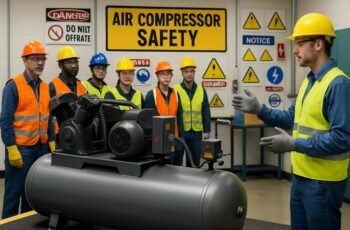
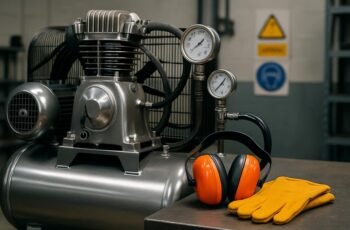
We must upfront identify and control compressor hazards, set clear operating envelopes, and enforce lockout/tagout for maintenance. We’ll cover proper setup, site prep, and daily inspections to prevent faults, plus safe start-up, operation, and shutdown practices. We’ll discuss piping, hose routing, PPE, and human factors, then emergency readiness and ongoing training. If our goals align, we’ll outline concrete steps and stay disciplined about continuous improvement—so you’ll see where gaps lie and how to close them, one decisive action at a time.
Key Takeaways
- Identify and control hazards upfront, focusing on electrical, mechanical, and pressure risks with clear operating envelopes and lockout/tagout procedures.
- Ensure proper site setup and electrical readiness, including grounding, ventilation, drainage, lighting, and secure mounting before startup.
- Conduct daily inspections with structured checklists to verify safety devices, leaks, air quality, and fault-prone components.
- Follow safe maintenance and lockout/tagout practices, confirming zero energy and isolations before work and restoring systems only after tasks complete.
- Implement emergency preparedness with defined roles, drills, after-action reviews, and continuous improvement to enhance incident response.
Identify and Control Compressor Hazards Up Front
To prevent accidents, we identify and control compressor hazards up front. We begin with a clear assessment of potential failure points, focusing on electrical, mechanical, and pressure-related risks. Our approach centers on the identification of hazards and the implementation of targeted control measures. We scrutinize wiring integrity, guard compliance, lubrication practices, and pressure relief reliability, documenting findings for accountability. We establish explicit operating envelopes, limit startup surges, and confirm proper cool-down sequences. We assign responsibility, verify labels, and enforce lockout/tagout procedures where appropriate. Routine inspections verify that safety devices function, while training reinforces recognition of abnormal sounds, overheating, and vibration. By documenting risks and responses, we create a traceable safety loop that informs ongoing precautions and minimizes incident potential.
Proper Setup and Site Preparation for Safe Operation
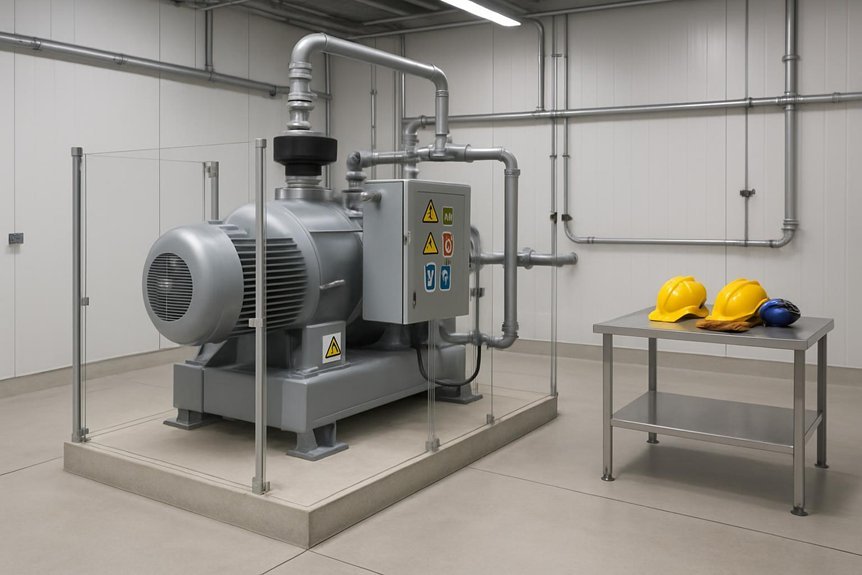
We establish a clear, site-specific setup that supports reliable compressor performance and protects personnel: we select a location with stable flooring, sufficient ventilation, and unobstructed access; we ensure electrical service matches equipment requirements; and we verify appropriate drainage and task lighting before startup. We configure intake and exhaust paths to maintain a safe location, minimizing obstructions and trip hazards. We confirm grounding, circuit protection, and compatible power ratings, then isolate the unit during mounting and piping. We implement restrained hose routing, secondary containment where needed, and clear labeling for shutoffs. We verify noise reduction measures are appropriate for the environment and that enclosures or barriers don’t impede cooling. Finally, we document setup parameters for repeatable safety and quick fault tracing.
Daily Inspection Checklists for Fault Prevention
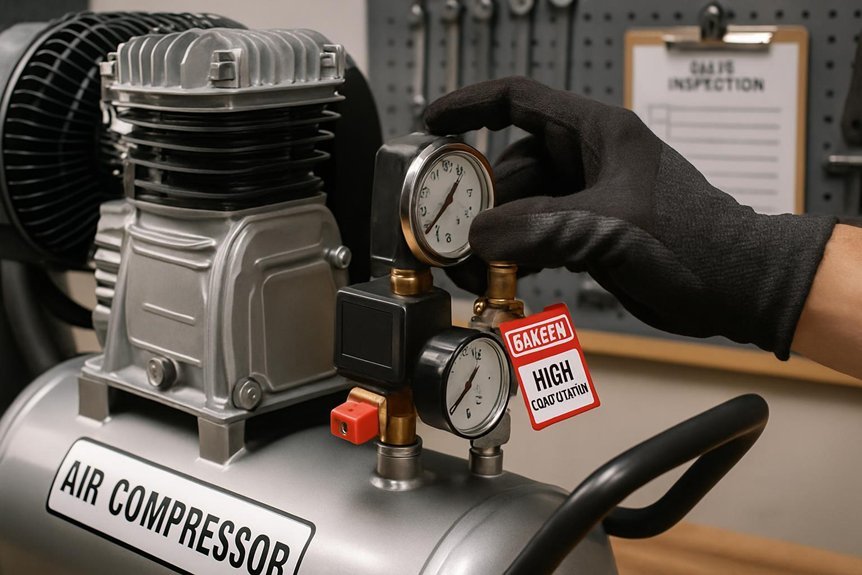
We’ll outline daily inspection essentials to catch faults early and maintain consistent performance. By following structured checklists, we prevent minor issues from becoming major downtime, and we document patterns to guide maintenance. Our focus is on precise routines, timely observations, and actionable fault-prevention tactics.
Daily Inspection Essentials
Do daily inspections truly prevent failures before they happen? We believe so, when guided by a disciplined routine that catches anomalies early. Our daily inspection essentials emphasize consistency, documentation, and immediate corrective action. By following a structured checklist, we verify operating parameters, check for leaks, inspect safety devices, and confirm clean, dry air delivery. This approach supports hands on maintenance and minimizes downtime in outdoor installations, where exposure accelerates wear. We present concise steps to keep systems reliable and compliant.
- Verify gauges, alarms, and pressure settings for accuracy
- Inspect hoses, fittings, and couplings for wear or leaks
- Confirm oil level, filters, and cooling components are clean
- Test safety shutdowns and emergency stop functionality
Fault Prevention Tactics
Fault prevention starts with disciplined daily inspections that target fault-prone areas before they escalate. We systematically checklist-critical components—belts, gauges, hoses, filters, and electrical connections—ensuring proper tension, alignment, and seal integrity. We verify lubrication schedules, record fluid levels, and confirm fasteners remain secure. We assess vibration signatures and inspect mounting feet for looseness, because early anomalies signal deeper faults. We document observed deviations, assign owners, and implement immediate corrective actions or hold-for-maintenance notes. We evaluate noise sources for noise reduction opportunities, isolating vibrating panels and ductwork as needed. We emphasize fault tolerance by preemptively swapping worn parts and validating backup systems. Our approach emphasizes consistency, traceability, and continuous improvement, reinforcing safety culture through precise, actionable daily practice.
Lockout/Tagout Procedures for Maintenance
Lockout/Tagout (LOTO) procedures are essential during maintenance to prevent unexpected machine startup and protect workers from injury. We implement clear, stepwise controls that isolate energy sources, verify zero energy, and secure devices before any work begins. Our approach emphasizes accountability, documentation, and timely communication to support safe maintenance scheduling.
- Identify energy sources and affected equipment before work starts.
- Lock or tag each energy point and confirm isolation with a visual checklist.
- Verify zero energy, then test controls to ensure no startup is possible.
- Restore systems only after all tasks are complete and safeguards are removed.
Following these steps, we minimize risk while sustaining efficient maintenance scheduling, reinforcing discipline, and ensuring ongoing compliance with safety standards.
Safe Start-Up, Operation, and Shutdown Practices
Safe start-up, operation, and shutdown practices require disciplined, predictable actions to protect workers and maintain equipment integrity. We present a clear routine that minimizes risk during each phase. We begin with careful pre-start checks, verifying guards, oil levels, vibration indicators, and electrical connections. The start up sequencing should follow factory specifications, ensuring orderly energization, compressed-air supply primed, and controls engaged in correct order. During operation, we monitor gauges, alarms, and loads, prioritizing energy efficiency through throttling, sequencing, and avoiding abrupt transitions. Operational ergonomics guides worker posture, tool use, and control access to reduce fatigue and injuries. We address noise abatement by scheduling exhaust routing, enclosure, and personal hearing protection. Finally, shutdowns occur in a controlled, sequential manner, securing the system for cooldown and maintenance windows.
Pressure System, Piping, and Hose Safety Essentials
We’ve covered how to start, run, and shut down safely, and now we turn to the Pressure System, Piping, and Hose Safety Essentials. We present concise, actionable guidance focused on reliability and safety. Our emphasis is on detecting hazards early, maintaining integrity, and preventing failure through disciplined practices.
- Inspect hose coupling and connections before use, verify fittings are secure, and replace damaged components.
- Inspect and mark routing alignment to prevent kinks, excessive bending, or interference with moving parts.
- Support piping to reduce vibration, use proper clamps, and route away from heat sources.
- Pressurize and test systems only after all checks, documenting results and confirming leak-free performance.
Personal Protective Equipment and Human Factors
Personal protective equipment (PPE) and human factors are our first line of defense in preventing injuries and ensuring consistent performance. We require proper PPE selection based on risk assessment, standard duties, and exposure duration. Our approach emphasizes fit, maintenance, and routine verification before every shift. Helmet fit remains critical; ensure straps, suspension, and shell accommodate head shape without pressure points, replacing damaged components promptly. Visor selection must balance optical clarity, impact resistance, and compatibility with face shields and hearing protection. We consider human factors by simplifying donning procedures, minimizing task interruption, and reinforcing adherence through observable cues and feedback. Training emphasizes situational awareness, proper PPE donning, and post-use inspection. By integrating equipment reliability with worker cognition, we reduce risk and sustain consistent, safe performance.
Emergency Preparedness, Incidents, and Ongoing Training
How can a facility respond swiftly and effectively when an incident occurs, and what ongoing training keeps responses reliable? We address preparedness as a core, integrated process that links incident response, drills, and continuous improvement. Our team prioritizes rapid escalation, clear roles, and verified procedures to reduce risk and downtime. Ongoing training reinforces decision-making, communication, and safety culture, ensuring every member acts with confidence during emergencies. We design contingency planning to anticipate failures, asset limits, and supply disruption, then validate it through practice. Our approach emphasizes measurable goals, after-action reviews, and corrective actions.
1) Emergency drills simulate real scenarios to test readiness.
2) Contingency planning aligns resources and responsibilities.
3) Post-incident reviews identify lessons learned.
4) Refresher training maintains proficiency and compliance.
Frequently Asked Questions
How Often Should Audible Alarms Be Tested and Calibrated?
Audible alarms should be tested and calibrated quarterly. We ensure calibration cadence is maintained, documenting results and any adjustments. We notify users of failures immediately and schedule rechecks, maintaining rigorous records and continuous compliance for safety and reliability.
What Are Best Practices for Handling Compressed Air Leaks?
We implement leak detection best practices, promptly address leaks, and manage downtime recovery; we conduct hose replacement when needed, perform ongoing testing alarms, track maintenance records, and perform vibration assessment to minimize leaks and optimize system reliability.
Which Maintenance Records Must Be Retained for Audits?
We retain maintenance records for audits, following retention policies that specify duration, format, and accessibility; these records include service logs, calibration data, parts replacements, and inspection checklists, ensuring traceability, accountability, and compliance throughout our ongoing maintenance program.
How Should Vibrations and Unusual Noises Be Assessed?
We perform a structured vibration assessment and investigate unusual noises by listening for patterns, confirming with measurements, and comparing against baseline data; we document findings, implement corrective actions, and recheck performance to guarantee safe, reliable operation.
What Factors Influence Compressor Downtime Recovery Timelines?
We respond by saying factors affecting downtime and recovery timelines hinge on parts availability, maintenance scheduling, and system complexity; influences on maintenance downtime include diagnostic speed, vendor support, and spare-part lead times, shaping recovery factors and total downtime.
Conclusion
We’ve laid the groundwork like engineers of old—watchful, deliberate, exact. From upfront hazard control to lockout/tagout, we chart a disciplined path, as if piloting a ship through calm to storm and back again. Daily checks, safe start-ups, and thoughtful PPE keep us on course; the piping and hoses follow a measured rhythm, like a well-tenced chorus. In emergencies, we respond as one, learning and improving, returning safely to service with renewed resolve.