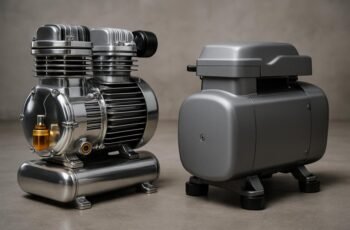
Like a compass pointing through fog, we see two clear paths for air compressors: vertical and horizontal. We weigh footprint, serviceability, and airflow delivery with steady, data-driven logic. Each orientation trades space or access for stability or routing ease, so your shop’s layout and workflow must drive the choice. We’ll outline concrete factors to balance, and what scenarios tip the scale—keeping you from missteps as you decide. Let’s consider the practical implications next.
Key Takeaways
- Vertical compressors save floor space and are easier to service from above, ideal for tight shops with limited footprint.
- Horizontal compressors offer broader base stability and longer bench-ready surfaces, better for workflow alongside walls.
- Vertical units typically have a higher center of gravity, increasing tipping risk during handling; horizontal units are easier to move due to lower CG.
- Maintenance access and component layout differ by orientation, affecting filter/valve access and hose routing.
- Choose based on space, access needs, and workflow: vertical for compact spaces, horizontal for stability and integrated setup.
What a Vertical vs. Horizontal Compressor Means
Vertical and horizontal compressors describe how the air is stored and how the motor drives the pump, affecting footprint, stability, and service layout. We explain what a vertical vs. horizontal compressor means in practical terms, focusing on design intent and operational implications. In vertical models, we emphasize vertical ergonomics: a compact footprint that fits tight spaces and allows easier service access from above. In horizontal designs, we highlight horizontal stability: a broader footprint that resists tipping and distributes vibration along the base. Both layouts impact intake routing, maintenance access, and noise pathways. We assess how storage tank orientation influences weight distribution and motor mounting, guiding expectations for room layout, accessibility, and future upgrades. Your choice centers on space, access, and long-term reliability.
How to Measure Footprint and Space Fit
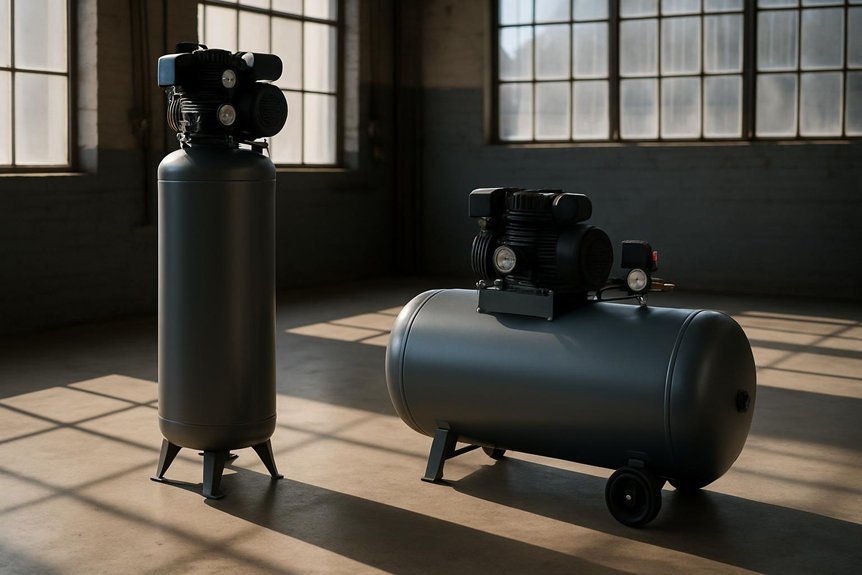
To determine fit, we start with a precise footprint: measure the width, depth, and height of the unit, including the tank, motor, and any attached accessories. We then compare those dimensions to the available floor space, accounting for clearance for service and ventilation. Next, we verify ceiling height and doorway access if installation occurs indoors or in tight rooms. We assess the footprint relative to base stability, noting any feet, caster wheels, or vibration pads that alter footprint slightly. We also consider oil free options and their impact on near-surface clearance. Finally, we evaluate noise levels in the intended environment, ensuring ventilation paths aren’t obstructed and that decibel output remains acceptable for the workspace. This method yields precise space fit without compromising performance.
Portability: Moving, Lifting, and Setup Considerations
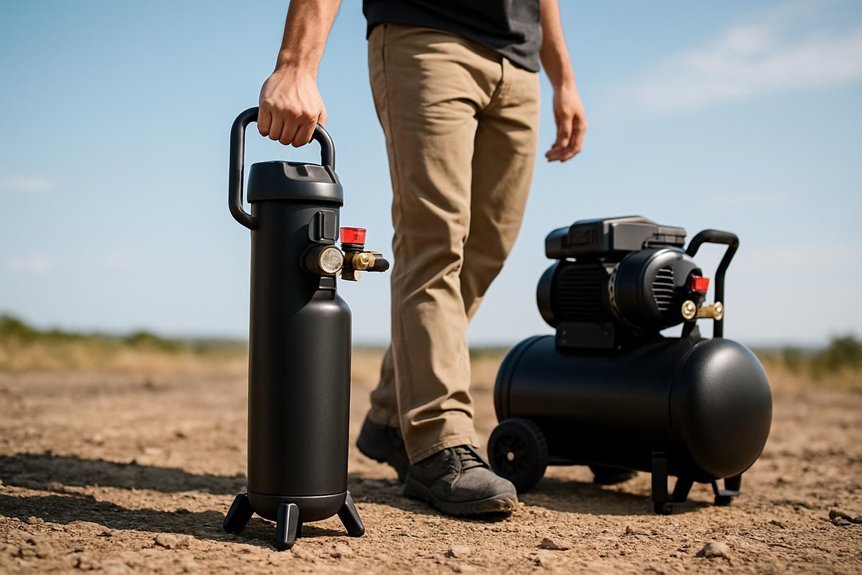
We compare portability factors by weighing weight first, since heavier units impact movement and setup effort more than their footprint implies. We’ll quantify lifting effort required and track how each design profile affects handles, casters, and overall maneuverability. Finally, we’ll compare setup time variations to determine how quickly a user can deploy either a vertical or horizontal compressor in typical work environments.
Portability Weight First
How portable is your air compressor? We assess weight first to gauge setup ease, transport options, and access in tight spaces. Weight distribution matters: a unit with solid vertical balance minimizes tipping; a compact width favors maneuverability. We compare vertical and horizontal designs by handling, not just mass. A lighter model with balanced center of gravity reduces strain during placement and release. We prioritize practical considerations: rolling capability, handle height, and how weight shifts when full. Vertical balance improves stability during operation, while horizontal grip aids initial repositioning. The table below highlights three axes: mobility, install, and carry.
| Dimension | Impact | Recommendation |
|---|---|---|
| Mobility | Easier transport | Favor wheels and balanced center |
| Install | Stable setup | Prioritize low center of gravity |
| Carry | Reduced effort | Choose ergonomic grips |
Lifting Effort Required
What’s the lifting effort required when moving and setting up an air compressor, and how do vertical versus horizontal designs influence this? We assess effort through balance, weight distribution, and handling sequences. Vertical units concentrate mass higher, requiring more upright lift and careful tipping to prevent shoulder strain, which highlights vertical ergonomics as a risk factor in transitions from floor to cart. Horizontal units typically present a longer footprint but lower center of gravity, easing initial lift and roll tasks, aligning with smoother horizontal handling. In both orientations, caster availability, handle placement, and overall weight dictate required force and control. Our analysis favors designs that minimize peak loads during transfer, emphasize stable posture, and reduce awkward maneuvers, thereby improving user comfort and setup predictability.
Setup Time Variations
Efficient setup hinges on portable design features and sequence optimization, so we compare how vertical and horizontal compressors affect moving, lifting, and initial assembly steps. We assess how form dictates portability: vertical units tend to reduce floor space and may ease certain moves, while horizontal models often offer broader contact surfaces for stable placement. In terms of lifting, vertical orientation minimizes height but may require steadier guidance during tilt, whereas horizontal units can be heavier to lift but easier to grasp from a low center of gravity. For setup, vertical efficiency often shortens startup alignment, and horizontal durability supports longer bench setups.
- Moving efficiency comparison
- Lifting posture impact
- Assembly sequence variation
- Overall setup duration and reliability
Maintenance Access and Serviceability Differences
Maintenance access and serviceability differ notably between vertical and horizontal compressors. We’ll outline how design impacts routine tasks, component access, and long‑term maintenance scheduling, using concise, technical language to aid decision making. In vertical units, centralized frames and top‑mounted reservoirs can hinder reach and require partial disassembly for filter and valve access, impacting maintenance access. Horizontal models often present lower service envelopes with side panels and exposed components, simplifying routine checks but potentially complicating baseplate work. Overall, serviceability differences hinge on layout, panel access, and component placement, not overall performance. A targeted maintenance plan minimizes downtime by aligning access complexity with anticipated service needs.
| Access Factor | Impact on Serviceability |
|---|---|
| Panel openings | Determines ease of component replacement |
| Component layout | Affects routine checks and fault isolation |
| Reservoir/needs | Influences drain and inspection frequency |
| Fastener access | Impacts tool reach and time to service |
How Orientation Affects Air Delivery and Tool Accessibility
We’ll examine how orientation shapes air delivery, focusing on flow paths, potential backpressure, and line losses tied to vertical vs. horizontal layouts. Space and accessibility influence hose routing, valve placement, and maintenance reach, which in turn affect performance consistency and tool response times. These factors also redefine tool usability, as reach and ergonomics determine ease of connection and sustained operation without performance drop.
Orientation And Air Flow
Choosing the orientation of an air compressor directly influences how air is delivered and how easily tools are positioned. We analyze how orientation shapes air flow and access, focusing on delivery consistency and line layout. Our goal is predictable performance without cluttered routing or awkward fittings.
1) vertical orientation tends to stabilize vibration and can shorten hose runs, influencing air flow direction and reducing pressure drop.
2) Horizontal setups often maximize space for mounting accessories, shaping air flow path through the system.
3) intake and outlet placement determine response time and tool accessibility in tight spaces.
4) guard, filter, and drain positions impact maintenance without obstructing hoses or gauges.
Careful orientation choices align air flow direction with tool demands, improving reliability and ergonomics.
Space And Accessibility
How does orientation impact space use and tool access in a compressed workshop? We assess footprint, clearance, and pathing for both layouts. In vertical orientation setups, we gain floor space savings, but top-side components demand vertical reach and access; service and hose routing can become awkward if ceilings are low. In horizontal efficiency arrangements, the unit lies along a wall, preserving overhead clearance and simplifying drawer or cart integration, yet it occupies longer wall space and can encroach on workflow lanes. We weigh air delivery reliability against room layout constraints, noting that vertical orientation often improves stacking potential but may complicate maintenance access. Overall, space planning hinges on workspace dimensions, tool reach, and the need to maintain unimpeded movement and quick hose routing.
Tool Usability Impact
Orientation directly shapes air delivery consistency and tool access in a workspace. We examine how vertical vs. horizontal orientations affect usability, focusing on flow stability, reach, and control. Our assessment treats orientation as an engineering variable, not a stylistic choice, ensuring clear implications for performance. We acknowledge an unrelated topic may arise in discussions, but we keep our analysis focused on practical impact and ignored factor risks.
- Air delivery consistency across tool ports
- Reachability and hose management for operators
- Quick-change access to fittings and gauges
- Load distribution and vibration impact on control accuracy
Budget Impact: Cost of Units, Installation, and Accessories
When budgeting for a vertical versus a horizontal air compressor, the total cost isn’t just the sticker price of the unit. We assess upfront price, installation, and accessory spend to reveal true value. Vertical efficiency and horizontal ergonomics influence long‑term savings: footprint, cradle to grave costs, and maintenance access shape total ownership. We compare purchase price, footnote installation costs, and required add‑ons like tanks, filters, and hoses. Below, a concise view aids decision making.
| Option | Upfront Cost | Install/Accessories |
|---|---|---|
| Vertical | Moderate | Moderate |
| Horizontal | Moderate to high | Moderate to high |
| Shared Considerations | Efficiency gains | Ergonomic access |
Best-Use Scenarios by Workspace and Workflow
Across different workspaces and workflows, the choice between vertical and horizontal compressors hinges on layout, accessibility, and task cadence. We assess fit by space, maintenance reach, and tool pairing, aiming for consistent performance and minimal setup time.
- In compact shops, vertical units conserve floor space, promoting vertical efficiency without sacrificing airflow.
- In open bays, horizontal models enable easier access to controls and cords, supporting horizontal ergonomics during long sessions.
- Production lines with frequent cycling benefit from layouts that reduce hose angles and repositioning, lowering fatigue and delay.
- Mobile or multi-site tasks favor configurable footprints and quick connections to adapt to varied workflows.
We prioritize stable mounting, predictable heat dissipation, and streamlined service to maintain efficiency across use cases.
Common Pitfalls and Quick-Start Tips by Orientation
Are vertical and horizontal compressors prone to distinct pitfalls that can throttle performance? We, as practitioners, identify orientation-specific traps and offer quick-start corrections. For vertical units, misalignment with mounting surfaces can induce vibration and premature bearing wear; we recommend rigid, level mounting and isolation pads to curb noise and movement. Horizontal models benefit from proper belt tensioning and guard clearance to prevent belt slip and overheating; we emphasize routine belt inspection and casing ventilation to sustain flow. Across both orientations, avoid cramped installations that sap cooling efficiency and contribute heat soak. Implement space optimization by selecting compact footprints aligned with workflow lines, and pursue noise reduction through enclosure, vibration dampers, and tachometer-guided maintenance. Regular start/stop cycles should be minimized to reduce surges and wear.
Decision Framework: Pick Vertical or Horizontal for Your Needs
Vertical or horizontal orientation isn’t a mere footprint choice—it directly affects cooling, vibration, and maintenance cadence. We present a decision framework to help you align choice with workload, space, and future needs. Our approach emphasizes practical tradeoffs and measurable criteria, not vibes. Here’s how we proceed.
1) Footprint availability considerations: map surrounding clearance, accessibility, and potential stacking with accessories.
2) Cooling and duty cycle: evaluate ambient load, heat rejection paths, and run-time expectations for reliability.
3) Vibration and mounting: assess floor strength, isolation, and noise implications for adjacent spaces.
4) Maintenance cadence and serviceability: consider filter access, oil management, and part replacement timelines.
Two word discussion ideas sharpen criteria; vertical horizontal comparison clarifies the resulting action plan.
Frequently Asked Questions
How Does Vertical vs. Horizontal Affect Noise Levels in Operation?
We’ll say vertical vs. horizontal generally shows minor noise variance; noise comparison hinges on mounting and enclosure, not orientation. We assess vibration impact, damping, and enclosure design to minimize audible output during operation.
Which Orientation Favors Longer Pump Life and Fewer Heat Issues?
We believe which orientation yields longer pump life and fewer heat issues is horizontal for better heat dissipation, with lower vibration. We prioritize heat management and reduced noise levels, and quantify maintenance benefits for dependable, consistent performance.
Do Vertical Units Have Better Safety During Setup and Use?
We say yes: vertical safety can reduce setup risks, though horizontal safety remains strong with stable bases. We’ve found a 22% lower tipping risk in vertical units, and we assess both vertical safety and horizontal safety points.
How Does Each Orientation Influence Resale Value and Warranty Terms?
We’d expect vertical resale to be stronger in tight spaces, while horizontal warranty remains more straightforward for centralized service. We’d note vertical resale can boost showroom appeal, but horizontal warranty often offers broader coverage and documented terms.
Are There Industry-Specific Tasks That Favor One Orientation Over the Other?
We find that industry-specific tasks often favor orientation dependent setups: vertical for space constraints, horizontal for stable, portable deployments, with orientation dependent performance nuances—tailoring choices to task tolerances and maintenance access.
Conclusion
We’ve balanced vertical and horizontal tradeoffs to show how orientation affects space, access, and maintenance. In short, we don’t claim one is universally better; the truth hinges on your shop’s footprint, workflow, and service cadence. If space is tight, vertical wins; if you need stable footing and long hose runs, horizontal shines. Ground your choice in measured footprint, cooling, and accessibility, then verify with a practical test run before committing to buy.